

16 Luminescent Materials for Organic Light-Emitting Diodes
575
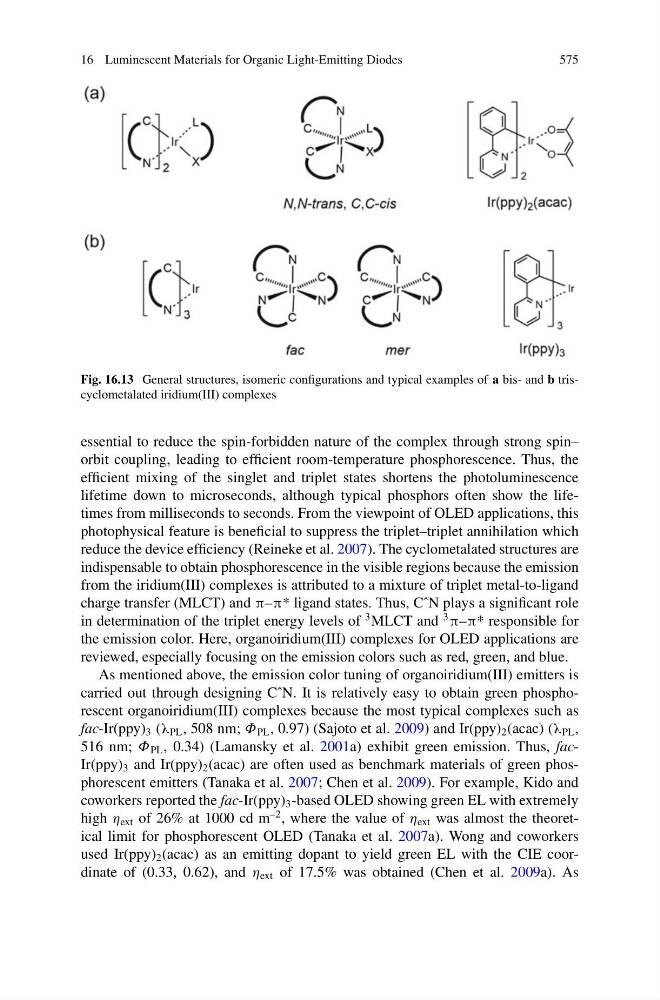
Fig. 16.13 General structures, isomeric configurations and typical examples of a bis- and b triscyclometalated iridium(III) complexes
essential to reduce the spin-forbidden nature of the complex through strong spin–
orbit coupling, leading to efficient room-temperature phosphorescence. Thus, the
efficient mixing of the singlet and triplet states shortens the photoluminescence
lifetime down to microseconds, although typical phosphors often show the lifetimes from milliseconds to seconds. From the viewpoint of OLED applications, this
photophysical feature is beneficial to suppress the triplet–triplet annihilation which
reduce the device efficiency (Reineke et al. 2007). The cyclometalated structures are
indispensable to obtain phosphorescence in the visible regions because the emission
from the iridium(III) complexes is attributed to a mixture of triplet metal-to-ligand
charge transfer (MLCT) and π–π* ligand states. Thus, CˆN plays a significant role
in determination of the triplet energy levels of
3 MLCT and
3
π–π* responsible for
the emission color. Here, organoiridium(III) complexes for OLED applications are
reviewed, especially focusing on the emission colors such as red, green, and blue.
As mentioned above, the emission color tuning of organoiridium(III) emitters is
carried out through designing CˆN. It is relatively easy to obtain green phosphorescent organoiridium(III) complexes because the most typical complexes such as
fac-Ir(ppy) 3 (λ PL , 508 nm; Φ PL , 0.97) (Sajoto et al. 2009) and Ir(ppy) 2 (acac) (λ PL ,
516 nm; Φ PL , 0.34) (Lamansky et al. 2001a) exhibit green emission. Thus, facIr(ppy) 3 and Ir(ppy) 2 (acac) are often used as benchmark materials of green phosphorescent emitters (Tanaka et al. 2007; Chen et al. 2009). For example, Kido and
coworkers reported the fac-Ir(ppy) 3 -based OLED showing green EL with extremely
high η ext of 26% at 1000 cd m
–2 , where the value of η ext was almost the theoretical limit for phosphorescent OLED (Tanaka et al. 2007a). Wong and coworkers
used Ir(ppy) 2 (acac) as an emitting dopant to yield green EL with the CIE coordinate of (0.33, 0.62), and η ext of 17.5% was obtained (Chen et al. 2009a). As