

578
S. Yagi
In the field of phosphorescent materials for OLED applications, one of challenging themes to overcome is the development of blue emitters. To obtain blue
phosphorescent organoiridium(III) complexes, stabilization of HOMO and destabilization of LUMO are effective, and the wide HOMO–LUMO energy gap leads
to a high-lying triplet energy level. In the case of typical ppy-based bis- and
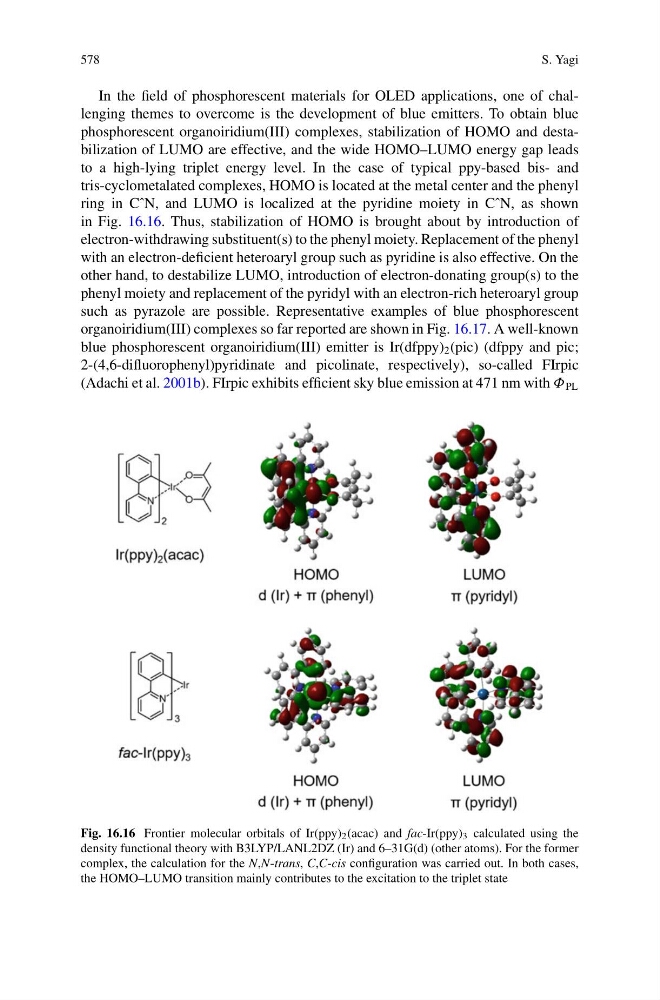
tris-cyclometalated complexes, HOMO is located at the metal center and the phenyl
ring in CˆN, and LUMO is localized at the pyridine moiety in CˆN, as shown
in Fig. 16.16. Thus, stabilization of HOMO is brought about by introduction of
electron-withdrawing substituent(s) to the phenyl moiety. Replacement of the phenyl
with an electron-deficient heteroaryl group such as pyridine is also effective. On the
other hand, to destabilize LUMO, introduction of electron-donating group(s) to the
phenyl moiety and replacement of the pyridyl with an electron-rich heteroaryl group
such as pyrazole are possible. Representative examples of blue phosphorescent
organoiridium(III) complexes so far reported are shown in Fig. 16.17. A well-known
blue phosphorescent organoiridium(III) emitter is Ir(dfppy) 2 (pic) (dfppy and pic;
2-(4,6-difluorophenyl)pyridinate and picolinate, respectively), so-called FIrpic
(Adachi et al. 2001b). FIrpic exhibits efficient sky blue emission at 471 nm with Φ PL
Fig. 16.16 Frontier molecular orbitals of Ir(ppy) 2 (acac) and fac-Ir(ppy) 3 calculated using the
density functional theory with B3LYP/LANL2DZ (Ir) and 6–31G(d) (other atoms). For the former
complex, the calculation for the N,N-trans, C,C-cis configuration was carried out. In both cases,
the HOMO–LUMO transition mainly contributes to the excitation to the triplet state