

16 Luminescent Materials for Organic Light-Emitting Diodes
571
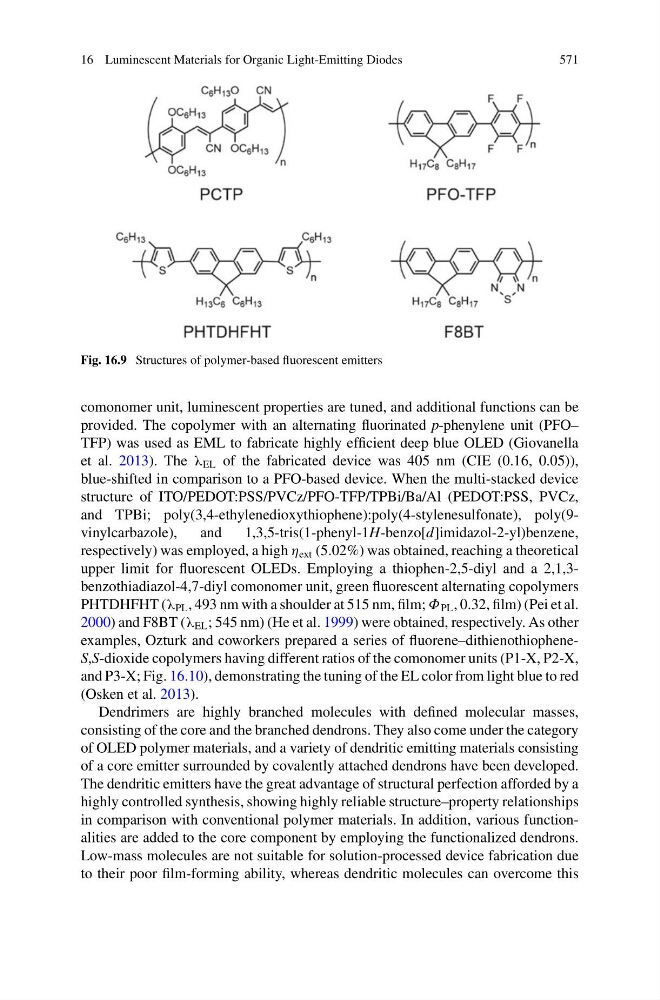
Fig. 16.9 Structures of polymer-based fluorescent emitters
comonomer unit, luminescent properties are tuned, and additional functions can be
provided. The copolymer with an alternating fluorinated p-phenylene unit (PFO–
TFP) was used as EML to fabricate highly efficient deep blue OLED (Giovanella
et al. 2013). The λ EL of the fabricated device was 405 nm (CIE (0.16, 0.05)),
blue-shifted in comparison to a PFO-based device. When the multi-stacked device
structure of ITO/PEDOT:PSS/PVCz/PFO-TFP/TPBi/Ba/Al (PEDOT:PSS, PVCz,
and TPBi; poly(3,4-ethylenedioxythiophene):poly(4-stylenesulfonate), poly(9vinylcarbazole),
and
1,3,5-tris(1-phenyl-1H-benzo[d]imidazol-2-yl)benzene,
respectively) was employed, a high η ext (5.02%) was obtained, reaching a theoretical
upper limit for fluorescent OLEDs. Employing a thiophen-2,5-diyl and a 2,1,3benzothiadiazol-4,7-diyl comonomer unit, green fluorescent alternating copolymers
PHTDHFHT (λ PL , 493 nm with a shoulder at 515 nm, film; Φ PL , 0.32, film) (Pei et al.
2000) and F8BT (λ EL ; 545 nm) (He et al. 1999) were obtained, respectively. As other
examples, Ozturk and coworkers prepared a series of fluorene–dithienothiopheneS,S-dioxide copolymers having different ratios of the comonomer units (P1-X, P2-X,
and P3-X; Fig. 16.10), demonstrating the tuning of the EL color from light blue to red
(Osken et al. 2013).
Dendrimers are highly branched molecules with defined molecular masses,
consisting of the core and the branched dendrons. They also come under the category
of OLED polymer materials, and a variety of dendritic emitting materials consisting
of a core emitter surrounded by covalently attached dendrons have been developed.
The dendritic emitters have the great advantage of structural perfection afforded by a
highly controlled synthesis, showing highly reliable structure–property relationships
in comparison with conventional polymer materials. In addition, various functionalities are added to the core component by employing the functionalized dendrons.
Low-mass molecules are not suitable for solution-processed device fabrication due
to their poor film-forming ability, whereas dendritic molecules can overcome this
571
Fig. 16.9 Structures of polymer-based fluorescent emitters
comonomer unit, luminescent properties are tuned, and additional functions can be
provided. The copolymer with an alternating fluorinated p-phenylene unit (PFO–
TFP) was used as EML to fabricate highly efficient deep blue OLED (Giovanella
et al. 2013). The λ EL of the fabricated device was 405 nm (CIE (0.16, 0.05)),
blue-shifted in comparison to a PFO-based device. When the multi-stacked device
structure of ITO/PEDOT:PSS/PVCz/PFO-TFP/TPBi/Ba/Al (PEDOT:PSS, PVCz,
and TPBi; poly(3,4-ethylenedioxythiophene):poly(4-stylenesulfonate), poly(9vinylcarbazole),
and
1,3,5-tris(1-phenyl-1H-benzo[d]imidazol-2-yl)benzene,
respectively) was employed, a high η ext (5.02%) was obtained, reaching a theoretical
upper limit for fluorescent OLEDs. Employing a thiophen-2,5-diyl and a 2,1,3benzothiadiazol-4,7-diyl comonomer unit, green fluorescent alternating copolymers
PHTDHFHT (λ PL , 493 nm with a shoulder at 515 nm, film; Φ PL , 0.32, film) (Pei et al.
2000) and F8BT (λ EL ; 545 nm) (He et al. 1999) were obtained, respectively. As other
examples, Ozturk and coworkers prepared a series of fluorene–dithienothiopheneS,S-dioxide copolymers having different ratios of the comonomer units (P1-X, P2-X,
and P3-X; Fig. 16.10), demonstrating the tuning of the EL color from light blue to red
(Osken et al. 2013).
Dendrimers are highly branched molecules with defined molecular masses,
consisting of the core and the branched dendrons. They also come under the category
of OLED polymer materials, and a variety of dendritic emitting materials consisting
of a core emitter surrounded by covalently attached dendrons have been developed.
The dendritic emitters have the great advantage of structural perfection afforded by a
highly controlled synthesis, showing highly reliable structure–property relationships
in comparison with conventional polymer materials. In addition, various functionalities are added to the core component by employing the functionalized dendrons.
Low-mass molecules are not suitable for solution-processed device fabrication due
to their poor film-forming ability, whereas dendritic molecules can overcome this