

572
S. Yagi
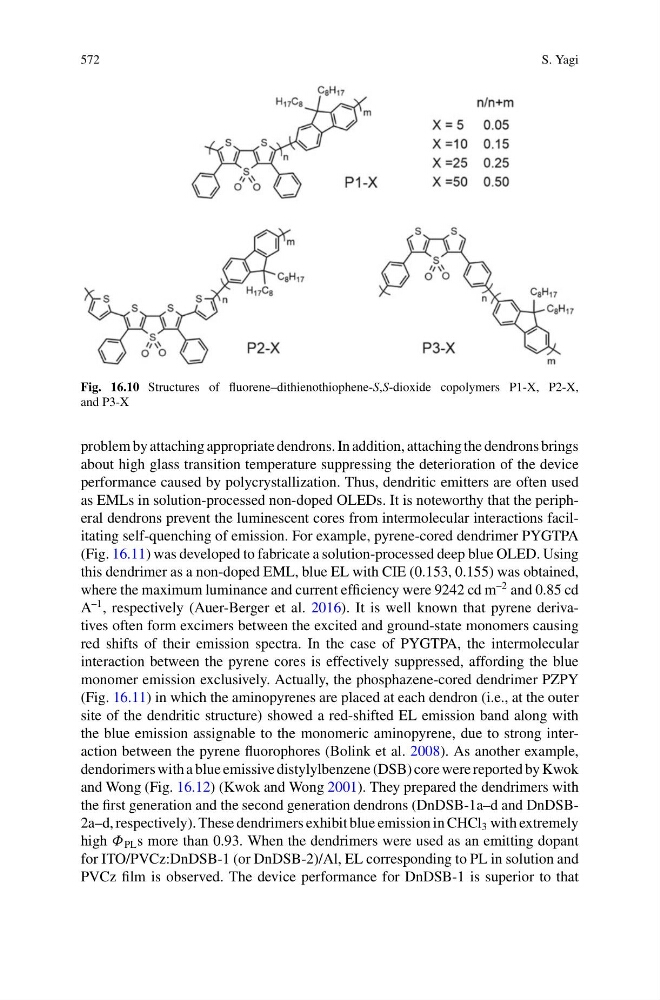
Fig. 16.10 Structures of fluorene–dithienothiophene-S,S-dioxide copolymers P1-X, P2-X,
and P3-X
problem by attaching appropriate dendrons. In addition, attaching the dendrons brings
about high glass transition temperature suppressing the deterioration of the device
performance caused by polycrystallization. Thus, dendritic emitters are often used
as EMLs in solution-processed non-doped OLEDs. It is noteworthy that the peripheral dendrons prevent the luminescent cores from intermolecular interactions facilitating self-quenching of emission. For example, pyrene-cored dendrimer PYGTPA
(Fig. 16.11) was developed to fabricate a solution-processed deep blue OLED. Using
this dendrimer as a non-doped EML, blue EL with CIE (0.153, 0.155) was obtained,
where the maximum luminance and current efficiency were 9242 cd m
–2 and 0.85 cd
A
–1 , respectively (Auer-Berger et al. 2016). It is well known that pyrene derivatives often form excimers between the excited and ground-state monomers causing
red shifts of their emission spectra. In the case of PYGTPA, the intermolecular
interaction between the pyrene cores is effectively suppressed, affording the blue
monomer emission exclusively. Actually, the phosphazene-cored dendrimer PZPY
(Fig. 16.11) in which the aminopyrenes are placed at each dendron (i.e., at the outer
site of the dendritic structure) showed a red-shifted EL emission band along with
the blue emission assignable to the monomeric aminopyrene, due to strong interaction between the pyrene fluorophores (Bolink et al. 2008). As another example,
dendorimers with a blue emissive distylylbenzene (DSB) core were reported by Kwok
and Wong (Fig. 16.12) (Kwok and Wong 2001). They prepared the dendrimers with
the first generation and the second generation dendrons (DnDSB-1a–d and DnDSB2a–d, respectively). These dendrimers exhibit blue emission in CHCl 3 with extremely
high Φ PL s more than 0.93. When the dendrimers were used as an emitting dopant
for ITO/PVCz:DnDSB-1 (or DnDSB-2)/Al, EL corresponding to PL in solution and
PVCz film is observed. The device performance for DnDSB-1 is superior to that
S. Yagi
Fig. 16.10 Structures of fluorene–dithienothiophene-S,S-dioxide copolymers P1-X, P2-X,
and P3-X
problem by attaching appropriate dendrons. In addition, attaching the dendrons brings
about high glass transition temperature suppressing the deterioration of the device
performance caused by polycrystallization. Thus, dendritic emitters are often used
as EMLs in solution-processed non-doped OLEDs. It is noteworthy that the peripheral dendrons prevent the luminescent cores from intermolecular interactions facilitating self-quenching of emission. For example, pyrene-cored dendrimer PYGTPA
(Fig. 16.11) was developed to fabricate a solution-processed deep blue OLED. Using
this dendrimer as a non-doped EML, blue EL with CIE (0.153, 0.155) was obtained,
where the maximum luminance and current efficiency were 9242 cd m
–2 and 0.85 cd
A
–1 , respectively (Auer-Berger et al. 2016). It is well known that pyrene derivatives often form excimers between the excited and ground-state monomers causing
red shifts of their emission spectra. In the case of PYGTPA, the intermolecular
interaction between the pyrene cores is effectively suppressed, affording the blue
monomer emission exclusively. Actually, the phosphazene-cored dendrimer PZPY
(Fig. 16.11) in which the aminopyrenes are placed at each dendron (i.e., at the outer
site of the dendritic structure) showed a red-shifted EL emission band along with
the blue emission assignable to the monomeric aminopyrene, due to strong interaction between the pyrene fluorophores (Bolink et al. 2008). As another example,
dendorimers with a blue emissive distylylbenzene (DSB) core were reported by Kwok
and Wong (Fig. 16.12) (Kwok and Wong 2001). They prepared the dendrimers with
the first generation and the second generation dendrons (DnDSB-1a–d and DnDSB2a–d, respectively). These dendrimers exhibit blue emission in CHCl 3 with extremely
high Φ PL s more than 0.93. When the dendrimers were used as an emitting dopant
for ITO/PVCz:DnDSB-1 (or DnDSB-2)/Al, EL corresponding to PL in solution and
PVCz film is observed. The device performance for DnDSB-1 is superior to that