

570
S. Yagi
16.2.2 Fluorescent Conjugated Polymers and Dendrimers
Although emitting materials with high-mass polymeric structures are not used for
dry-processed OLEDs, they are highly suitable to the wet-processed devices due
to their excellent film-forming ability. Emitters bearing dendritic structures also
come under this category. At the early stage of development of polymer-based
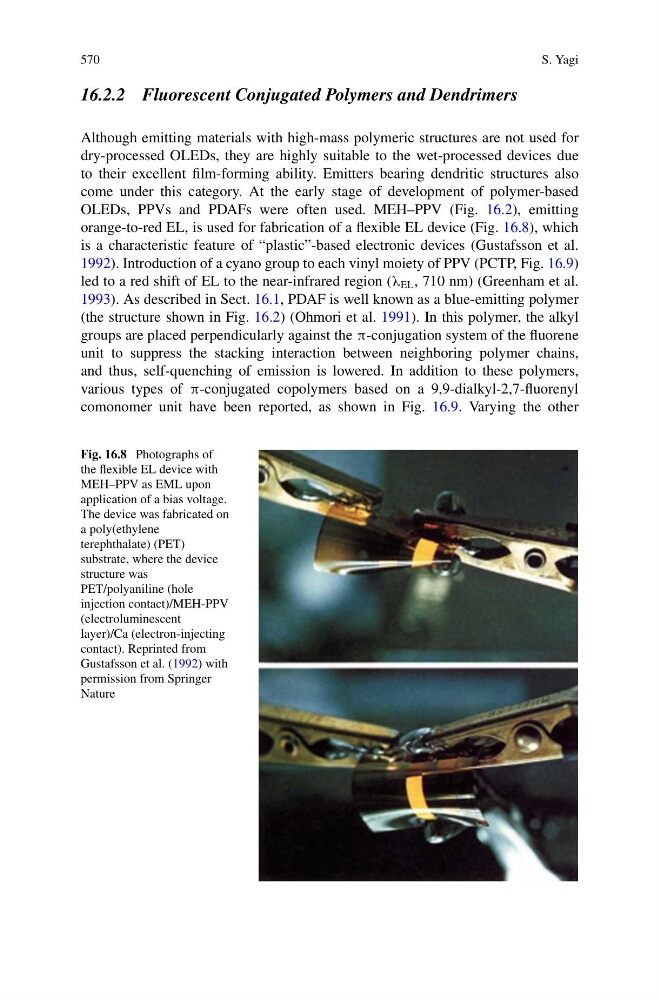
OLEDs, PPVs and PDAFs were often used. MEH–PPV (Fig. 16.2), emitting
orange-to-red EL, is used for fabrication of a flexible EL device (Fig. 16.8), which
is a characteristic feature of “plastic”-based electronic devices (Gustafsson et al.
1992). Introduction of a cyano group to each vinyl moiety of PPV (PCTP, Fig. 16.9)
led to a red shift of EL to the near-infrared region (λ EL , 710 nm) (Greenham et al.
1993). As described in Sect. 16.1, PDAF is well known as a blue-emitting polymer
(the structure shown in Fig. 16.2) (Ohmori et al. 1991). In this polymer, the alkyl
groups are placed perpendicularly against the π-conjugation system of the fluorene
unit to suppress the stacking interaction between neighboring polymer chains,
and thus, self-quenching of emission is lowered. In addition to these polymers,
various types of π-conjugated copolymers based on a 9,9-dialkyl-2,7-fluorenyl
comonomer unit have been reported, as shown in Fig. 16.9. Varying the other
Fig. 16.8 Photographs of
the flexible EL device with
MEH–PPV as EML upon
application of a bias voltage.
The device was fabricated on
a poly(ethylene
terephthalate) (PET)
substrate, where the device
structure was
PET/polyaniline (hole
injection contact)/MEH-PPV
(electroluminescent
layer)/Ca (electron-injecting
contact). Reprinted from
Gustafsson et al. (1992) with
permission from Springer
Nature
S. Yagi
16.2.2 Fluorescent Conjugated Polymers and Dendrimers
Although emitting materials with high-mass polymeric structures are not used for
dry-processed OLEDs, they are highly suitable to the wet-processed devices due
to their excellent film-forming ability. Emitters bearing dendritic structures also
come under this category. At the early stage of development of polymer-based
OLEDs, PPVs and PDAFs were often used. MEH–PPV (Fig. 16.2), emitting
orange-to-red EL, is used for fabrication of a flexible EL device (Fig. 16.8), which
is a characteristic feature of “plastic”-based electronic devices (Gustafsson et al.
1992). Introduction of a cyano group to each vinyl moiety of PPV (PCTP, Fig. 16.9)
led to a red shift of EL to the near-infrared region (λ EL , 710 nm) (Greenham et al.
1993). As described in Sect. 16.1, PDAF is well known as a blue-emitting polymer
(the structure shown in Fig. 16.2) (Ohmori et al. 1991). In this polymer, the alkyl
groups are placed perpendicularly against the π-conjugation system of the fluorene
unit to suppress the stacking interaction between neighboring polymer chains,
and thus, self-quenching of emission is lowered. In addition to these polymers,
various types of π-conjugated copolymers based on a 9,9-dialkyl-2,7-fluorenyl
comonomer unit have been reported, as shown in Fig. 16.9. Varying the other
Fig. 16.8 Photographs of
the flexible EL device with
MEH–PPV as EML upon
application of a bias voltage.
The device was fabricated on
a poly(ethylene
terephthalate) (PET)
substrate, where the device
structure was
PET/polyaniline (hole
injection contact)/MEH-PPV
(electroluminescent
layer)/Ca (electron-injecting
contact). Reprinted from
Gustafsson et al. (1992) with
permission from Springer
Nature