

16 Luminescent Materials for Organic Light-Emitting Diodes
569
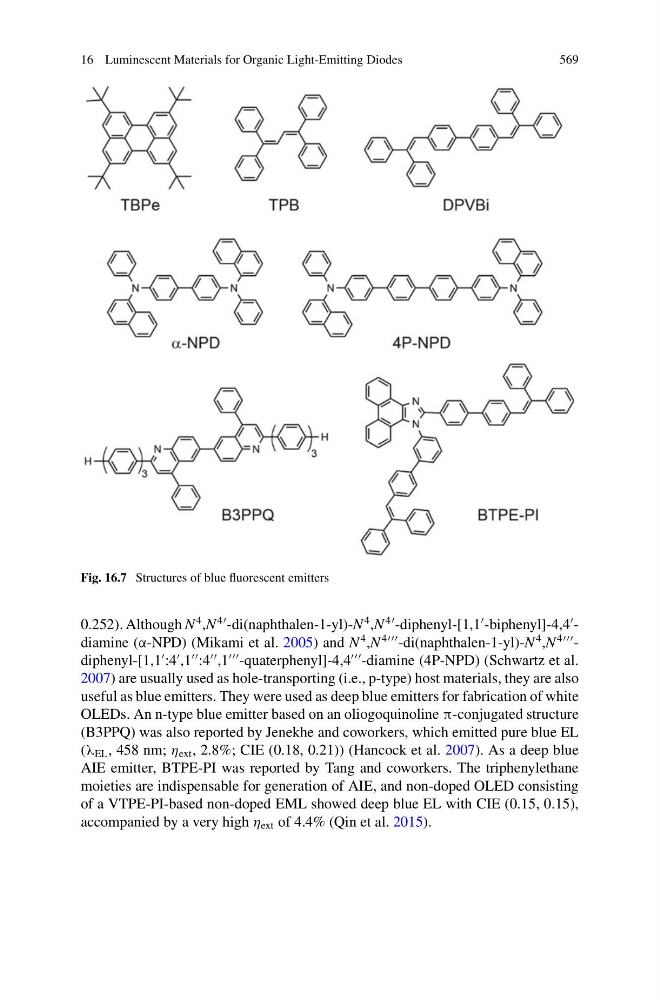
Fig. 16.7 Structures of blue fluorescent emitters
0.252). Although N
4 ,N
4 -di(naphthalen-1-yl)-N
4 ,N
4 -diphenyl-[1,1
-biphenyl]-4,4
-
diamine (α-NPD) (Mikami et al. 2005) and N
4 ,N
4 -di(naphthalen-1-yl)-N
4 ,N
4 -
diphenyl-[1,1
:4
,1
:4
,1
-quaterphenyl]-4,4
-diamine (4P-NPD) (Schwartz et al.
2007) are usually used as hole-transporting (i.e., p-type) host materials, they are also
useful as blue emitters. They were used as deep blue emitters for fabrication of white
OLEDs. An n-type blue emitter based on an oliogoquinoline π-conjugated structure
(B3PPQ) was also reported by Jenekhe and coworkers, which emitted pure blue EL
(λ EL , 458 nm; η ext , 2.8%; CIE (0.18, 0.21)) (Hancock et al. 2007). As a deep blue
AIE emitter, BTPE-PI was reported by Tang and coworkers. The triphenylethane
moieties are indispensable for generation of AIE, and non-doped OLED consisting
of a VTPE-PI-based non-doped EML showed deep blue EL with CIE (0.15, 0.15),
accompanied by a very high η ext of 4.4% (Qin et al. 2015).
569
Fig. 16.7 Structures of blue fluorescent emitters
0.252). Although N
4 ,N
4 -di(naphthalen-1-yl)-N
4 ,N
4 -diphenyl-[1,1
-biphenyl]-4,4
-
diamine (α-NPD) (Mikami et al. 2005) and N
4 ,N
4 -di(naphthalen-1-yl)-N
4 ,N
4 -
diphenyl-[1,1
:4
,1
:4
,1
-quaterphenyl]-4,4
-diamine (4P-NPD) (Schwartz et al.
2007) are usually used as hole-transporting (i.e., p-type) host materials, they are also
useful as blue emitters. They were used as deep blue emitters for fabrication of white
OLEDs. An n-type blue emitter based on an oliogoquinoline π-conjugated structure
(B3PPQ) was also reported by Jenekhe and coworkers, which emitted pure blue EL
(λ EL , 458 nm; η ext , 2.8%; CIE (0.18, 0.21)) (Hancock et al. 2007). As a deep blue
AIE emitter, BTPE-PI was reported by Tang and coworkers. The triphenylethane
moieties are indispensable for generation of AIE, and non-doped OLED consisting
of a VTPE-PI-based non-doped EML showed deep blue EL with CIE (0.15, 0.15),
accompanied by a very high η ext of 4.4% (Qin et al. 2015).