

568
S. Yagi
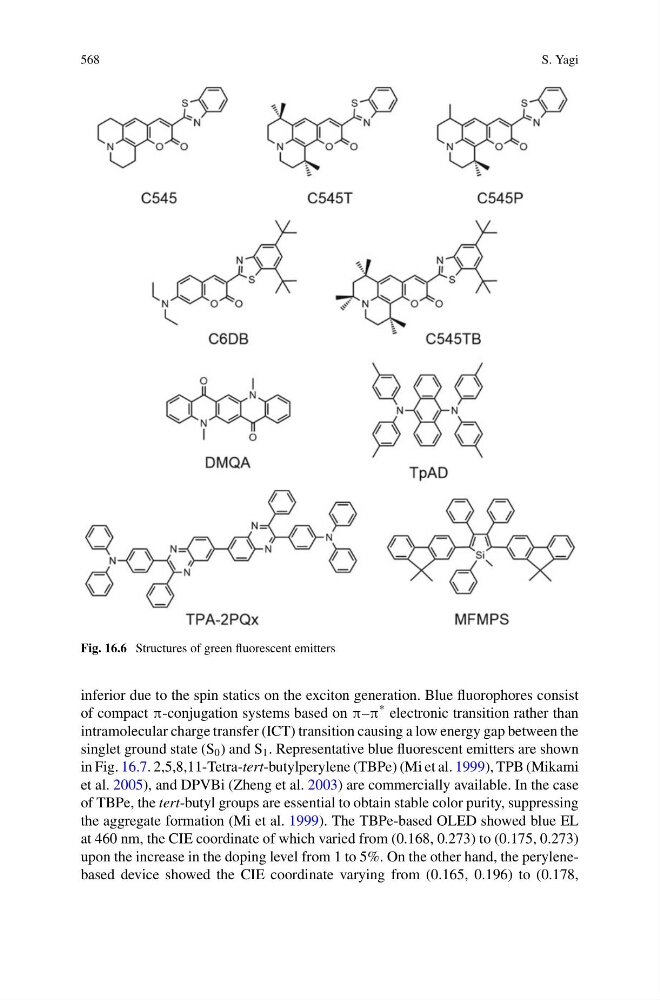
Fig. 16.6 Structures of green fluorescent emitters
inferior due to the spin statics on the exciton generation. Blue fluorophores consist
of compact π-conjugation systems based on π–π
* electronic transition rather than
intramolecular charge transfer (ICT) transition causing a low energy gap between the
singlet ground state (S 0 ) and S 1 . Representative blue fluorescent emitters are shown
in Fig. 16.7. 2,5,8,11-Tetra-tert-butylperylene (TBPe) (Mi et al. 1999), TPB (Mikami
et al. 2005), and DPVBi (Zheng et al. 2003) are commercially available. In the case
of TBPe, the tert-butyl groups are essential to obtain stable color purity, suppressing
the aggregate formation (Mi et al. 1999). The TBPe-based OLED showed blue EL
at 460 nm, the CIE coordinate of which varied from (0.168, 0.273) to (0.175, 0.273)
upon the increase in the doping level from 1 to 5%. On the other hand, the perylenebased device showed the CIE coordinate varying from (0.165, 0.196) to (0.178,
S. Yagi
Fig. 16.6 Structures of green fluorescent emitters
inferior due to the spin statics on the exciton generation. Blue fluorophores consist
of compact π-conjugation systems based on π–π
* electronic transition rather than
intramolecular charge transfer (ICT) transition causing a low energy gap between the
singlet ground state (S 0 ) and S 1 . Representative blue fluorescent emitters are shown
in Fig. 16.7. 2,5,8,11-Tetra-tert-butylperylene (TBPe) (Mi et al. 1999), TPB (Mikami
et al. 2005), and DPVBi (Zheng et al. 2003) are commercially available. In the case
of TBPe, the tert-butyl groups are essential to obtain stable color purity, suppressing
the aggregate formation (Mi et al. 1999). The TBPe-based OLED showed blue EL
at 460 nm, the CIE coordinate of which varied from (0.168, 0.273) to (0.175, 0.273)
upon the increase in the doping level from 1 to 5%. On the other hand, the perylenebased device showed the CIE coordinate varying from (0.165, 0.196) to (0.178,