

554
I. Osaka
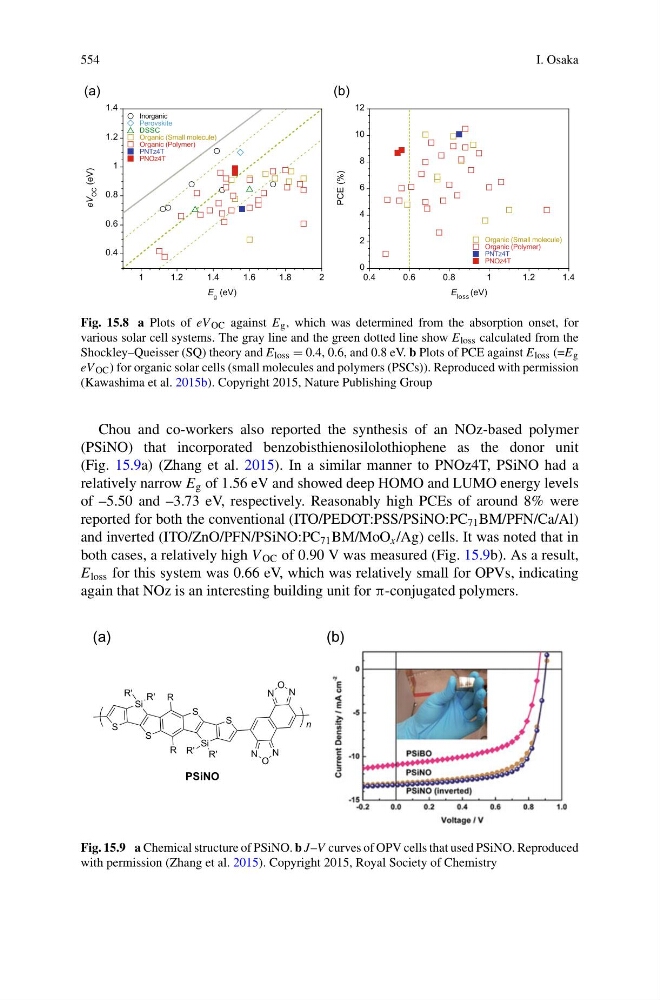
Fig. 15.8 a Plots of eV OC against E g , which was determined from the absorption onset, for
various solar cell systems. The gray line and the green dotted line show E loss calculated from the
Shockley–Queisser (SQ) theory and E loss = 0.4, 0.6, and 0.8 eV. b Plots of PCE against E loss (=E g
eV OC ) for organic solar cells (small molecules and polymers (PSCs)). Reproduced with permission
(Kawashima et al. 2015b). Copyright 2015, Nature Publishing Group
Chou and co-workers also reported the synthesis of an NOz-based polymer
(PSiNO) that incorporated benzobisthienosilolothiophene as the donor unit
(Fig. 15.9a) (Zhang et al. 2015). In a similar manner to PNOz4T, PSiNO had a
relatively narrow E g of 1.56 eV and showed deep HOMO and LUMO energy levels
of –5.50 and –3.73 eV, respectively. Reasonably high PCEs of around 8% were
reported for both the conventional (ITO/PEDOT:PSS/PSiNO:PC 71 BM/PFN/Ca/Al)
and inverted (ITO/ZnO/PFN/PSiNO:PC 71 BM/MoO x /Ag) cells. It was noted that in
both cases, a relatively high V OC of 0.90 V was measured (Fig. 15.9b). As a result,
E loss for this system was 0.66 eV, which was relatively small for OPVs, indicating
again that NOz is an interesting building unit for π-conjugated polymers.
(b)
(a)
S
S
Si
Si
S
S
R'
R'
R'
R'
R
R
N
O
N
N
O
N
n
PSiNO
Fig. 15.9 a Chemical structure of PSiNO. b J–V curves of OPV cells that used PSiNO. Reproduced
with permission (Zhang et al. 2015). Copyright 2015, Royal Society of Chemistry
I. Osaka
Fig. 15.8 a Plots of eV OC against E g , which was determined from the absorption onset, for
various solar cell systems. The gray line and the green dotted line show E loss calculated from the
Shockley–Queisser (SQ) theory and E loss = 0.4, 0.6, and 0.8 eV. b Plots of PCE against E loss (=E g
eV OC ) for organic solar cells (small molecules and polymers (PSCs)). Reproduced with permission
(Kawashima et al. 2015b). Copyright 2015, Nature Publishing Group
Chou and co-workers also reported the synthesis of an NOz-based polymer
(PSiNO) that incorporated benzobisthienosilolothiophene as the donor unit
(Fig. 15.9a) (Zhang et al. 2015). In a similar manner to PNOz4T, PSiNO had a
relatively narrow E g of 1.56 eV and showed deep HOMO and LUMO energy levels
of –5.50 and –3.73 eV, respectively. Reasonably high PCEs of around 8% were
reported for both the conventional (ITO/PEDOT:PSS/PSiNO:PC 71 BM/PFN/Ca/Al)
and inverted (ITO/ZnO/PFN/PSiNO:PC 71 BM/MoO x /Ag) cells. It was noted that in
both cases, a relatively high V OC of 0.90 V was measured (Fig. 15.9b). As a result,
E loss for this system was 0.66 eV, which was relatively small for OPVs, indicating
again that NOz is an interesting building unit for π-conjugated polymers.
(b)
(a)
S
S
Si
Si
S
S
R'
R'
R'
R'
R
R
N
O
N
N
O
N
n
PSiNO
Fig. 15.9 a Chemical structure of PSiNO. b J–V curves of OPV cells that used PSiNO. Reproduced
with permission (Zhang et al. 2015). Copyright 2015, Royal Society of Chemistry