

15 π-Conjugated Polymers Incorporating Naphthalene-Based …
553
(c)
(d)
(b)
(a)
PNOz4T
N
O
N
N
O
N
S
S
S
C 10 H 21
C 12 H 25
C 10 H 21
C 12 H 25
n
S
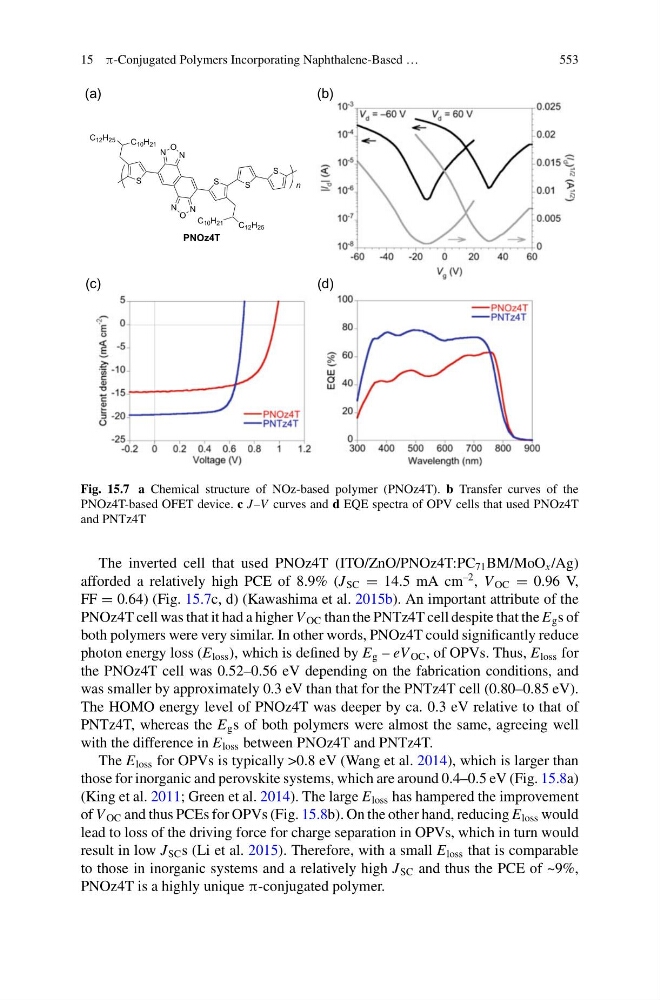
Fig. 15.7 a Chemical structure of NOz-based polymer (PNOz4T). b Transfer curves of the
PNOz4T-based OFET device. c J–V curves and d EQE spectra of OPV cells that used PNOz4T
and PNTz4T
The inverted cell that used PNOz4T (ITO/ZnO/PNOz4T:PC 71 BM/MoO x /Ag)
afforded a relatively high PCE of 8.9% (J SC = 14.5 mA cm
–2 , V OC = 0.96 V,
FF = 0.64) (Fig. 15.7c, d) (Kawashima et al. 2015b). An important attribute of the
PNOz4T cell was that it had a higher V OC than the PNTz4T cell despite that the E g s of
both polymers were very similar. In other words, PNOz4T could significantly reduce
photon energy loss (E loss ), which is defined by E g – eV OC , of OPVs. Thus, E loss for
the PNOz4T cell was 0.52–0.56 eV depending on the fabrication conditions, and
was smaller by approximately 0.3 eV than that for the PNTz4T cell (0.80–0.85 eV).
The HOMO energy level of PNOz4T was deeper by ca. 0.3 eV relative to that of
PNTz4T, whereas the E g s of both polymers were almost the same, agreeing well
with the difference in E loss between PNOz4T and PNTz4T.
The E loss for OPVs is typically >0.8 eV (Wang et al. 2014), which is larger than
those for inorganic and perovskite systems, which are around 0.4–0.5 eV (Fig. 15.8a)
(King et al. 2011; Green et al. 2014). The large E loss has hampered the improvement
of V OC and thus PCEs for OPVs (Fig. 15.8b). On the other hand, reducing E loss would
lead to loss of the driving force for charge separation in OPVs, which in turn would
result in low J SC s (Li et al. 2015). Therefore, with a small E loss that is comparable
to those in inorganic systems and a relatively high J SC and thus the PCE of ~9%,
PNOz4T is a highly unique π-conjugated polymer.
553
(c)
(d)
(b)
(a)
PNOz4T
N
O
N
N
O
N
S
S
S
C 10 H 21
C 12 H 25
C 10 H 21
C 12 H 25
n
S
Fig. 15.7 a Chemical structure of NOz-based polymer (PNOz4T). b Transfer curves of the
PNOz4T-based OFET device. c J–V curves and d EQE spectra of OPV cells that used PNOz4T
and PNTz4T
The inverted cell that used PNOz4T (ITO/ZnO/PNOz4T:PC 71 BM/MoO x /Ag)
afforded a relatively high PCE of 8.9% (J SC = 14.5 mA cm
–2 , V OC = 0.96 V,
FF = 0.64) (Fig. 15.7c, d) (Kawashima et al. 2015b). An important attribute of the
PNOz4T cell was that it had a higher V OC than the PNTz4T cell despite that the E g s of
both polymers were very similar. In other words, PNOz4T could significantly reduce
photon energy loss (E loss ), which is defined by E g – eV OC , of OPVs. Thus, E loss for
the PNOz4T cell was 0.52–0.56 eV depending on the fabrication conditions, and
was smaller by approximately 0.3 eV than that for the PNTz4T cell (0.80–0.85 eV).
The HOMO energy level of PNOz4T was deeper by ca. 0.3 eV relative to that of
PNTz4T, whereas the E g s of both polymers were almost the same, agreeing well
with the difference in E loss between PNOz4T and PNTz4T.
The E loss for OPVs is typically >0.8 eV (Wang et al. 2014), which is larger than
those for inorganic and perovskite systems, which are around 0.4–0.5 eV (Fig. 15.8a)
(King et al. 2011; Green et al. 2014). The large E loss has hampered the improvement
of V OC and thus PCEs for OPVs (Fig. 15.8b). On the other hand, reducing E loss would
lead to loss of the driving force for charge separation in OPVs, which in turn would
result in low J SC s (Li et al. 2015). Therefore, with a small E loss that is comparable
to those in inorganic systems and a relatively high J SC and thus the PCE of ~9%,
PNOz4T is a highly unique π-conjugated polymer.