

552
I. Osaka
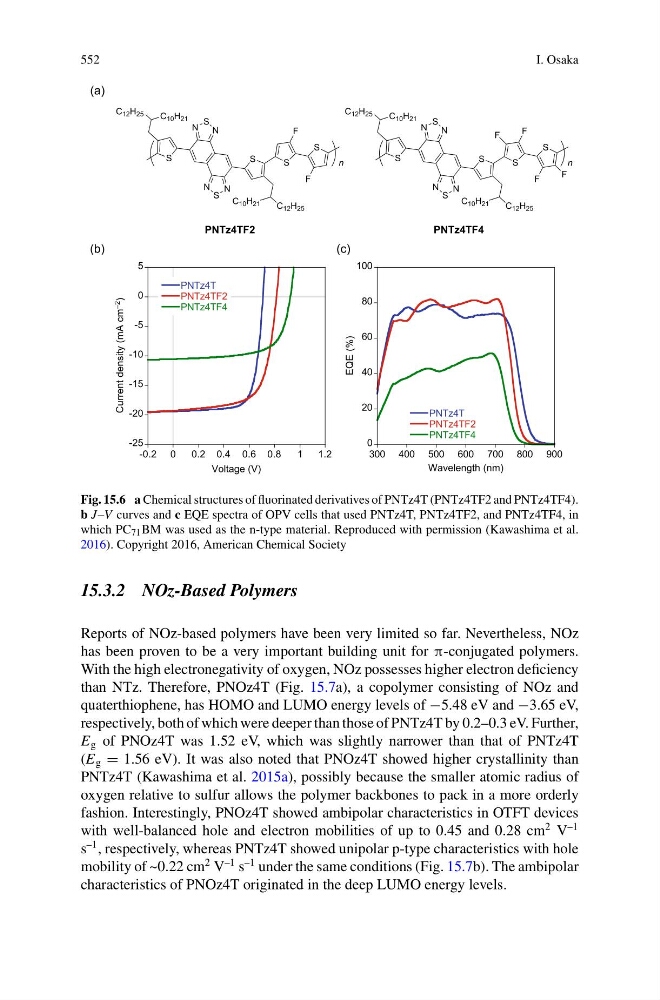
Fig. 15.6 a Chemical structures of fluorinated derivatives of PNTz4T (PNTz4TF2 and PNTz4TF4).
b J–V curves and c EQE spectra of OPV cells that used PNTz4T, PNTz4TF2, and PNTz4TF4, in
which PC 71 BM was used as the n-type material. Reproduced with permission (Kawashima et al.
2016). Copyright 2016, American Chemical Society
15.3.2 NOz-Based Polymers
Reports of NOz-based polymers have been very limited so far. Nevertheless, NOz
has been proven to be a very important building unit for π-conjugated polymers.
With the high electronegativity of oxygen, NOz possesses higher electron deficiency
than NTz. Therefore, PNOz4T (Fig. 15.7a), a copolymer consisting of NOz and
quaterthiophene, has HOMO and LUMO energy levels of −5.48 eV and −3.65 eV,
respectively, both of which were deeper than those of PNTz4T by 0.2–0.3 eV. Further,
E g of PNOz4T was 1.52 eV, which was slightly narrower than that of PNTz4T
(E g = 1.56 eV). It was also noted that PNOz4T showed higher crystallinity than
PNTz4T (Kawashima et al. 2015a), possibly because the smaller atomic radius of
oxygen relative to sulfur allows the polymer backbones to pack in a more orderly
fashion. Interestingly, PNOz4T showed ambipolar characteristics in OTFT devices
with well-balanced hole and electron mobilities of up to 0.45 and 0.28 cm
2 V
–1
s
–1 , respectively, whereas PNTz4T showed unipolar p-type characteristics with hole
mobility of ~0.22 cm
2 V
–1 s
–1 under the same conditions (Fig. 15.7b). The ambipolar
characteristics of PNOz4T originated in the deep LUMO energy levels.
I. Osaka
Fig. 15.6 a Chemical structures of fluorinated derivatives of PNTz4T (PNTz4TF2 and PNTz4TF4).
b J–V curves and c EQE spectra of OPV cells that used PNTz4T, PNTz4TF2, and PNTz4TF4, in
which PC 71 BM was used as the n-type material. Reproduced with permission (Kawashima et al.
2016). Copyright 2016, American Chemical Society
15.3.2 NOz-Based Polymers
Reports of NOz-based polymers have been very limited so far. Nevertheless, NOz
has been proven to be a very important building unit for π-conjugated polymers.
With the high electronegativity of oxygen, NOz possesses higher electron deficiency
than NTz. Therefore, PNOz4T (Fig. 15.7a), a copolymer consisting of NOz and
quaterthiophene, has HOMO and LUMO energy levels of −5.48 eV and −3.65 eV,
respectively, both of which were deeper than those of PNTz4T by 0.2–0.3 eV. Further,
E g of PNOz4T was 1.52 eV, which was slightly narrower than that of PNTz4T
(E g = 1.56 eV). It was also noted that PNOz4T showed higher crystallinity than
PNTz4T (Kawashima et al. 2015a), possibly because the smaller atomic radius of
oxygen relative to sulfur allows the polymer backbones to pack in a more orderly
fashion. Interestingly, PNOz4T showed ambipolar characteristics in OTFT devices
with well-balanced hole and electron mobilities of up to 0.45 and 0.28 cm
2 V
–1
s
–1 , respectively, whereas PNTz4T showed unipolar p-type characteristics with hole
mobility of ~0.22 cm
2 V
–1 s
–1 under the same conditions (Fig. 15.7b). The ambipolar
characteristics of PNOz4T originated in the deep LUMO energy levels.