

15 π-Conjugated Polymers Incorporating Naphthalene-Based …
551
-25
-20
-15
-10
-5
0
5
-0.2
0
0.2
0.4
0.6
0.8
1
Conventional (PC 61 BM)
Conventional (PC 71 BM)
Inverted (PC 61 BM)
Inverted (PC 71 BM)
Current density (mA cm
– 2
)
Voltage (V)
0
20
40
60
80
100
300 400 500 600 700 800 900
Conventional (PC 61 BM)
Conventional (PC 71 BM)
Inverted (PC 61 BM)
Inverted (PC 71 BM)
EQE (%)
Wavelength (nm)
(a)
(b)
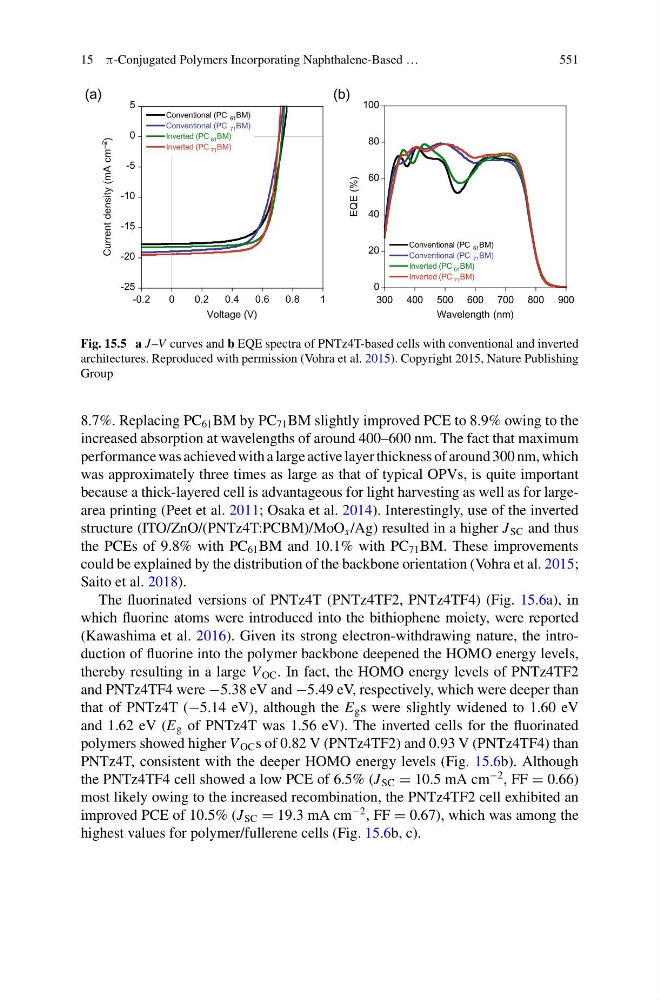
Fig. 15.5 a J–V curves and b EQE spectra of PNTz4T-based cells with conventional and inverted
architectures. Reproduced with permission (Vohra et al. 2015). Copyright 2015, Nature Publishing
Group
8.7%. Replacing PC 61 BM by PC 71 BM slightly improved PCE to 8.9% owing to the
increased absorption at wavelengths of around 400–600 nm. The fact that maximum
performance was achieved with a large active layer thickness of around 300 nm, which
was approximately three times as large as that of typical OPVs, is quite important
because a thick-layered cell is advantageous for light harvesting as well as for largearea printing (Peet et al. 2011; Osaka et al. 2014). Interestingly, use of the inverted
structure (ITO/ZnO/(PNTz4T:PCBM)/MoO x /Ag) resulted in a higher J SC and thus
the PCEs of 9.8% with PC 61 BM and 10.1% with PC 71 BM. These improvements
could be explained by the distribution of the backbone orientation (Vohra et al. 2015;
Saito et al. 2018).
The fluorinated versions of PNTz4T (PNTz4TF2, PNTz4TF4) (Fig. 15.6a), in
which fluorine atoms were introduced into the bithiophene moiety, were reported
(Kawashima et al. 2016). Given its strong electron-withdrawing nature, the introduction of fluorine into the polymer backbone deepened the HOMO energy levels,
thereby resulting in a large V OC . In fact, the HOMO energy levels of PNTz4TF2
and PNTz4TF4 were −5.38 eV and −5.49 eV, respectively, which were deeper than
that of PNTz4T (−5.14 eV), although the E g s were slightly widened to 1.60 eV
and 1.62 eV (E g of PNTz4T was 1.56 eV). The inverted cells for the fluorinated
polymers showed higher V OC s of 0.82 V (PNTz4TF2) and 0.93 V (PNTz4TF4) than
PNTz4T, consistent with the deeper HOMO energy levels (Fig. 15.6b). Although
the PNTz4TF4 cell showed a low PCE of 6.5% (J SC = 10.5 mA cm
−2 , FF = 0.66)
most likely owing to the increased recombination, the PNTz4TF2 cell exhibited an
improved PCE of 10.5% (J SC = 19.3 mA cm
−2 , FF = 0.67), which was among the
highest values for polymer/fullerene cells (Fig. 15.6b, c).
551
-25
-20
-15
-10
-5
0
5
-0.2
0
0.2
0.4
0.6
0.8
1
Conventional (PC 61 BM)
Conventional (PC 71 BM)
Inverted (PC 61 BM)
Inverted (PC 71 BM)
Current density (mA cm
– 2
)
Voltage (V)
0
20
40
60
80
100
300 400 500 600 700 800 900
Conventional (PC 61 BM)
Conventional (PC 71 BM)
Inverted (PC 61 BM)
Inverted (PC 71 BM)
EQE (%)
Wavelength (nm)
(a)
(b)
Fig. 15.5 a J–V curves and b EQE spectra of PNTz4T-based cells with conventional and inverted
architectures. Reproduced with permission (Vohra et al. 2015). Copyright 2015, Nature Publishing
Group
8.7%. Replacing PC 61 BM by PC 71 BM slightly improved PCE to 8.9% owing to the
increased absorption at wavelengths of around 400–600 nm. The fact that maximum
performance was achieved with a large active layer thickness of around 300 nm, which
was approximately three times as large as that of typical OPVs, is quite important
because a thick-layered cell is advantageous for light harvesting as well as for largearea printing (Peet et al. 2011; Osaka et al. 2014). Interestingly, use of the inverted
structure (ITO/ZnO/(PNTz4T:PCBM)/MoO x /Ag) resulted in a higher J SC and thus
the PCEs of 9.8% with PC 61 BM and 10.1% with PC 71 BM. These improvements
could be explained by the distribution of the backbone orientation (Vohra et al. 2015;
Saito et al. 2018).
The fluorinated versions of PNTz4T (PNTz4TF2, PNTz4TF4) (Fig. 15.6a), in
which fluorine atoms were introduced into the bithiophene moiety, were reported
(Kawashima et al. 2016). Given its strong electron-withdrawing nature, the introduction of fluorine into the polymer backbone deepened the HOMO energy levels,
thereby resulting in a large V OC . In fact, the HOMO energy levels of PNTz4TF2
and PNTz4TF4 were −5.38 eV and −5.49 eV, respectively, which were deeper than
that of PNTz4T (−5.14 eV), although the E g s were slightly widened to 1.60 eV
and 1.62 eV (E g of PNTz4T was 1.56 eV). The inverted cells for the fluorinated
polymers showed higher V OC s of 0.82 V (PNTz4TF2) and 0.93 V (PNTz4TF4) than
PNTz4T, consistent with the deeper HOMO energy levels (Fig. 15.6b). Although
the PNTz4TF4 cell showed a low PCE of 6.5% (J SC = 10.5 mA cm
−2 , FF = 0.66)
most likely owing to the increased recombination, the PNTz4TF2 cell exhibited an
improved PCE of 10.5% (J SC = 19.3 mA cm
−2 , FF = 0.67), which was among the
highest values for polymer/fullerene cells (Fig. 15.6b, c).