

15 π-Conjugated Polymers Incorporating Naphthalene-Based …
555
15.3.3 TZNT-Based Polymers
TZNT is also an interesting building unit because it also allows the introduction
of functional groups at N-positions, thereby leading to the high solubility of the
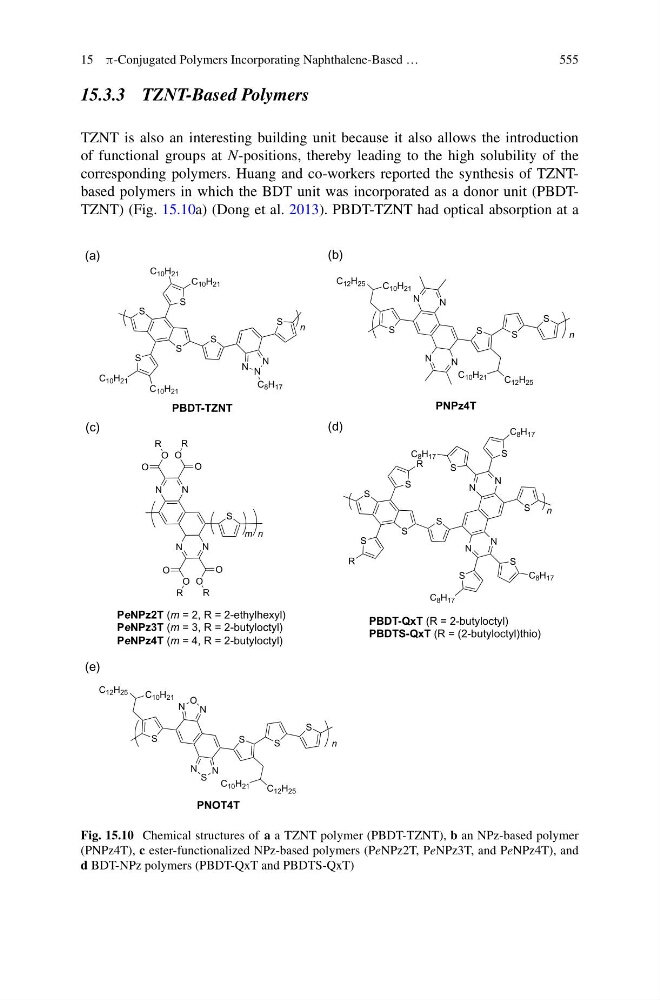
corresponding polymers. Huang and co-workers reported the synthesis of TZNTbased polymers in which the BDT unit was incorporated as a donor unit (PBDTTZNT) (Fig. 15.10a) (Dong et al. 2013). PBDT-TZNT had optical absorption at a
S
S
S
N
N
N
S
S
S
C 10 H 21
C 10 H 21
C 10 H 21
C 10 H 21
n
C 8 H 17
(b)
(a)
S
S
S
C 10 H 21
C 12 H 25
C 10 H 21
C 12 H 25
n
S
N
N
N
N
S
m
N
N
N
N
O
R
O
R
O
R
O
R
O
O
O
O
n
(d)
(c)
S
S
S
S
S
S
n
R
R
N
N
N
N
S
S
S
S
C 8 H 17
C 8 H 17
C 8 H 17
C 8 H 17
PBDT-TZNT
PNPz4T
PeNPz2T (m = 2, R = 2-ethylhexyl)
PeNPz3T (m = 3, R = 2-butyloctyl)
PeNPz4T (m = 4, R = 2-butyloctyl)
PBDT-QxT (R = 2-butyloctyl)
PBDTS-QxT (R = (2-butyloctyl)thio)
N
O
N
N
S
N
S
S
S
C 10 H 21
C 12 H 25
C 10 H 21
C 12 H 25
n
S
(e)
PNOT4T
Fig. 15.10 Chemical structures of a a TZNT polymer (PBDT-TZNT), b an NPz-based polymer
(PNPz4T), c ester-functionalized NPz-based polymers (PeNPz2T, PeNPz3T, and PeNPz4T), and
d BDT-NPz polymers (PBDT-QxT and PBDTS-QxT)
555
15.3.3 TZNT-Based Polymers
TZNT is also an interesting building unit because it also allows the introduction
of functional groups at N-positions, thereby leading to the high solubility of the
corresponding polymers. Huang and co-workers reported the synthesis of TZNTbased polymers in which the BDT unit was incorporated as a donor unit (PBDTTZNT) (Fig. 15.10a) (Dong et al. 2013). PBDT-TZNT had optical absorption at a
S
S
S
N
N
N
S
S
S
C 10 H 21
C 10 H 21
C 10 H 21
C 10 H 21
n
C 8 H 17
(b)
(a)
S
S
S
C 10 H 21
C 12 H 25
C 10 H 21
C 12 H 25
n
S
N
N
N
N
S
m
N
N
N
N
O
R
O
R
O
R
O
R
O
O
O
O
n
(d)
(c)
S
S
S
S
S
S
n
R
R
N
N
N
N
S
S
S
S
C 8 H 17
C 8 H 17
C 8 H 17
C 8 H 17
PBDT-TZNT
PNPz4T
PeNPz2T (m = 2, R = 2-ethylhexyl)
PeNPz3T (m = 3, R = 2-butyloctyl)
PeNPz4T (m = 4, R = 2-butyloctyl)
PBDT-QxT (R = 2-butyloctyl)
PBDTS-QxT (R = (2-butyloctyl)thio)
N
O
N
N
S
N
S
S
S
C 10 H 21
C 12 H 25
C 10 H 21
C 12 H 25
n
S
(e)
PNOT4T
Fig. 15.10 Chemical structures of a a TZNT polymer (PBDT-TZNT), b an NPz-based polymer
(PNPz4T), c ester-functionalized NPz-based polymers (PeNPz2T, PeNPz3T, and PeNPz4T), and
d BDT-NPz polymers (PBDT-QxT and PBDTS-QxT)