

15 π-Conjugated Polymers Incorporating Naphthalene-Based …
549
10
-10
10 -9
10
-8
10 -7
10 -6
10 -5
10 -4
10
-3
0
0.005
0.01
0.015
0.02
-60
-40
-20
0
20
PBTz4T
PNTz4T
–
I
DS
(A)
(– I DS ) 1/2 (A 1/2 )
V G (V)
-15
-10
-5
0
5
-0.2
0
0.2
0.4
0.6
0.8
1
PNTz4T/PC 61 BM
PBTz4T/PC 61 BM
Current density (mA/cm
2
)
Voltage (V)
(c)
(d)
300 400 500 600 700 800 900
PNTz4T
PBTz4T
Absorbance (a.u.)
Wavelength (nm)
(b)
(a)
N
S
N
N
S
N
S
S
S
C 10 H 21
C 12 H 25
C 10 H 21
C 12 H 25
n
S
N
S
N
S
S
S
C 8 H 17
C 10 H 21
C 8 H 17
C 10 H 21
n
S
PNTz4T
PBTz4T
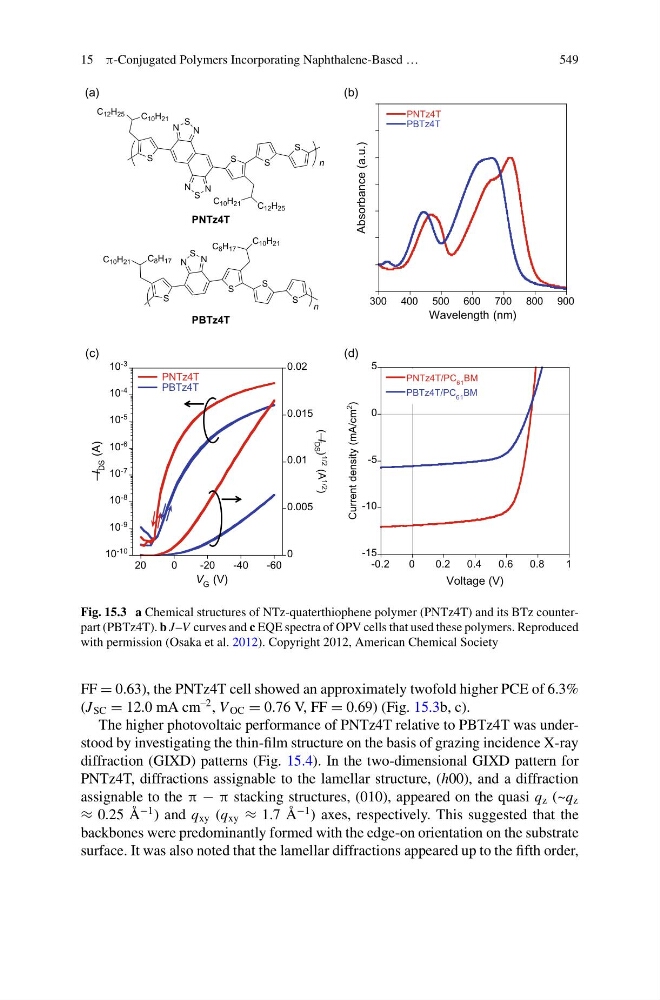
Fig. 15.3 a Chemical structures of NTz-quaterthiophene polymer (PNTz4T) and its BTz counterpart (PBTz4T). b J–V curves and c EQE spectra of OPV cells that used these polymers. Reproduced
with permission (Osaka et al. 2012). Copyright 2012, American Chemical Society
FF = 0.63), the PNTz4T cell showed an approximately twofold higher PCE of 6.3%
(J SC = 12.0 mA cm
–2 , V OC = 0.76 V, FF = 0.69) (Fig. 15.3b, c).
The higher photovoltaic performance of PNTz4T relative to PBTz4T was understood by investigating the thin-film structure on the basis of grazing incidence X-ray
diffraction (GIXD) patterns (Fig. 15.4). In the two-dimensional GIXD pattern for
PNTz4T, diffractions assignable to the lamellar structure, (h00), and a diffraction
assignable to the π − π stacking structures, (010), appeared on the quasi q z (~q z
≈ 0.25 Å
−1 ) and q xy (q xy ≈ 1.7 Å
−1 ) axes, respectively. This suggested that the
backbones were predominantly formed with the edge-on orientation on the substrate
surface. It was also noted that the lamellar diffractions appeared up to the fifth order,
549
10
-10
10 -9
10
-8
10 -7
10 -6
10 -5
10 -4
10
-3
0
0.005
0.01
0.015
0.02
-60
-40
-20
0
20
PBTz4T
PNTz4T
–
I
DS
(A)
(– I DS ) 1/2 (A 1/2 )
V G (V)
-15
-10
-5
0
5
-0.2
0
0.2
0.4
0.6
0.8
1
PNTz4T/PC 61 BM
PBTz4T/PC 61 BM
Current density (mA/cm
2
)
Voltage (V)
(c)
(d)
300 400 500 600 700 800 900
PNTz4T
PBTz4T
Absorbance (a.u.)
Wavelength (nm)
(b)
(a)
N
S
N
N
S
N
S
S
S
C 10 H 21
C 12 H 25
C 10 H 21
C 12 H 25
n
S
N
S
N
S
S
S
C 8 H 17
C 10 H 21
C 8 H 17
C 10 H 21
n
S
PNTz4T
PBTz4T
Fig. 15.3 a Chemical structures of NTz-quaterthiophene polymer (PNTz4T) and its BTz counterpart (PBTz4T). b J–V curves and c EQE spectra of OPV cells that used these polymers. Reproduced
with permission (Osaka et al. 2012). Copyright 2012, American Chemical Society
FF = 0.63), the PNTz4T cell showed an approximately twofold higher PCE of 6.3%
(J SC = 12.0 mA cm
–2 , V OC = 0.76 V, FF = 0.69) (Fig. 15.3b, c).
The higher photovoltaic performance of PNTz4T relative to PBTz4T was understood by investigating the thin-film structure on the basis of grazing incidence X-ray
diffraction (GIXD) patterns (Fig. 15.4). In the two-dimensional GIXD pattern for
PNTz4T, diffractions assignable to the lamellar structure, (h00), and a diffraction
assignable to the π − π stacking structures, (010), appeared on the quasi q z (~q z
≈ 0.25 Å
−1 ) and q xy (q xy ≈ 1.7 Å
−1 ) axes, respectively. This suggested that the
backbones were predominantly formed with the edge-on orientation on the substrate
surface. It was also noted that the lamellar diffractions appeared up to the fifth order,