

548
I. Osaka
S
S
S
N
S
N
N
S N
S
S
S
C 10 H 21
C 10 H 21
C 10 H 21
C 10 H 21
C 6 H 13
C 6 H 13
n
S
S
S
N
S
N
S
S
S
C 10 H 21
C 10 H 21
C 10 H 21
C 10 H 21
C 6 H 13
C 6 H 13
n
PBDT-DTNT
PBDT-DTBT
(a)
(b)
(c)
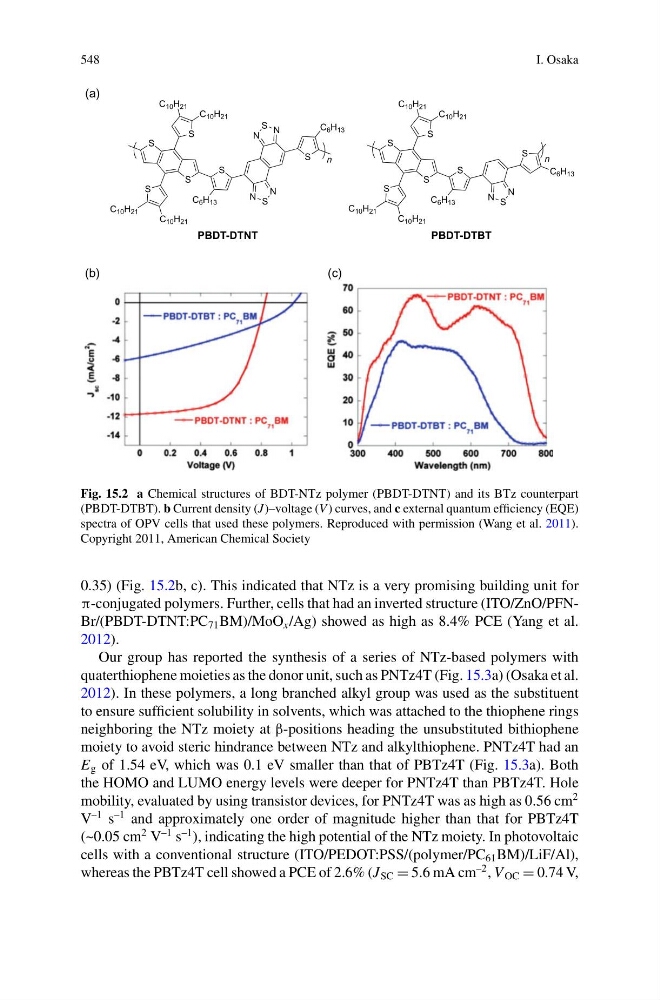
Fig. 15.2 a Chemical structures of BDT-NTz polymer (PBDT-DTNT) and its BTz counterpart
(PBDT-DTBT). b Current density (J)–voltage (V ) curves, and c external quantum efficiency (EQE)
spectra of OPV cells that used these polymers. Reproduced with permission (Wang et al. 2011).
Copyright 2011, American Chemical Society
0.35) (Fig. 15.2b, c). This indicated that NTz is a very promising building unit for
π-conjugated polymers. Further, cells that had an inverted structure (ITO/ZnO/PFNBr/(PBDT-DTNT:PC 71 BM)/MoO x /Ag) showed as high as 8.4% PCE (Yang et al.
2012).
Our group has reported the synthesis of a series of NTz-based polymers with
quaterthiophene moieties as the donor unit, such as PNTz4T (Fig. 15.3a) (Osaka et al.
2012). In these polymers, a long branched alkyl group was used as the substituent
to ensure sufficient solubility in solvents, which was attached to the thiophene rings
neighboring the NTz moiety at β-positions heading the unsubstituted bithiophene
moiety to avoid steric hindrance between NTz and alkylthiophene. PNTz4T had an
E g of 1.54 eV, which was 0.1 eV smaller than that of PBTz4T (Fig. 15.3a). Both
the HOMO and LUMO energy levels were deeper for PNTz4T than PBTz4T. Hole
mobility, evaluated by using transistor devices, for PNTz4T was as high as 0.56 cm
2
V
–1 s
–1 and approximately one order of magnitude higher than that for PBTz4T
(~0.05 cm
2 V
–1 s
–1 ), indicating the high potential of the NTz moiety. In photovoltaic
cells with a conventional structure (ITO/PEDOT:PSS/(polymer/PC 61 BM)/LiF/Al),
whereas the PBTz4T cell showed a PCE of 2.6% (J SC = 5.6 mA cm
–2 , V OC = 0.74 V,
I. Osaka
S
S
S
N
S
N
N
S N
S
S
S
C 10 H 21
C 10 H 21
C 10 H 21
C 10 H 21
C 6 H 13
C 6 H 13
n
S
S
S
N
S
N
S
S
S
C 10 H 21
C 10 H 21
C 10 H 21
C 10 H 21
C 6 H 13
C 6 H 13
n
PBDT-DTNT
PBDT-DTBT
(a)
(b)
(c)
Fig. 15.2 a Chemical structures of BDT-NTz polymer (PBDT-DTNT) and its BTz counterpart
(PBDT-DTBT). b Current density (J)–voltage (V ) curves, and c external quantum efficiency (EQE)
spectra of OPV cells that used these polymers. Reproduced with permission (Wang et al. 2011).
Copyright 2011, American Chemical Society
0.35) (Fig. 15.2b, c). This indicated that NTz is a very promising building unit for
π-conjugated polymers. Further, cells that had an inverted structure (ITO/ZnO/PFNBr/(PBDT-DTNT:PC 71 BM)/MoO x /Ag) showed as high as 8.4% PCE (Yang et al.
2012).
Our group has reported the synthesis of a series of NTz-based polymers with
quaterthiophene moieties as the donor unit, such as PNTz4T (Fig. 15.3a) (Osaka et al.
2012). In these polymers, a long branched alkyl group was used as the substituent
to ensure sufficient solubility in solvents, which was attached to the thiophene rings
neighboring the NTz moiety at β-positions heading the unsubstituted bithiophene
moiety to avoid steric hindrance between NTz and alkylthiophene. PNTz4T had an
E g of 1.54 eV, which was 0.1 eV smaller than that of PBTz4T (Fig. 15.3a). Both
the HOMO and LUMO energy levels were deeper for PNTz4T than PBTz4T. Hole
mobility, evaluated by using transistor devices, for PNTz4T was as high as 0.56 cm
2
V
–1 s
–1 and approximately one order of magnitude higher than that for PBTz4T
(~0.05 cm
2 V
–1 s
–1 ), indicating the high potential of the NTz moiety. In photovoltaic
cells with a conventional structure (ITO/PEDOT:PSS/(polymer/PC 61 BM)/LiF/Al),
whereas the PBTz4T cell showed a PCE of 2.6% (J SC = 5.6 mA cm
–2 , V OC = 0.74 V,