

15 π-Conjugated Polymers Incorporating Naphthalene-Based …
547
N
S
N
N
S
N
S
S
R
R
NTz2T
N
S
N
N
S
N
Br
Br
NTz-Br2
S
R
Me3Sn
N
S
N
N
S
N
S
S
R
R
Br
Br
NTz2T-Br2
NBS
N
S
N
N
S
N
S
S
R
R
PNTz4T
S
S
n
S
S
Me3Sn
SnMe3
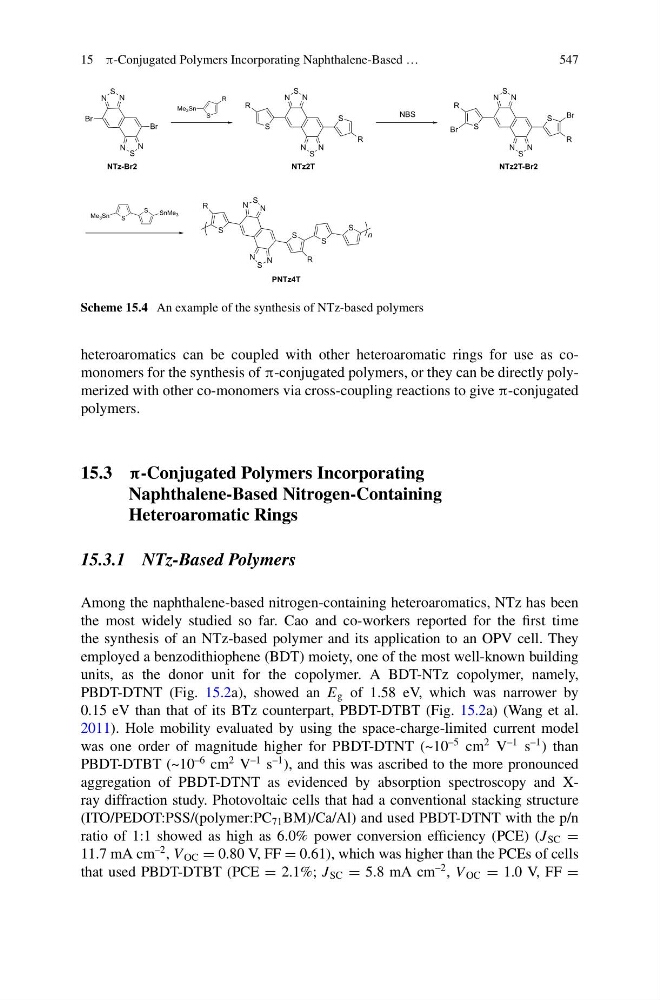
Scheme 15.4 An example of the synthesis of NTz-based polymers
heteroaromatics can be coupled with other heteroaromatic rings for use as comonomers for the synthesis of π-conjugated polymers, or they can be directly polymerized with other co-monomers via cross-coupling reactions to give π-conjugated
polymers.
15.3 π-Conjugated Polymers Incorporating
Naphthalene-Based Nitrogen-Containing
Heteroaromatic Rings
15.3.1 NTz-Based Polymers
Among the naphthalene-based nitrogen-containing heteroaromatics, NTz has been
the most widely studied so far. Cao and co-workers reported for the first time
the synthesis of an NTz-based polymer and its application to an OPV cell. They
employed a benzodithiophene (BDT) moiety, one of the most well-known building
units, as the donor unit for the copolymer. A BDT-NTz copolymer, namely,
PBDT-DTNT (Fig. 15.2a), showed an E g of 1.58 eV, which was narrower by
0.15 eV than that of its BTz counterpart, PBDT-DTBT (Fig. 15.2a) (Wang et al.
2011). Hole mobility evaluated by using the space-charge-limited current model
was one order of magnitude higher for PBDT-DTNT (~10
–5 cm
2 V
–1 s
–1 ) than
PBDT-DTBT (~10
–6 cm
2 V
–1 s
–1 ), and this was ascribed to the more pronounced
aggregation of PBDT-DTNT as evidenced by absorption spectroscopy and Xray diffraction study. Photovoltaic cells that had a conventional stacking structure
(ITO/PEDOT:PSS/(polymer:PC 71 BM)/Ca/Al) and used PBDT-DTNT with the p/n
ratio of 1:1 showed as high as 6.0% power conversion efficiency (PCE) (J SC =
11.7 mA cm
–2 , V OC = 0.80 V, FF = 0.61), which was higher than the PCEs of cells
that used PBDT-DTBT (PCE = 2.1%; J SC = 5.8 mA cm
–2 , V OC = 1.0 V, FF =
547
N
S
N
N
S
N
S
S
R
R
NTz2T
N
S
N
N
S
N
Br
Br
NTz-Br2
S
R
Me3Sn
N
S
N
N
S
N
S
S
R
R
Br
Br
NTz2T-Br2
NBS
N
S
N
N
S
N
S
S
R
R
PNTz4T
S
S
n
S
S
Me3Sn
SnMe3
Scheme 15.4 An example of the synthesis of NTz-based polymers
heteroaromatics can be coupled with other heteroaromatic rings for use as comonomers for the synthesis of π-conjugated polymers, or they can be directly polymerized with other co-monomers via cross-coupling reactions to give π-conjugated
polymers.
15.3 π-Conjugated Polymers Incorporating
Naphthalene-Based Nitrogen-Containing
Heteroaromatic Rings
15.3.1 NTz-Based Polymers
Among the naphthalene-based nitrogen-containing heteroaromatics, NTz has been
the most widely studied so far. Cao and co-workers reported for the first time
the synthesis of an NTz-based polymer and its application to an OPV cell. They
employed a benzodithiophene (BDT) moiety, one of the most well-known building
units, as the donor unit for the copolymer. A BDT-NTz copolymer, namely,
PBDT-DTNT (Fig. 15.2a), showed an E g of 1.58 eV, which was narrower by
0.15 eV than that of its BTz counterpart, PBDT-DTBT (Fig. 15.2a) (Wang et al.
2011). Hole mobility evaluated by using the space-charge-limited current model
was one order of magnitude higher for PBDT-DTNT (~10
–5 cm
2 V
–1 s
–1 ) than
PBDT-DTBT (~10
–6 cm
2 V
–1 s
–1 ), and this was ascribed to the more pronounced
aggregation of PBDT-DTNT as evidenced by absorption spectroscopy and Xray diffraction study. Photovoltaic cells that had a conventional stacking structure
(ITO/PEDOT:PSS/(polymer:PC 71 BM)/Ca/Al) and used PBDT-DTNT with the p/n
ratio of 1:1 showed as high as 6.0% power conversion efficiency (PCE) (J SC =
11.7 mA cm
–2 , V OC = 0.80 V, FF = 0.61), which was higher than the PCEs of cells
that used PBDT-DTBT (PCE = 2.1%; J SC = 5.8 mA cm
–2 , V OC = 1.0 V, FF =