

14 Photoenergy Conversion (Dye-Sensitized Solar Cells)
519
Nikolaou et al. 2017). Carboxyl groups have been widely employed as anchoring
groups in dye sensitizers for NiO DSSCs, although they are not necessarily an
optimal group for hole injection because they stabilize the LUMO rather than the
HOMO. Therefore, electron-withdrawing anchoring groups including a carboxyl
group are not appropriate for organic dyes to efficiently inject holes and suppress
geminate recombination in NiO DSSCs. A study on photovoltaic performances of
NiO DSSCs using ruthenium polypyridine complexes with carboxylic acids, biscarbodithioic acids, catechol, or methylphosphonic acids as anchoring groups suggested
that methylphosphonic acid is a favorable anchoring group for a stable linkage with
a metal oxide, while catechol is another promising anchoring group that can enhance
electronic coupling with the NiO electrode because of the more rich electron density
compared to carboxylic acid (Pellegrin et al. 2011). That is, the study proposed
that catechol and methylphosphonic acid are promising anchoring groups for dye
sensitizers to replace the conventional carboxyl group in NiO DSSCs.
The molecular design opposite to organic dyes for TiO 2 DSSCs and ZnO DSSCs
is required for those used in NiO DSSCs: the organic dye sensitizer should be fixed
on the NiO surface through an anchoring group connected to the electron-donating
moiety (i.e., HOMO) of the dye, while the electron-accepting moiety (i.e., LUMO) of
the dye should be located apart from the NiO surface. The HOMO energy level of the
dye must be lower (more positive) than that of the VB of the NiO electrode, in order
to achieve efficient hole injection from the excited dye to the VB of NiO. Moreover,
the LUMO energy level of the dye must be higher (more negative) than the redox
potential of the I 3
− /I
− ion couple, in order to achieve efficient dye regeneration of the
reduced state through electron transfer from the reduced dyes to the I 3
− ions in the
redox mediator. Obviously, the LUMO energy level must be sufficiently lower than
the energy level of the NiO CB. Therefore, the hole injection and dye regeneration
must be thermodynamically feasible.
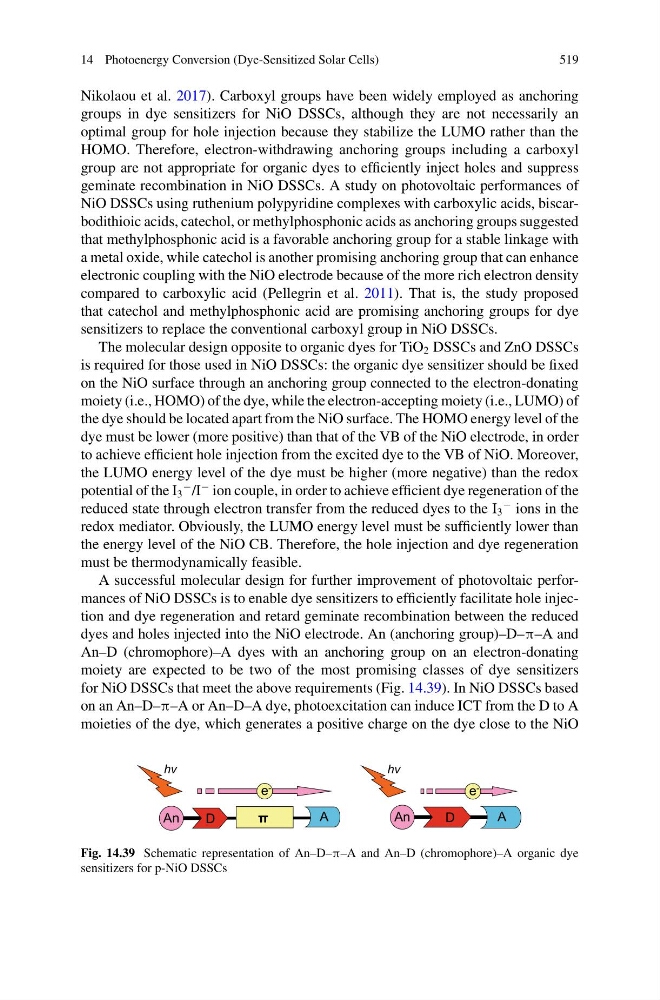
A successful molecular design for further improvement of photovoltaic performances of NiO DSSCs is to enable dye sensitizers to efficiently facilitate hole injection and dye regeneration and retard geminate recombination between the reduced
dyes and holes injected into the NiO electrode. An (anchoring group)–D–π–A and
An–D (chromophore)–A dyes with an anchoring group on an electron-donating
moiety are expected to be two of the most promising classes of dye sensitizers
for NiO DSSCs that meet the above requirements (Fig. 14.39). In NiO DSSCs based
on an An–D–π–A or An–D–A dye, photoexcitation can induce ICT from the D to A
moieties of the dye, which generates a positive charge on the dye close to the NiO
A
hv
e -
D
π
A
An
D
An
hv
e -
Fig. 14.39 Schematic representation of An–D–π–A and An–D (chromophore)–A organic dye
sensitizers for p-NiO DSSCs
519
Nikolaou et al. 2017). Carboxyl groups have been widely employed as anchoring
groups in dye sensitizers for NiO DSSCs, although they are not necessarily an
optimal group for hole injection because they stabilize the LUMO rather than the
HOMO. Therefore, electron-withdrawing anchoring groups including a carboxyl
group are not appropriate for organic dyes to efficiently inject holes and suppress
geminate recombination in NiO DSSCs. A study on photovoltaic performances of
NiO DSSCs using ruthenium polypyridine complexes with carboxylic acids, biscarbodithioic acids, catechol, or methylphosphonic acids as anchoring groups suggested
that methylphosphonic acid is a favorable anchoring group for a stable linkage with
a metal oxide, while catechol is another promising anchoring group that can enhance
electronic coupling with the NiO electrode because of the more rich electron density
compared to carboxylic acid (Pellegrin et al. 2011). That is, the study proposed
that catechol and methylphosphonic acid are promising anchoring groups for dye
sensitizers to replace the conventional carboxyl group in NiO DSSCs.
The molecular design opposite to organic dyes for TiO 2 DSSCs and ZnO DSSCs
is required for those used in NiO DSSCs: the organic dye sensitizer should be fixed
on the NiO surface through an anchoring group connected to the electron-donating
moiety (i.e., HOMO) of the dye, while the electron-accepting moiety (i.e., LUMO) of
the dye should be located apart from the NiO surface. The HOMO energy level of the
dye must be lower (more positive) than that of the VB of the NiO electrode, in order
to achieve efficient hole injection from the excited dye to the VB of NiO. Moreover,
the LUMO energy level of the dye must be higher (more negative) than the redox
potential of the I 3
− /I
− ion couple, in order to achieve efficient dye regeneration of the
reduced state through electron transfer from the reduced dyes to the I 3
− ions in the
redox mediator. Obviously, the LUMO energy level must be sufficiently lower than
the energy level of the NiO CB. Therefore, the hole injection and dye regeneration
must be thermodynamically feasible.
A successful molecular design for further improvement of photovoltaic performances of NiO DSSCs is to enable dye sensitizers to efficiently facilitate hole injection and dye regeneration and retard geminate recombination between the reduced
dyes and holes injected into the NiO electrode. An (anchoring group)–D–π–A and
An–D (chromophore)–A dyes with an anchoring group on an electron-donating
moiety are expected to be two of the most promising classes of dye sensitizers
for NiO DSSCs that meet the above requirements (Fig. 14.39). In NiO DSSCs based
on an An–D–π–A or An–D–A dye, photoexcitation can induce ICT from the D to A
moieties of the dye, which generates a positive charge on the dye close to the NiO
A
hv
e -
D
π
A
An
D
An
hv
e -
Fig. 14.39 Schematic representation of An–D–π–A and An–D (chromophore)–A organic dye
sensitizers for p-NiO DSSCs