

520
Y. Ooyama
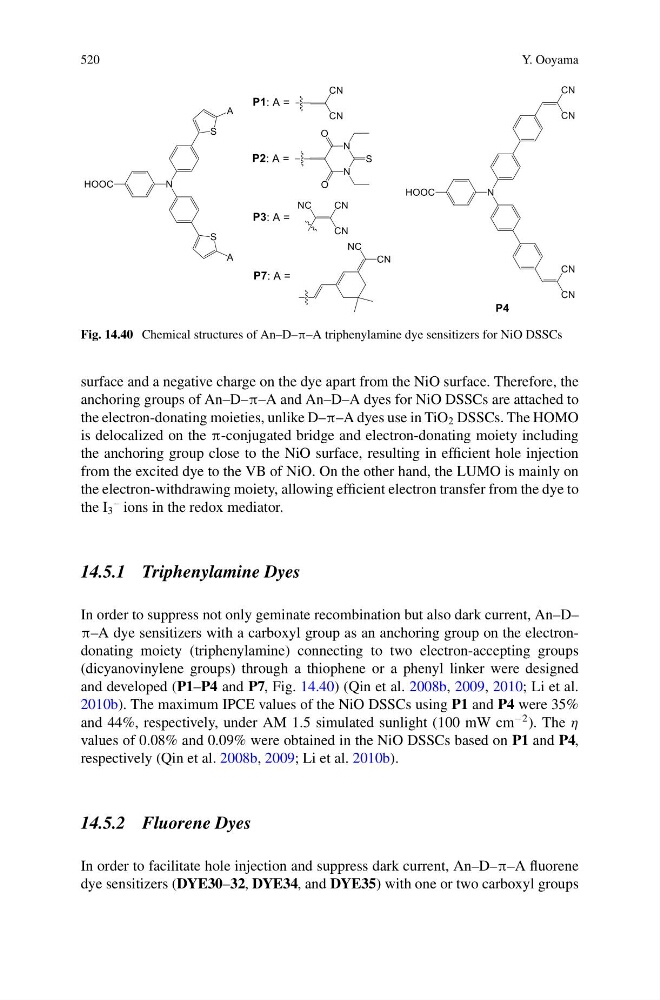
Fig. 14.40 Chemical structures of An–D–π–A triphenylamine dye sensitizers for NiO DSSCs
surface and a negative charge on the dye apart from the NiO surface. Therefore, the
anchoring groups of An–D–π–A and An–D–A dyes for NiO DSSCs are attached to
the electron-donating moieties, unlike D–π–A dyes use in TiO 2 DSSCs. The HOMO
is delocalized on the π-conjugated bridge and electron-donating moiety including
the anchoring group close to the NiO surface, resulting in efficient hole injection
from the excited dye to the VB of NiO. On the other hand, the LUMO is mainly on
the electron-withdrawing moiety, allowing efficient electron transfer from the dye to
the I 3
– ions in the redox mediator.
14.5.1 Triphenylamine Dyes
In order to suppress not only geminate recombination but also dark current, An–D–
π–A dye sensitizers with a carboxyl group as an anchoring group on the electrondonating moiety (triphenylamine) connecting to two electron-accepting groups
(dicyanovinylene groups) through a thiophene or a phenyl linker were designed
and developed (P1–P4 and P7, Fig. 14.40) (Qin et al. 2008b, 2009, 2010; Li et al.
2010b). The maximum IPCE values of the NiO DSSCs using P1 and P4 were 35%
and 44%, respectively, under AM 1.5 simulated sunlight (100 mW cm
−2 ). The η
values of 0.08% and 0.09% were obtained in the NiO DSSCs based on P1 and P4,
respectively (Qin et al. 2008b, 2009; Li et al. 2010b).
14.5.2 Fluorene Dyes
In order to facilitate hole injection and suppress dark current, An–D–π–A fluorene
dye sensitizers (DYE30–32, DYE34, and DYE35) with one or two carboxyl groups
Y. Ooyama
Fig. 14.40 Chemical structures of An–D–π–A triphenylamine dye sensitizers for NiO DSSCs
surface and a negative charge on the dye apart from the NiO surface. Therefore, the
anchoring groups of An–D–π–A and An–D–A dyes for NiO DSSCs are attached to
the electron-donating moieties, unlike D–π–A dyes use in TiO 2 DSSCs. The HOMO
is delocalized on the π-conjugated bridge and electron-donating moiety including
the anchoring group close to the NiO surface, resulting in efficient hole injection
from the excited dye to the VB of NiO. On the other hand, the LUMO is mainly on
the electron-withdrawing moiety, allowing efficient electron transfer from the dye to
the I 3
– ions in the redox mediator.
14.5.1 Triphenylamine Dyes
In order to suppress not only geminate recombination but also dark current, An–D–
π–A dye sensitizers with a carboxyl group as an anchoring group on the electrondonating moiety (triphenylamine) connecting to two electron-accepting groups
(dicyanovinylene groups) through a thiophene or a phenyl linker were designed
and developed (P1–P4 and P7, Fig. 14.40) (Qin et al. 2008b, 2009, 2010; Li et al.
2010b). The maximum IPCE values of the NiO DSSCs using P1 and P4 were 35%
and 44%, respectively, under AM 1.5 simulated sunlight (100 mW cm
−2 ). The η
values of 0.08% and 0.09% were obtained in the NiO DSSCs based on P1 and P4,
respectively (Qin et al. 2008b, 2009; Li et al. 2010b).
14.5.2 Fluorene Dyes
In order to facilitate hole injection and suppress dark current, An–D–π–A fluorene
dye sensitizers (DYE30–32, DYE34, and DYE35) with one or two carboxyl groups