

518
Y. Ooyama
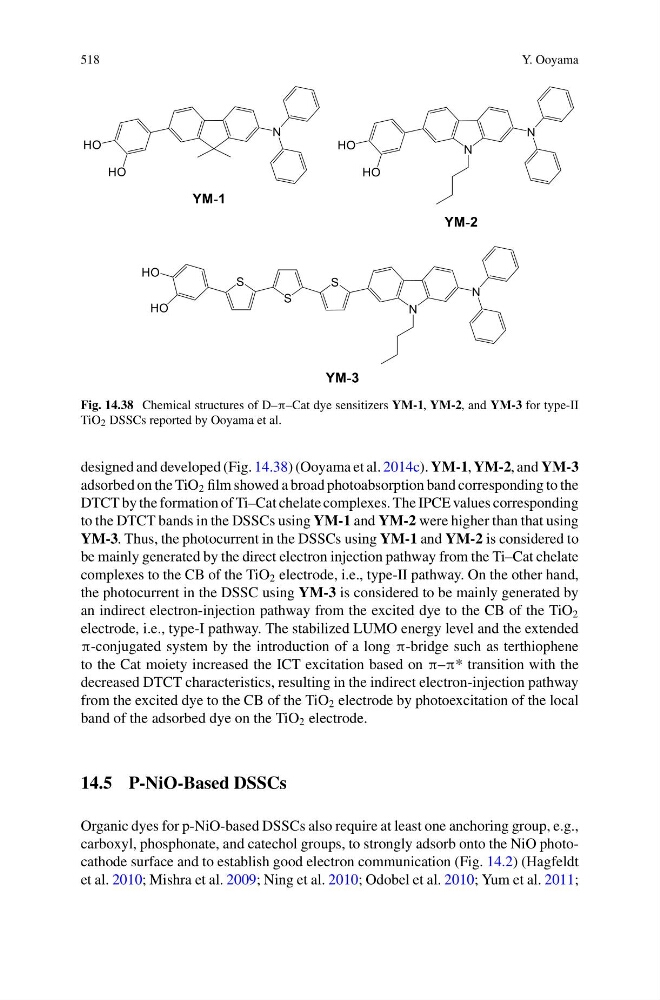
Fig. 14.38 Chemical structures of D–π–Cat dye sensitizers YM-1, YM-2, and YM-3 for type-II
TiO 2 DSSCs reported by Ooyama et al.
designed and developed (Fig. 14.38) (Ooyama et al. 2014c). YM-1, YM-2, and YM-3
adsorbed on the TiO 2 film showed a broad photoabsorption band corresponding to the
DTCT by the formation of Ti–Cat chelate complexes. The IPCE values corresponding
to the DTCT bands in the DSSCs using YM-1 and YM-2 were higher than that using
YM-3. Thus, the photocurrent in the DSSCs using YM-1 and YM-2 is considered to
be mainly generated by the direct electron injection pathway from the Ti–Cat chelate
complexes to the CB of the TiO 2 electrode, i.e., type-II pathway. On the other hand,
the photocurrent in the DSSC using YM-3 is considered to be mainly generated by
an indirect electron-injection pathway from the excited dye to the CB of the TiO 2
electrode, i.e., type-I pathway. The stabilized LUMO energy level and the extended
π-conjugated system by the introduction of a long π-bridge such as terthiophene
to the Cat moiety increased the ICT excitation based on π–π* transition with the
decreased DTCT characteristics, resulting in the indirect electron-injection pathway
from the excited dye to the CB of the TiO 2 electrode by photoexcitation of the local
band of the adsorbed dye on the TiO 2 electrode.
14.5 P-NiO-Based DSSCs
Organic dyes for p-NiO-based DSSCs also require at least one anchoring group, e.g.,
carboxyl, phosphonate, and catechol groups, to strongly adsorb onto the NiO photocathode surface and to establish good electron communication (Fig. 14.2) (Hagfeldt
et al. 2010; Mishra et al. 2009; Ning et al. 2010; Odobel et al. 2010; Yum et al. 2011;
Y. Ooyama
Fig. 14.38 Chemical structures of D–π–Cat dye sensitizers YM-1, YM-2, and YM-3 for type-II
TiO 2 DSSCs reported by Ooyama et al.
designed and developed (Fig. 14.38) (Ooyama et al. 2014c). YM-1, YM-2, and YM-3
adsorbed on the TiO 2 film showed a broad photoabsorption band corresponding to the
DTCT by the formation of Ti–Cat chelate complexes. The IPCE values corresponding
to the DTCT bands in the DSSCs using YM-1 and YM-2 were higher than that using
YM-3. Thus, the photocurrent in the DSSCs using YM-1 and YM-2 is considered to
be mainly generated by the direct electron injection pathway from the Ti–Cat chelate
complexes to the CB of the TiO 2 electrode, i.e., type-II pathway. On the other hand,
the photocurrent in the DSSC using YM-3 is considered to be mainly generated by
an indirect electron-injection pathway from the excited dye to the CB of the TiO 2
electrode, i.e., type-I pathway. The stabilized LUMO energy level and the extended
π-conjugated system by the introduction of a long π-bridge such as terthiophene
to the Cat moiety increased the ICT excitation based on π–π* transition with the
decreased DTCT characteristics, resulting in the indirect electron-injection pathway
from the excited dye to the CB of the TiO 2 electrode by photoexcitation of the local
band of the adsorbed dye on the TiO 2 electrode.
14.5 P-NiO-Based DSSCs
Organic dyes for p-NiO-based DSSCs also require at least one anchoring group, e.g.,
carboxyl, phosphonate, and catechol groups, to strongly adsorb onto the NiO photocathode surface and to establish good electron communication (Fig. 14.2) (Hagfeldt
et al. 2010; Mishra et al. 2009; Ning et al. 2010; Odobel et al. 2010; Yum et al. 2011;