

14 Photoenergy Conversion (Dye-Sensitized Solar Cells)
517
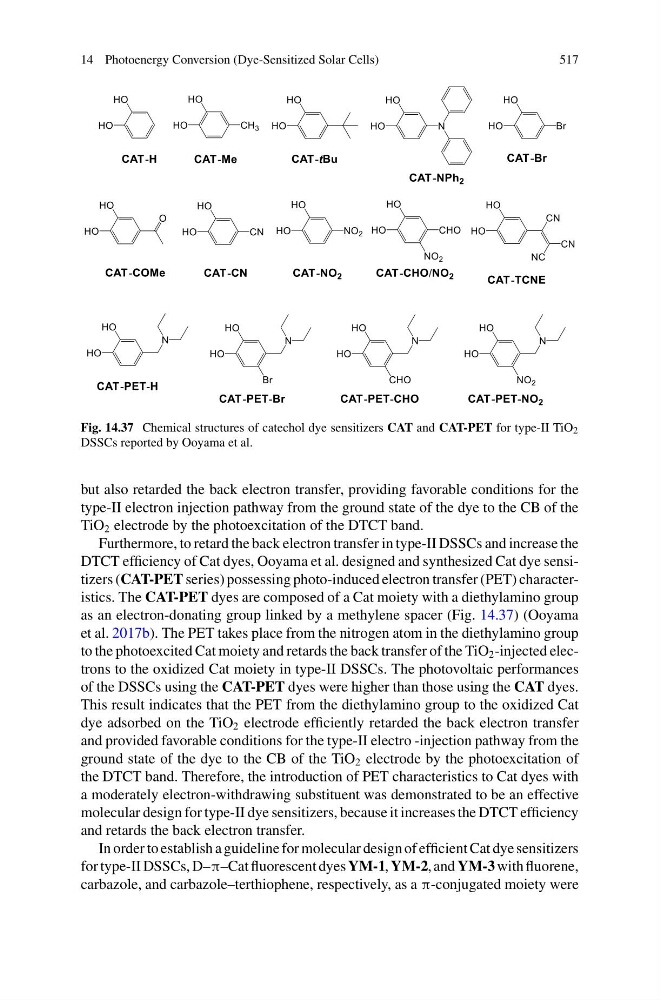
Fig. 14.37 Chemical structures of catechol dye sensitizers CAT and CAT-PET for type-II TiO 2
DSSCs reported by Ooyama et al.
but also retarded the back electron transfer, providing favorable conditions for the
type-II electron injection pathway from the ground state of the dye to the CB of the
TiO 2 electrode by the photoexcitation of the DTCT band.
Furthermore, to retard the back electron transfer in type-II DSSCs and increase the
DTCT efficiency of Cat dyes, Ooyama et al. designed and synthesized Cat dye sensitizers (CAT-PET series) possessing photo-induced electron transfer (PET) characteristics. The CAT-PET dyes are composed of a Cat moiety with a diethylamino group
as an electron-donating group linked by a methylene spacer (Fig. 14.37) (Ooyama
et al. 2017b). The PET takes place from the nitrogen atom in the diethylamino group
to the photoexcited Cat moiety and retards the back transfer of the TiO 2 -injected electrons to the oxidized Cat moiety in type-II DSSCs. The photovoltaic performances
of the DSSCs using the CAT-PET dyes were higher than those using the CAT dyes.
This result indicates that the PET from the diethylamino group to the oxidized Cat
dye adsorbed on the TiO 2 electrode efficiently retarded the back electron transfer
and provided favorable conditions for the type-II electro -injection pathway from the
ground state of the dye to the CB of the TiO 2 electrode by the photoexcitation of
the DTCT band. Therefore, the introduction of PET characteristics to Cat dyes with
a moderately electron-withdrawing substituent was demonstrated to be an effective
molecular design for type-II dye sensitizers, because it increases the DTCT efficiency
and retards the back electron transfer.
In order to establish a guideline for molecular design of efficient Cat dye sensitizers
for type-II DSSCs, D–π–Cat fluorescent dyes YM-1, YM-2, and YM-3 with fluorene,
carbazole, and carbazole–terthiophene, respectively, as a π-conjugated moiety were
517
Fig. 14.37 Chemical structures of catechol dye sensitizers CAT and CAT-PET for type-II TiO 2
DSSCs reported by Ooyama et al.
but also retarded the back electron transfer, providing favorable conditions for the
type-II electron injection pathway from the ground state of the dye to the CB of the
TiO 2 electrode by the photoexcitation of the DTCT band.
Furthermore, to retard the back electron transfer in type-II DSSCs and increase the
DTCT efficiency of Cat dyes, Ooyama et al. designed and synthesized Cat dye sensitizers (CAT-PET series) possessing photo-induced electron transfer (PET) characteristics. The CAT-PET dyes are composed of a Cat moiety with a diethylamino group
as an electron-donating group linked by a methylene spacer (Fig. 14.37) (Ooyama
et al. 2017b). The PET takes place from the nitrogen atom in the diethylamino group
to the photoexcited Cat moiety and retards the back transfer of the TiO 2 -injected electrons to the oxidized Cat moiety in type-II DSSCs. The photovoltaic performances
of the DSSCs using the CAT-PET dyes were higher than those using the CAT dyes.
This result indicates that the PET from the diethylamino group to the oxidized Cat
dye adsorbed on the TiO 2 electrode efficiently retarded the back electron transfer
and provided favorable conditions for the type-II electro -injection pathway from the
ground state of the dye to the CB of the TiO 2 electrode by the photoexcitation of
the DTCT band. Therefore, the introduction of PET characteristics to Cat dyes with
a moderately electron-withdrawing substituent was demonstrated to be an effective
molecular design for type-II dye sensitizers, because it increases the DTCT efficiency
and retards the back electron transfer.
In order to establish a guideline for molecular design of efficient Cat dye sensitizers
for type-II DSSCs, D–π–Cat fluorescent dyes YM-1, YM-2, and YM-3 with fluorene,
carbazole, and carbazole–terthiophene, respectively, as a π-conjugated moiety were