

516
Y. Ooyama
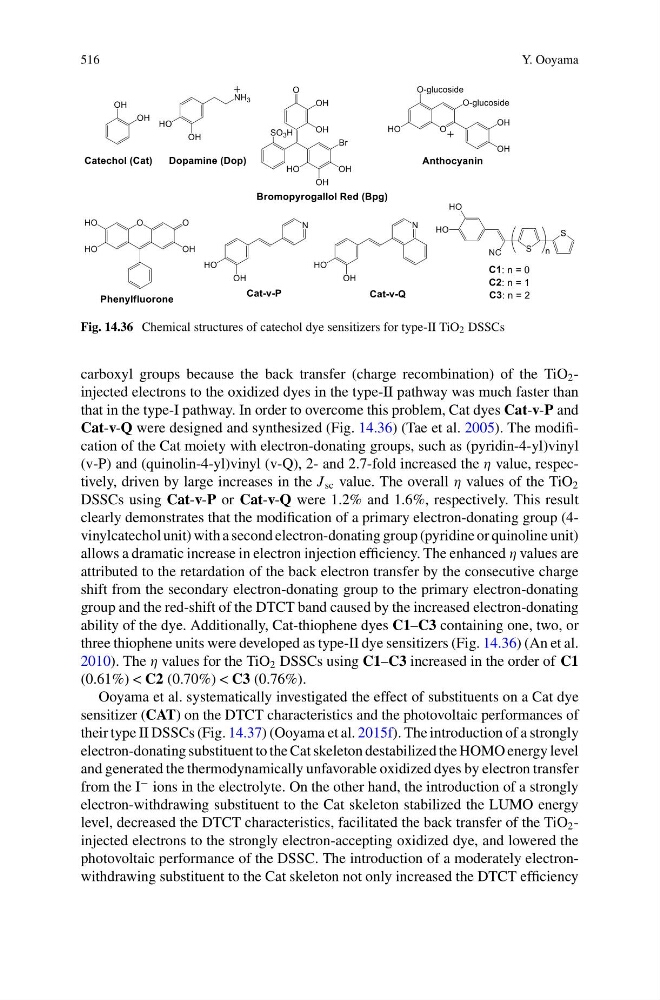
Fig. 14.36 Chemical structures of catechol dye sensitizers for type-II TiO 2 DSSCs
carboxyl groups because the back transfer (charge recombination) of the TiO 2 -
injected electrons to the oxidized dyes in the type-II pathway was much faster than
that in the type-I pathway. In order to overcome this problem, Cat dyes Cat-v-P and
Cat-v-Q were designed and synthesized (Fig. 14.36) (Tae et al. 2005). The modification of the Cat moiety with electron-donating groups, such as (pyridin-4-yl)vinyl
(v-P) and (quinolin-4-yl)vinyl (v-Q), 2- and 2.7-fold increased the η value, respectively, driven by large increases in the J sc value. The overall η values of the TiO 2
DSSCs using Cat-v-P or Cat-v-Q were 1.2% and 1.6%, respectively. This result
clearly demonstrates that the modification of a primary electron-donating group (4vinylcatechol unit) with a second electron-donating group (pyridine or quinoline unit)
allows a dramatic increase in electron injection efficiency. The enhanced η values are
attributed to the retardation of the back electron transfer by the consecutive charge
shift from the secondary electron-donating group to the primary electron-donating
group and the red-shift of the DTCT band caused by the increased electron-donating
ability of the dye. Additionally, Cat-thiophene dyes C1–C3 containing one, two, or
three thiophene units were developed as type-II dye sensitizers (Fig. 14.36) (An et al.
2010). The η values for the TiO 2 DSSCs using C1–C3 increased in the order of C1
(0.61%) < C2 (0.70%) < C3 (0.76%).
Ooyama et al. systematically investigated the effect of substituents on a Cat dye
sensitizer (CAT) on the DTCT characteristics and the photovoltaic performances of
their type II DSSCs (Fig. 14.37) (Ooyama et al. 2015f). The introduction of a strongly
electron-donating substituent to the Cat skeleton destabilized the HOMO energy level
and generated the thermodynamically unfavorable oxidized dyes by electron transfer
from the I
− ions in the electrolyte. On the other hand, the introduction of a strongly
electron-withdrawing substituent to the Cat skeleton stabilized the LUMO energy
level, decreased the DTCT characteristics, facilitated the back transfer of the TiO 2 -
injected electrons to the strongly electron-accepting oxidized dye, and lowered the
photovoltaic performance of the DSSC. The introduction of a moderately electronwithdrawing substituent to the Cat skeleton not only increased the DTCT efficiency
Y. Ooyama
Fig. 14.36 Chemical structures of catechol dye sensitizers for type-II TiO 2 DSSCs
carboxyl groups because the back transfer (charge recombination) of the TiO 2 -
injected electrons to the oxidized dyes in the type-II pathway was much faster than
that in the type-I pathway. In order to overcome this problem, Cat dyes Cat-v-P and
Cat-v-Q were designed and synthesized (Fig. 14.36) (Tae et al. 2005). The modification of the Cat moiety with electron-donating groups, such as (pyridin-4-yl)vinyl
(v-P) and (quinolin-4-yl)vinyl (v-Q), 2- and 2.7-fold increased the η value, respectively, driven by large increases in the J sc value. The overall η values of the TiO 2
DSSCs using Cat-v-P or Cat-v-Q were 1.2% and 1.6%, respectively. This result
clearly demonstrates that the modification of a primary electron-donating group (4vinylcatechol unit) with a second electron-donating group (pyridine or quinoline unit)
allows a dramatic increase in electron injection efficiency. The enhanced η values are
attributed to the retardation of the back electron transfer by the consecutive charge
shift from the secondary electron-donating group to the primary electron-donating
group and the red-shift of the DTCT band caused by the increased electron-donating
ability of the dye. Additionally, Cat-thiophene dyes C1–C3 containing one, two, or
three thiophene units were developed as type-II dye sensitizers (Fig. 14.36) (An et al.
2010). The η values for the TiO 2 DSSCs using C1–C3 increased in the order of C1
(0.61%) < C2 (0.70%) < C3 (0.76%).
Ooyama et al. systematically investigated the effect of substituents on a Cat dye
sensitizer (CAT) on the DTCT characteristics and the photovoltaic performances of
their type II DSSCs (Fig. 14.37) (Ooyama et al. 2015f). The introduction of a strongly
electron-donating substituent to the Cat skeleton destabilized the HOMO energy level
and generated the thermodynamically unfavorable oxidized dyes by electron transfer
from the I
− ions in the electrolyte. On the other hand, the introduction of a strongly
electron-withdrawing substituent to the Cat skeleton stabilized the LUMO energy
level, decreased the DTCT characteristics, facilitated the back transfer of the TiO 2 -
injected electrons to the strongly electron-accepting oxidized dye, and lowered the
photovoltaic performance of the DSSC. The introduction of a moderately electronwithdrawing substituent to the Cat skeleton not only increased the DTCT efficiency