

14 Photoenergy Conversion (Dye-Sensitized Solar Cells)
515
14.3.5 Squaraine Dyes
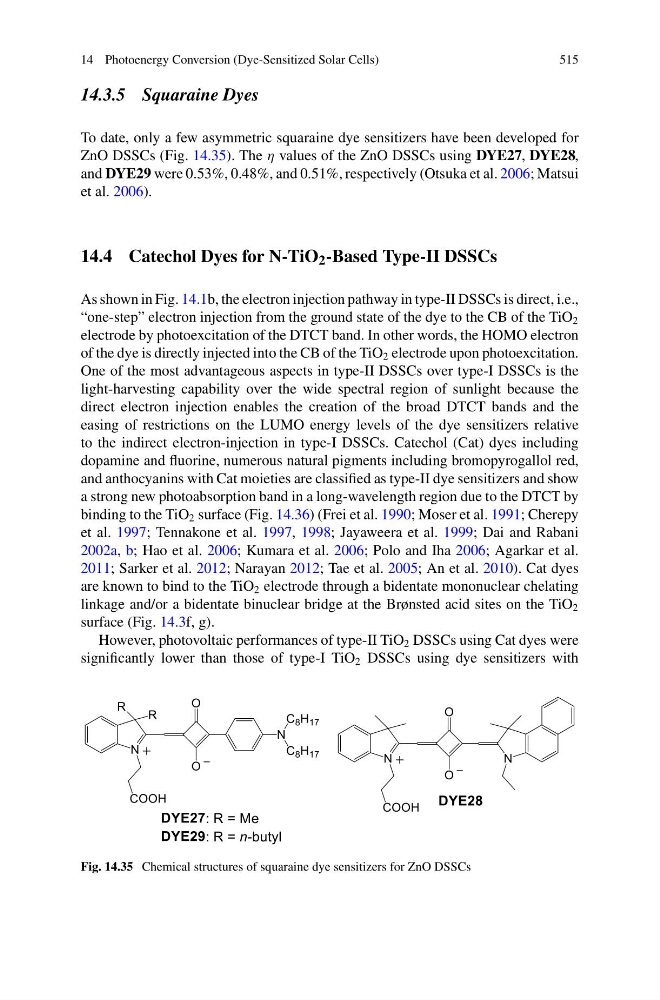
To date, only a few asymmetric squaraine dye sensitizers have been developed for
ZnO DSSCs (Fig. 14.35). The η values of the ZnO DSSCs using DYE27, DYE28,
and DYE29 were 0.53%, 0.48%, and 0.51%, respectively (Otsuka et al. 2006; Matsui
et al. 2006).
14.4 Catechol Dyes for N-TiO 2 -Based Type-II DSSCs
As shown in Fig. 14.1b, the electron injection pathway in type-II DSSCs is direct, i.e.,
“one-step” electron injection from the ground state of the dye to the CB of the TiO 2
electrode by photoexcitation of the DTCT band. In other words, the HOMO electron
of the dye is directly injected into the CB of the TiO 2 electrode upon photoexcitation.
One of the most advantageous aspects in type-II DSSCs over type-I DSSCs is the
light-harvesting capability over the wide spectral region of sunlight because the
direct electron injection enables the creation of the broad DTCT bands and the
easing of restrictions on the LUMO energy levels of the dye sensitizers relative
to the indirect electron-injection in type-I DSSCs. Catechol (Cat) dyes including
dopamine and fluorine, numerous natural pigments including bromopyrogallol red,
and anthocyanins with Cat moieties are classified as type-II dye sensitizers and show
a strong new photoabsorption band in a long-wavelength region due to the DTCT by
binding to the TiO 2 surface (Fig. 14.36) (Frei et al. 1990; Moser et al. 1991; Cherepy
et al. 1997; Tennakone et al. 1997, 1998; Jayaweera et al. 1999; Dai and Rabani
2002a, b; Hao et al. 2006; Kumara et al. 2006; Polo and Iha 2006; Agarkar et al.
2011; Sarker et al. 2012; Narayan 2012; Tae et al. 2005; An et al. 2010). Cat dyes
are known to bind to the TiO 2 electrode through a bidentate mononuclear chelating
linkage and/or a bidentate binuclear bridge at the Brønsted acid sites on the TiO 2
surface (Fig. 14.3f, g).
However, photovoltaic performances of type-II TiO 2 DSSCs using Cat dyes were
significantly lower than those of type-I TiO 2 DSSCs using dye sensitizers with
Fig. 14.35 Chemical structures of squaraine dye sensitizers for ZnO DSSCs
515
14.3.5 Squaraine Dyes
To date, only a few asymmetric squaraine dye sensitizers have been developed for
ZnO DSSCs (Fig. 14.35). The η values of the ZnO DSSCs using DYE27, DYE28,
and DYE29 were 0.53%, 0.48%, and 0.51%, respectively (Otsuka et al. 2006; Matsui
et al. 2006).
14.4 Catechol Dyes for N-TiO 2 -Based Type-II DSSCs
As shown in Fig. 14.1b, the electron injection pathway in type-II DSSCs is direct, i.e.,
“one-step” electron injection from the ground state of the dye to the CB of the TiO 2
electrode by photoexcitation of the DTCT band. In other words, the HOMO electron
of the dye is directly injected into the CB of the TiO 2 electrode upon photoexcitation.
One of the most advantageous aspects in type-II DSSCs over type-I DSSCs is the
light-harvesting capability over the wide spectral region of sunlight because the
direct electron injection enables the creation of the broad DTCT bands and the
easing of restrictions on the LUMO energy levels of the dye sensitizers relative
to the indirect electron-injection in type-I DSSCs. Catechol (Cat) dyes including
dopamine and fluorine, numerous natural pigments including bromopyrogallol red,
and anthocyanins with Cat moieties are classified as type-II dye sensitizers and show
a strong new photoabsorption band in a long-wavelength region due to the DTCT by
binding to the TiO 2 surface (Fig. 14.36) (Frei et al. 1990; Moser et al. 1991; Cherepy
et al. 1997; Tennakone et al. 1997, 1998; Jayaweera et al. 1999; Dai and Rabani
2002a, b; Hao et al. 2006; Kumara et al. 2006; Polo and Iha 2006; Agarkar et al.
2011; Sarker et al. 2012; Narayan 2012; Tae et al. 2005; An et al. 2010). Cat dyes
are known to bind to the TiO 2 electrode through a bidentate mononuclear chelating
linkage and/or a bidentate binuclear bridge at the Brønsted acid sites on the TiO 2
surface (Fig. 14.3f, g).
However, photovoltaic performances of type-II TiO 2 DSSCs using Cat dyes were
significantly lower than those of type-I TiO 2 DSSCs using dye sensitizers with
Fig. 14.35 Chemical structures of squaraine dye sensitizers for ZnO DSSCs