

14 Photoenergy Conversion (Dye-Sensitized Solar Cells)
509
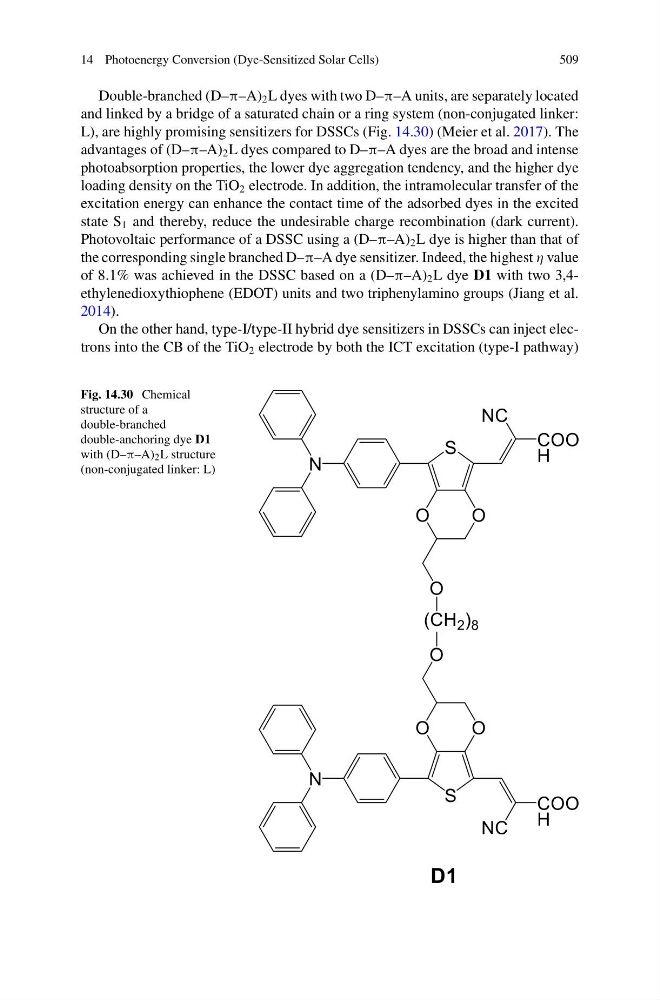
Double-branched (D–π–A) 2 L dyes with two D–π–A units, are separately located
and linked by a bridge of a saturated chain or a ring system (non-conjugated linker:
L), are highly promising sensitizers for DSSCs (Fig. 14.30) (Meier et al. 2017). The
advantages of (D–π–A) 2 L dyes compared to D–π–A dyes are the broad and intense
photoabsorption properties, the lower dye aggregation tendency, and the higher dye
loading density on the TiO 2 electrode. In addition, the intramolecular transfer of the
excitation energy can enhance the contact time of the adsorbed dyes in the excited
state S 1 and thereby, reduce the undesirable charge recombination (dark current).
Photovoltaic performance of a DSSC using a (D–π–A) 2 L dye is higher than that of
the corresponding single branched D–π–A dye sensitizer. Indeed, the highest η value
of 8.1% was achieved in the DSSC based on a (D–π–A) 2 L dye D1 with two 3,4ethylenedioxythiophene (EDOT) units and two triphenylamino groups (Jiang et al.
2014).
On the other hand, type-I/type-II hybrid dye sensitizers in DSSCs can inject electrons into the CB of the TiO 2 electrode by both the ICT excitation (type-I pathway)
Fig. 14.30 Chemical
structure of a
double-branched
double-anchoring dye D1
with (D–π–A) 2 L structure
(non-conjugated linker: L)
509
Double-branched (D–π–A) 2 L dyes with two D–π–A units, are separately located
and linked by a bridge of a saturated chain or a ring system (non-conjugated linker:
L), are highly promising sensitizers for DSSCs (Fig. 14.30) (Meier et al. 2017). The
advantages of (D–π–A) 2 L dyes compared to D–π–A dyes are the broad and intense
photoabsorption properties, the lower dye aggregation tendency, and the higher dye
loading density on the TiO 2 electrode. In addition, the intramolecular transfer of the
excitation energy can enhance the contact time of the adsorbed dyes in the excited
state S 1 and thereby, reduce the undesirable charge recombination (dark current).
Photovoltaic performance of a DSSC using a (D–π–A) 2 L dye is higher than that of
the corresponding single branched D–π–A dye sensitizer. Indeed, the highest η value
of 8.1% was achieved in the DSSC based on a (D–π–A) 2 L dye D1 with two 3,4ethylenedioxythiophene (EDOT) units and two triphenylamino groups (Jiang et al.
2014).
On the other hand, type-I/type-II hybrid dye sensitizers in DSSCs can inject electrons into the CB of the TiO 2 electrode by both the ICT excitation (type-I pathway)
Fig. 14.30 Chemical
structure of a
double-branched
double-anchoring dye D1
with (D–π–A) 2 L structure
(non-conjugated linker: L)