

510
Y. Ooyama
and the photoexcitation of the DTCT band (type-II pathway). Therefore, Ooyama
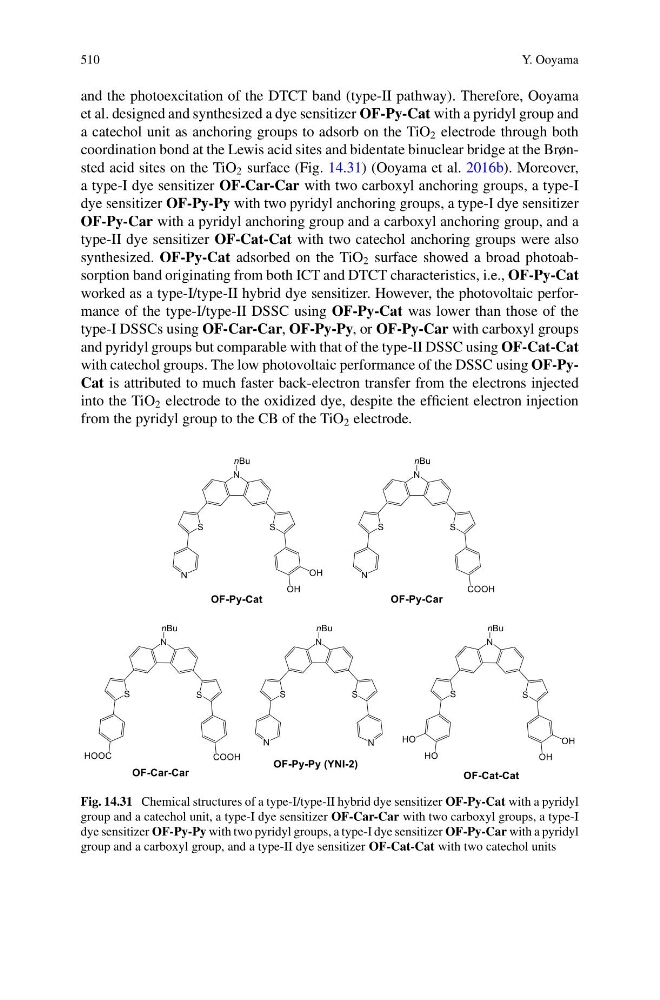
et al. designed and synthesized a dye sensitizer OF-Py-Cat with a pyridyl group and
a catechol unit as anchoring groups to adsorb on the TiO 2 electrode through both
coordination bond at the Lewis acid sites and bidentate binuclear bridge at the Brønsted acid sites on the TiO 2 surface (Fig. 14.31) (Ooyama et al. 2016b). Moreover,
a type-I dye sensitizer OF-Car-Car with two carboxyl anchoring groups, a type-I
dye sensitizer OF-Py-Py with two pyridyl anchoring groups, a type-I dye sensitizer
OF-Py-Car with a pyridyl anchoring group and a carboxyl anchoring group, and a
type-II dye sensitizer OF-Cat-Cat with two catechol anchoring groups were also
synthesized. OF-Py-Cat adsorbed on the TiO 2 surface showed a broad photoabsorption band originating from both ICT and DTCT characteristics, i.e., OF-Py-Cat
worked as a type-I/type-II hybrid dye sensitizer. However, the photovoltaic performance of the type-I/type-II DSSC using OF-Py-Cat was lower than those of the
type-I DSSCs using OF-Car-Car, OF-Py-Py, or OF-Py-Car with carboxyl groups
and pyridyl groups but comparable with that of the type-II DSSC using OF-Cat-Cat
with catechol groups. The low photovoltaic performance of the DSSC using OF-PyCat is attributed to much faster back-electron transfer from the electrons injected
into the TiO 2 electrode to the oxidized dye, despite the efficient electron injection
from the pyridyl group to the CB of the TiO 2 electrode.
Fig. 14.31 Chemical structures of a type-I/type-II hybrid dye sensitizer OF-Py-Cat with a pyridyl
group and a catechol unit, a type-I dye sensitizer OF-Car-Car with two carboxyl groups, a type-I
dye sensitizer OF-Py-Py with two pyridyl groups, a type-I dye sensitizer OF-Py-Car with a pyridyl
group and a carboxyl group, and a type-II dye sensitizer OF-Cat-Cat with two catechol units
Y. Ooyama
and the photoexcitation of the DTCT band (type-II pathway). Therefore, Ooyama
et al. designed and synthesized a dye sensitizer OF-Py-Cat with a pyridyl group and
a catechol unit as anchoring groups to adsorb on the TiO 2 electrode through both
coordination bond at the Lewis acid sites and bidentate binuclear bridge at the Brønsted acid sites on the TiO 2 surface (Fig. 14.31) (Ooyama et al. 2016b). Moreover,
a type-I dye sensitizer OF-Car-Car with two carboxyl anchoring groups, a type-I
dye sensitizer OF-Py-Py with two pyridyl anchoring groups, a type-I dye sensitizer
OF-Py-Car with a pyridyl anchoring group and a carboxyl anchoring group, and a
type-II dye sensitizer OF-Cat-Cat with two catechol anchoring groups were also
synthesized. OF-Py-Cat adsorbed on the TiO 2 surface showed a broad photoabsorption band originating from both ICT and DTCT characteristics, i.e., OF-Py-Cat
worked as a type-I/type-II hybrid dye sensitizer. However, the photovoltaic performance of the type-I/type-II DSSC using OF-Py-Cat was lower than those of the
type-I DSSCs using OF-Car-Car, OF-Py-Py, or OF-Py-Car with carboxyl groups
and pyridyl groups but comparable with that of the type-II DSSC using OF-Cat-Cat
with catechol groups. The low photovoltaic performance of the DSSC using OF-PyCat is attributed to much faster back-electron transfer from the electrons injected
into the TiO 2 electrode to the oxidized dye, despite the efficient electron injection
from the pyridyl group to the CB of the TiO 2 electrode.
Fig. 14.31 Chemical structures of a type-I/type-II hybrid dye sensitizer OF-Py-Cat with a pyridyl
group and a catechol unit, a type-I dye sensitizer OF-Car-Car with two carboxyl groups, a type-I
dye sensitizer OF-Py-Py with two pyridyl groups, a type-I dye sensitizer OF-Py-Car with a pyridyl
group and a carboxyl group, and a type-II dye sensitizer OF-Cat-Cat with two catechol units