

508
Y. Ooyama
14.2.20 Double-Branched Double-Anchoring Dyes
Many research groups have developed double-branched double-anchoring dye sensitizers based on D–(π–A) 2 structures with arylamine, carbazole, and phenoxazine
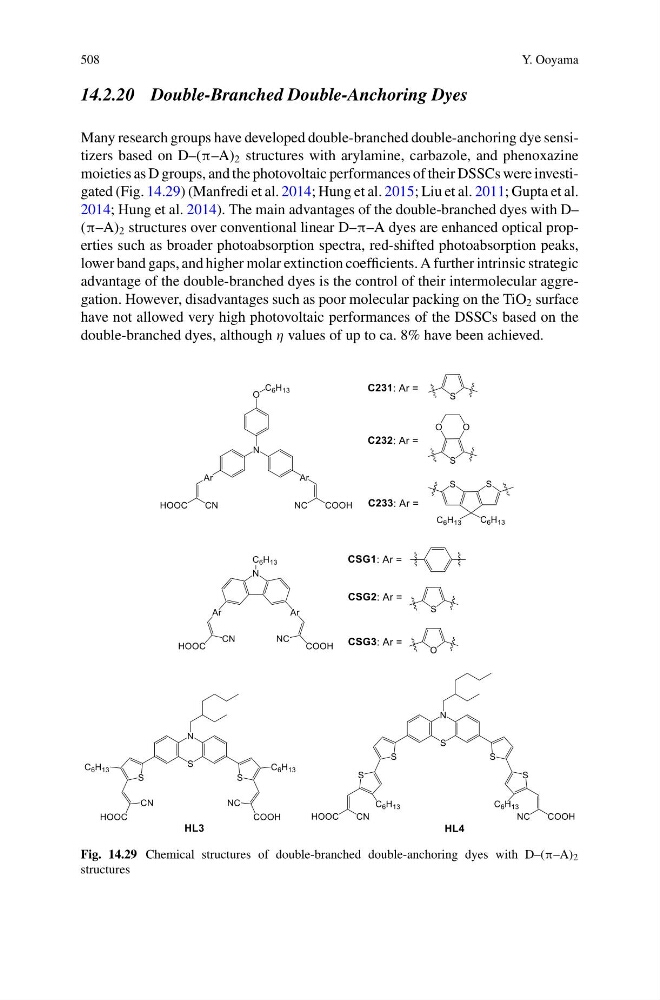
moieties as D groups, and the photovoltaic performances of their DSSCs were investigated (Fig. 14.29) (Manfredi et al. 2014; Hung et al. 2015; Liu et al. 2011; Gupta et al.
2014; Hung et al. 2014). The main advantages of the double-branched dyes with D–
(π–A) 2 structures over conventional linear D–π–A dyes are enhanced optical properties such as broader photoabsorption spectra, red-shifted photoabsorption peaks,
lower band gaps, and higher molar extinction coefficients. A further intrinsic strategic
advantage of the double-branched dyes is the control of their intermolecular aggregation. However, disadvantages such as poor molecular packing on the TiO 2 surface
have not allowed very high photovoltaic performances of the DSSCs based on the
double-branched dyes, although η values of up to ca. 8% have been achieved.
Fig. 14.29 Chemical structures of double-branched double-anchoring dyes with D–(π–A) 2
structures
Y. Ooyama
14.2.20 Double-Branched Double-Anchoring Dyes
Many research groups have developed double-branched double-anchoring dye sensitizers based on D–(π–A) 2 structures with arylamine, carbazole, and phenoxazine
moieties as D groups, and the photovoltaic performances of their DSSCs were investigated (Fig. 14.29) (Manfredi et al. 2014; Hung et al. 2015; Liu et al. 2011; Gupta et al.
2014; Hung et al. 2014). The main advantages of the double-branched dyes with D–
(π–A) 2 structures over conventional linear D–π–A dyes are enhanced optical properties such as broader photoabsorption spectra, red-shifted photoabsorption peaks,
lower band gaps, and higher molar extinction coefficients. A further intrinsic strategic
advantage of the double-branched dyes is the control of their intermolecular aggregation. However, disadvantages such as poor molecular packing on the TiO 2 surface
have not allowed very high photovoltaic performances of the DSSCs based on the
double-branched dyes, although η values of up to ca. 8% have been achieved.
Fig. 14.29 Chemical structures of double-branched double-anchoring dyes with D–(π–A) 2
structures