

14 Photoenergy Conversion (Dye-Sensitized Solar Cells)
483
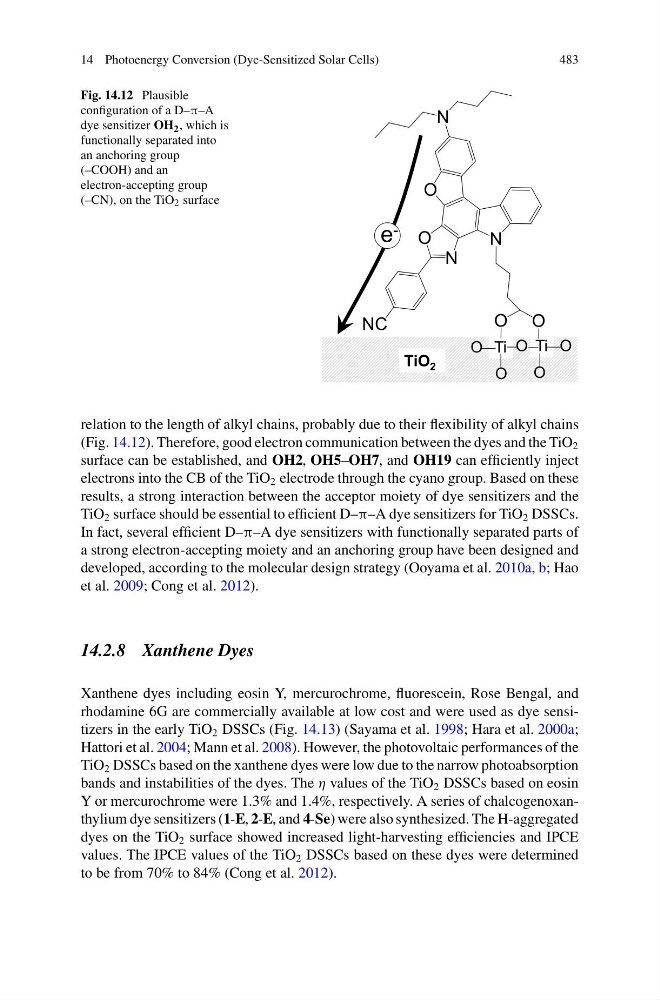
Fig. 14.12 Plausible
configuration of a D–π–A
dye sensitizer OH 2 , which is
functionally separated into
an anchoring group
(–COOH) and an
electron-accepting group
(–CN), on the TiO 2 surface
TiO 2
Ti
O
O
O Ti
O
O
e -
relation to the length of alkyl chains, probably due to their flexibility of alkyl chains
(Fig. 14.12). Therefore, good electron communication between the dyes and the TiO 2
surface can be established, and OH2, OH5–OH7, and OH19 can efficiently inject
electrons into the CB of the TiO 2 electrode through the cyano group. Based on these
results, a strong interaction between the acceptor moiety of dye sensitizers and the
TiO 2 surface should be essential to efficient D–π–A dye sensitizers for TiO 2 DSSCs.
In fact, several efficient D–π–A dye sensitizers with functionally separated parts of
a strong electron-accepting moiety and an anchoring group have been designed and
developed, according to the molecular design strategy (Ooyama et al. 2010a, b; Hao
et al. 2009; Cong et al. 2012).
14.2.8 Xanthene Dyes
Xanthene dyes including eosin Y, mercurochrome, fluorescein, Rose Bengal, and
rhodamine 6G are commercially available at low cost and were used as dye sensitizers in the early TiO 2 DSSCs (Fig. 14.13) (Sayama et al. 1998; Hara et al. 2000a;
Hattori et al. 2004; Mann et al. 2008). However, the photovoltaic performances of the
TiO 2 DSSCs based on the xanthene dyes were low due to the narrow photoabsorption
bands and instabilities of the dyes. The η values of the TiO 2 DSSCs based on eosin
Y or mercurochrome were 1.3% and 1.4%, respectively. A series of chalcogenoxanthylium dye sensitizers (1-E, 2-E, and 4-Se) were also synthesized. The H-aggregated
dyes on the TiO 2 surface showed increased light-harvesting efficiencies and IPCE
values. The IPCE values of the TiO 2 DSSCs based on these dyes were determined
to be from 70% to 84% (Cong et al. 2012).
483
Fig. 14.12 Plausible
configuration of a D–π–A
dye sensitizer OH 2 , which is
functionally separated into
an anchoring group
(–COOH) and an
electron-accepting group
(–CN), on the TiO 2 surface
TiO 2
Ti
O
O
O Ti
O
O
e -
relation to the length of alkyl chains, probably due to their flexibility of alkyl chains
(Fig. 14.12). Therefore, good electron communication between the dyes and the TiO 2
surface can be established, and OH2, OH5–OH7, and OH19 can efficiently inject
electrons into the CB of the TiO 2 electrode through the cyano group. Based on these
results, a strong interaction between the acceptor moiety of dye sensitizers and the
TiO 2 surface should be essential to efficient D–π–A dye sensitizers for TiO 2 DSSCs.
In fact, several efficient D–π–A dye sensitizers with functionally separated parts of
a strong electron-accepting moiety and an anchoring group have been designed and
developed, according to the molecular design strategy (Ooyama et al. 2010a, b; Hao
et al. 2009; Cong et al. 2012).
14.2.8 Xanthene Dyes
Xanthene dyes including eosin Y, mercurochrome, fluorescein, Rose Bengal, and
rhodamine 6G are commercially available at low cost and were used as dye sensitizers in the early TiO 2 DSSCs (Fig. 14.13) (Sayama et al. 1998; Hara et al. 2000a;
Hattori et al. 2004; Mann et al. 2008). However, the photovoltaic performances of the
TiO 2 DSSCs based on the xanthene dyes were low due to the narrow photoabsorption
bands and instabilities of the dyes. The η values of the TiO 2 DSSCs based on eosin
Y or mercurochrome were 1.3% and 1.4%, respectively. A series of chalcogenoxanthylium dye sensitizers (1-E, 2-E, and 4-Se) were also synthesized. The H-aggregated
dyes on the TiO 2 surface showed increased light-harvesting efficiencies and IPCE
values. The IPCE values of the TiO 2 DSSCs based on these dyes were determined
to be from 70% to 84% (Cong et al. 2012).