

482
Y. Ooyama
on D205 showed an η value of 9.5% with a J sc value of 18.6 mA cm
−2 , a V oc value
of 720 mV, and a ff value of 0.72. The IPCE value reached nearly 80% in the visible
region (Kuang et al. 2008; Ito et al. 2008).
14.2.7 Heteropolycyclic Dyes
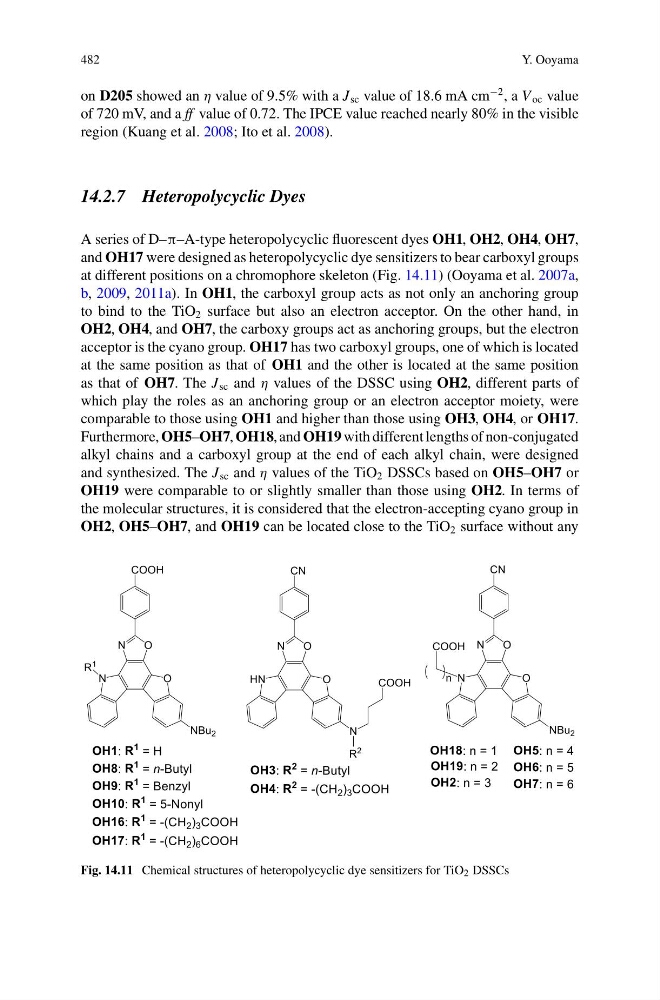
A series of D–π–A-type heteropolycyclic fluorescent dyes OH1, OH2, OH4, OH7,
and OH17 were designed as heteropolycyclic dye sensitizers to bear carboxyl groups
at different positions on a chromophore skeleton (Fig. 14.11) (Ooyama et al. 2007a,
b, 2009, 2011a). In OH1, the carboxyl group acts as not only an anchoring group
to bind to the TiO 2 surface but also an electron acceptor. On the other hand, in
OH2, OH4, and OH7, the carboxy groups act as anchoring groups, but the electron
acceptor is the cyano group. OH17 has two carboxyl groups, one of which is located
at the same position as that of OH1 and the other is located at the same position
as that of OH7. The J sc and η values of the DSSC using OH2, different parts of
which play the roles as an anchoring group or an electron acceptor moiety, were
comparable to those using OH1 and higher than those using OH3, OH4, or OH17.
Furthermore, OH5–OH7, OH18, and OH19 with different lengths of non-conjugated
alkyl chains and a carboxyl group at the end of each alkyl chain, were designed
and synthesized. The J sc and η values of the TiO 2 DSSCs based on OH5–OH7 or
OH19 were comparable to or slightly smaller than those using OH2. In terms of
the molecular structures, it is considered that the electron-accepting cyano group in
OH2, OH5–OH7, and OH19 can be located close to the TiO 2 surface without any
Fig. 14.11 Chemical structures of heteropolycyclic dye sensitizers for TiO 2 DSSCs
Y. Ooyama
on D205 showed an η value of 9.5% with a J sc value of 18.6 mA cm
−2 , a V oc value
of 720 mV, and a ff value of 0.72. The IPCE value reached nearly 80% in the visible
region (Kuang et al. 2008; Ito et al. 2008).
14.2.7 Heteropolycyclic Dyes
A series of D–π–A-type heteropolycyclic fluorescent dyes OH1, OH2, OH4, OH7,
and OH17 were designed as heteropolycyclic dye sensitizers to bear carboxyl groups
at different positions on a chromophore skeleton (Fig. 14.11) (Ooyama et al. 2007a,
b, 2009, 2011a). In OH1, the carboxyl group acts as not only an anchoring group
to bind to the TiO 2 surface but also an electron acceptor. On the other hand, in
OH2, OH4, and OH7, the carboxy groups act as anchoring groups, but the electron
acceptor is the cyano group. OH17 has two carboxyl groups, one of which is located
at the same position as that of OH1 and the other is located at the same position
as that of OH7. The J sc and η values of the DSSC using OH2, different parts of
which play the roles as an anchoring group or an electron acceptor moiety, were
comparable to those using OH1 and higher than those using OH3, OH4, or OH17.
Furthermore, OH5–OH7, OH18, and OH19 with different lengths of non-conjugated
alkyl chains and a carboxyl group at the end of each alkyl chain, were designed
and synthesized. The J sc and η values of the TiO 2 DSSCs based on OH5–OH7 or
OH19 were comparable to or slightly smaller than those using OH2. In terms of
the molecular structures, it is considered that the electron-accepting cyano group in
OH2, OH5–OH7, and OH19 can be located close to the TiO 2 surface without any
Fig. 14.11 Chemical structures of heteropolycyclic dye sensitizers for TiO 2 DSSCs