

14 Photoenergy Conversion (Dye-Sensitized Solar Cells)
481
value of 74% were achieved in the TiO 2 DSSC based on HC-1 under AM 1.5 simulated sunlight. HC2–HC5 showed the η values of 3.5%, 4.4%, 3.1%, 2.0%, and
2.6%, respectively (Chen et al. 2005a).
14.2.6 Indoline Dyes
Indoline dye sensitizers are also one of the most promising candidates as organic
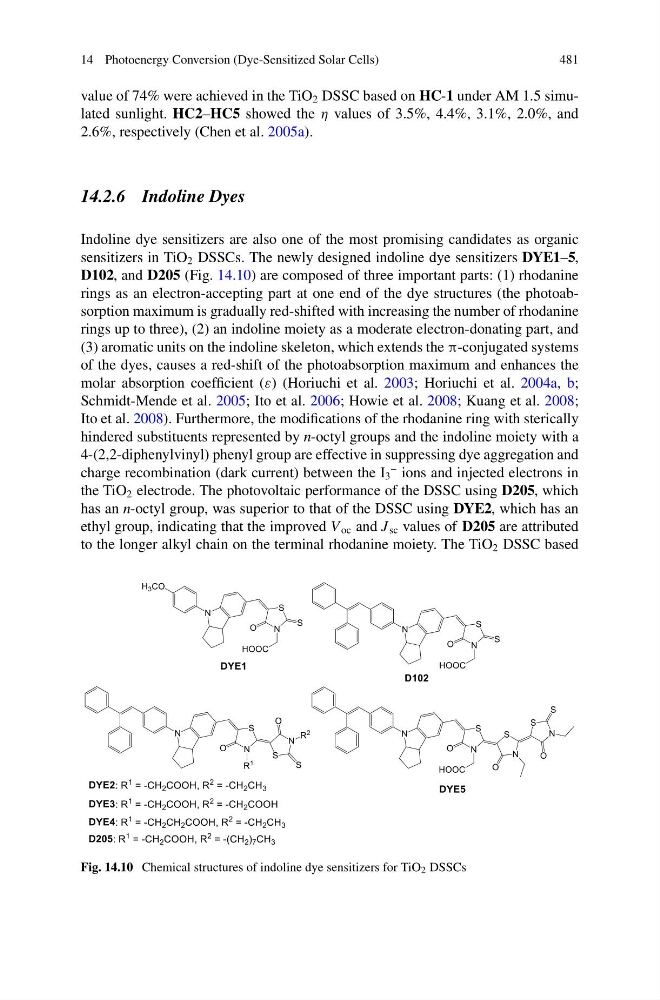
sensitizers in TiO 2 DSSCs. The newly designed indoline dye sensitizers DYE1–5,
D102, and D205 (Fig. 14.10) are composed of three important parts: (1) rhodanine
rings as an electron-accepting part at one end of the dye structures (the photoabsorption maximum is gradually red-shifted with increasing the number of rhodanine
rings up to three), (2) an indoline moiety as a moderate electron-donating part, and
(3) aromatic units on the indoline skeleton, which extends the π-conjugated systems
of the dyes, causes a red-shift of the photoabsorption maximum and enhances the
molar absorption coefficient (ε) (Horiuchi et al. 2003; Horiuchi et al. 2004a, b;
Schmidt-Mende et al. 2005; Ito et al. 2006; Howie et al. 2008; Kuang et al. 2008;
Ito et al. 2008). Furthermore, the modifications of the rhodanine ring with sterically
hindered substituents represented by n-octyl groups and the indoline moiety with a
4-(2,2-diphenylvinyl) phenyl group are effective in suppressing dye aggregation and
charge recombination (dark current) between the I 3
– ions and injected electrons in
the TiO 2 electrode. The photovoltaic performance of the DSSC using D205, which
has an n-octyl group, was superior to that of the DSSC using DYE2, which has an
ethyl group, indicating that the improved V oc and J sc values of D205 are attributed
to the longer alkyl chain on the terminal rhodanine moiety. The TiO 2 DSSC based
Fig. 14.10 Chemical structures of indoline dye sensitizers for TiO 2 DSSCs
481
value of 74% were achieved in the TiO 2 DSSC based on HC-1 under AM 1.5 simulated sunlight. HC2–HC5 showed the η values of 3.5%, 4.4%, 3.1%, 2.0%, and
2.6%, respectively (Chen et al. 2005a).
14.2.6 Indoline Dyes
Indoline dye sensitizers are also one of the most promising candidates as organic
sensitizers in TiO 2 DSSCs. The newly designed indoline dye sensitizers DYE1–5,
D102, and D205 (Fig. 14.10) are composed of three important parts: (1) rhodanine
rings as an electron-accepting part at one end of the dye structures (the photoabsorption maximum is gradually red-shifted with increasing the number of rhodanine
rings up to three), (2) an indoline moiety as a moderate electron-donating part, and
(3) aromatic units on the indoline skeleton, which extends the π-conjugated systems
of the dyes, causes a red-shift of the photoabsorption maximum and enhances the
molar absorption coefficient (ε) (Horiuchi et al. 2003; Horiuchi et al. 2004a, b;
Schmidt-Mende et al. 2005; Ito et al. 2006; Howie et al. 2008; Kuang et al. 2008;
Ito et al. 2008). Furthermore, the modifications of the rhodanine ring with sterically
hindered substituents represented by n-octyl groups and the indoline moiety with a
4-(2,2-diphenylvinyl) phenyl group are effective in suppressing dye aggregation and
charge recombination (dark current) between the I 3
– ions and injected electrons in
the TiO 2 electrode. The photovoltaic performance of the DSSC using D205, which
has an n-octyl group, was superior to that of the DSSC using DYE2, which has an
ethyl group, indicating that the improved V oc and J sc values of D205 are attributed
to the longer alkyl chain on the terminal rhodanine moiety. The TiO 2 DSSC based
Fig. 14.10 Chemical structures of indoline dye sensitizers for TiO 2 DSSCs