

484
Y. Ooyama
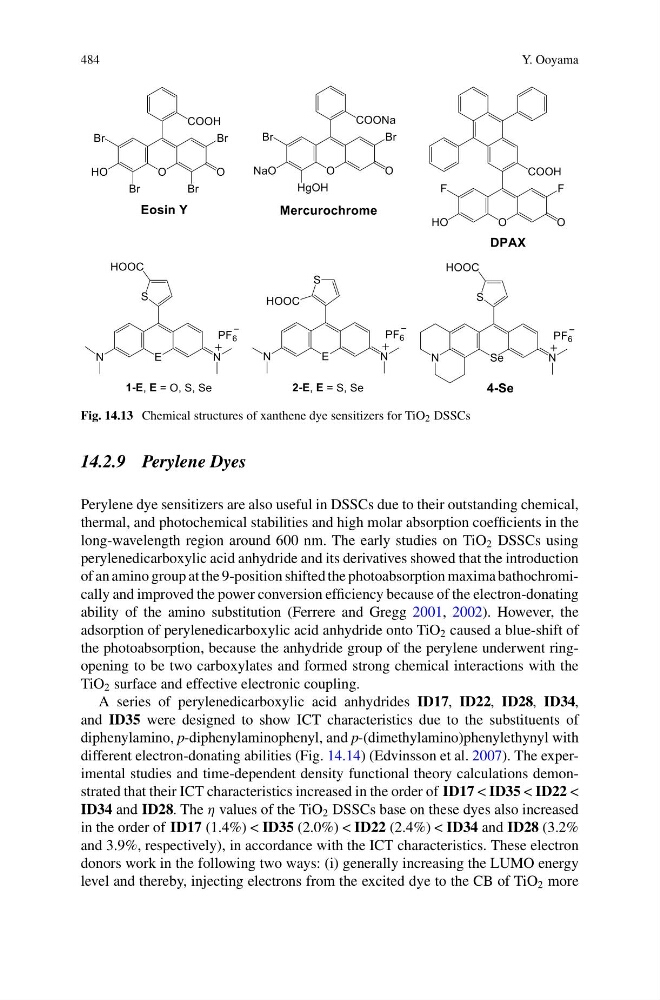
Fig. 14.13 Chemical structures of xanthene dye sensitizers for TiO 2 DSSCs
14.2.9 Perylene Dyes
Perylene dye sensitizers are also useful in DSSCs due to their outstanding chemical,
thermal, and photochemical stabilities and high molar absorption coefficients in the
long-wavelength region around 600 nm. The early studies on TiO 2 DSSCs using
perylenedicarboxylic acid anhydride and its derivatives showed that the introduction
of an amino group at the 9-position shifted the photoabsorption maxima bathochromically and improved the power conversion efficiency because of the electron-donating
ability of the amino substitution (Ferrere and Gregg 2001, 2002). However, the
adsorption of perylenedicarboxylic acid anhydride onto TiO 2 caused a blue-shift of
the photoabsorption, because the anhydride group of the perylene underwent ringopening to be two carboxylates and formed strong chemical interactions with the
TiO 2 surface and effective electronic coupling.
A series of perylenedicarboxylic acid anhydrides ID17, ID22, ID28, ID34,
and ID35 were designed to show ICT characteristics due to the substituents of
diphenylamino, p-diphenylaminophenyl, and p-(dimethylamino)phenylethynyl with
different electron-donating abilities (Fig. 14.14) (Edvinsson et al. 2007). The experimental studies and time-dependent density functional theory calculations demonstrated that their ICT characteristics increased in the order of ID17 < ID35 < ID22 <
ID34 and ID28. The η values of the TiO 2 DSSCs base on these dyes also increased
in the order of ID17 (1.4%) < ID35 (2.0%) < ID22 (2.4%) < ID34 and ID28 (3.2%
and 3.9%, respectively), in accordance with the ICT characteristics. These electron
donors work in the following two ways: (i) generally increasing the LUMO energy
level and thereby, injecting electrons from the excited dye to the CB of TiO 2 more
Y. Ooyama
Fig. 14.13 Chemical structures of xanthene dye sensitizers for TiO 2 DSSCs
14.2.9 Perylene Dyes
Perylene dye sensitizers are also useful in DSSCs due to their outstanding chemical,
thermal, and photochemical stabilities and high molar absorption coefficients in the
long-wavelength region around 600 nm. The early studies on TiO 2 DSSCs using
perylenedicarboxylic acid anhydride and its derivatives showed that the introduction
of an amino group at the 9-position shifted the photoabsorption maxima bathochromically and improved the power conversion efficiency because of the electron-donating
ability of the amino substitution (Ferrere and Gregg 2001, 2002). However, the
adsorption of perylenedicarboxylic acid anhydride onto TiO 2 caused a blue-shift of
the photoabsorption, because the anhydride group of the perylene underwent ringopening to be two carboxylates and formed strong chemical interactions with the
TiO 2 surface and effective electronic coupling.
A series of perylenedicarboxylic acid anhydrides ID17, ID22, ID28, ID34,
and ID35 were designed to show ICT characteristics due to the substituents of
diphenylamino, p-diphenylaminophenyl, and p-(dimethylamino)phenylethynyl with
different electron-donating abilities (Fig. 14.14) (Edvinsson et al. 2007). The experimental studies and time-dependent density functional theory calculations demonstrated that their ICT characteristics increased in the order of ID17 < ID35 < ID22 <
ID34 and ID28. The η values of the TiO 2 DSSCs base on these dyes also increased
in the order of ID17 (1.4%) < ID35 (2.0%) < ID22 (2.4%) < ID34 and ID28 (3.2%
and 3.9%, respectively), in accordance with the ICT characteristics. These electron
donors work in the following two ways: (i) generally increasing the LUMO energy
level and thereby, injecting electrons from the excited dye to the CB of TiO 2 more