

42
T. Maeda
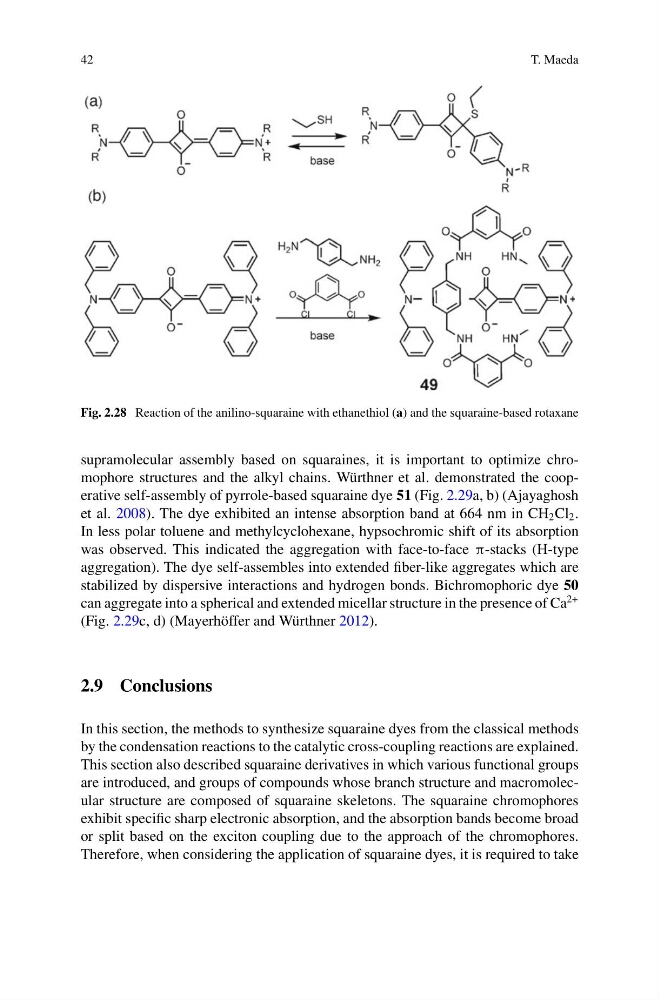
Fig. 2.28 Reaction of the anilino-squaraine with ethanethiol (a) and the squaraine-based rotaxane
supramolecular assembly based on squaraines, it is important to optimize chromophore structures and the alkyl chains. Würthner et al. demonstrated the cooperative self-assembly of pyrrole-based squaraine dye 51 (Fig. 2.29a, b) (Ajayaghosh
et al. 2008). The dye exhibited an intense absorption band at 664 nm in CH 2 Cl 2 .
In less polar toluene and methylcyclohexane, hypsochromic shift of its absorption
was observed. This indicated the aggregation with face-to-face π-stacks (H-type
aggregation). The dye self-assembles into extended fiber-like aggregates which are
stabilized by dispersive interactions and hydrogen bonds. Bichromophoric dye 50
can aggregate into a spherical and extended micellar structure in the presence of Ca
2+
(Fig. 2.29c, d) (Mayerhöffer and Würthner 2012).
2.9 Conclusions
In this section, the methods to synthesize squaraine dyes from the classical methods
by the condensation reactions to the catalytic cross-coupling reactions are explained.
This section also described squaraine derivatives in which various functional groups
are introduced, and groups of compounds whose branch structure and macromolecular structure are composed of squaraine skeletons. The squaraine chromophores
exhibit specific sharp electronic absorption, and the absorption bands become broad
or split based on the exciton coupling due to the approach of the chromophores.
Therefore, when considering the application of squaraine dyes, it is required to take
T. Maeda
Fig. 2.28 Reaction of the anilino-squaraine with ethanethiol (a) and the squaraine-based rotaxane
supramolecular assembly based on squaraines, it is important to optimize chromophore structures and the alkyl chains. Würthner et al. demonstrated the cooperative self-assembly of pyrrole-based squaraine dye 51 (Fig. 2.29a, b) (Ajayaghosh
et al. 2008). The dye exhibited an intense absorption band at 664 nm in CH 2 Cl 2 .
In less polar toluene and methylcyclohexane, hypsochromic shift of its absorption
was observed. This indicated the aggregation with face-to-face π-stacks (H-type
aggregation). The dye self-assembles into extended fiber-like aggregates which are
stabilized by dispersive interactions and hydrogen bonds. Bichromophoric dye 50
can aggregate into a spherical and extended micellar structure in the presence of Ca
2+
(Fig. 2.29c, d) (Mayerhöffer and Würthner 2012).
2.9 Conclusions
In this section, the methods to synthesize squaraine dyes from the classical methods
by the condensation reactions to the catalytic cross-coupling reactions are explained.
This section also described squaraine derivatives in which various functional groups
are introduced, and groups of compounds whose branch structure and macromolecular structure are composed of squaraine skeletons. The squaraine chromophores
exhibit specific sharp electronic absorption, and the absorption bands become broad
or split based on the exciton coupling due to the approach of the chromophores.
Therefore, when considering the application of squaraine dyes, it is required to take