

2 Squaraine Dyes
43
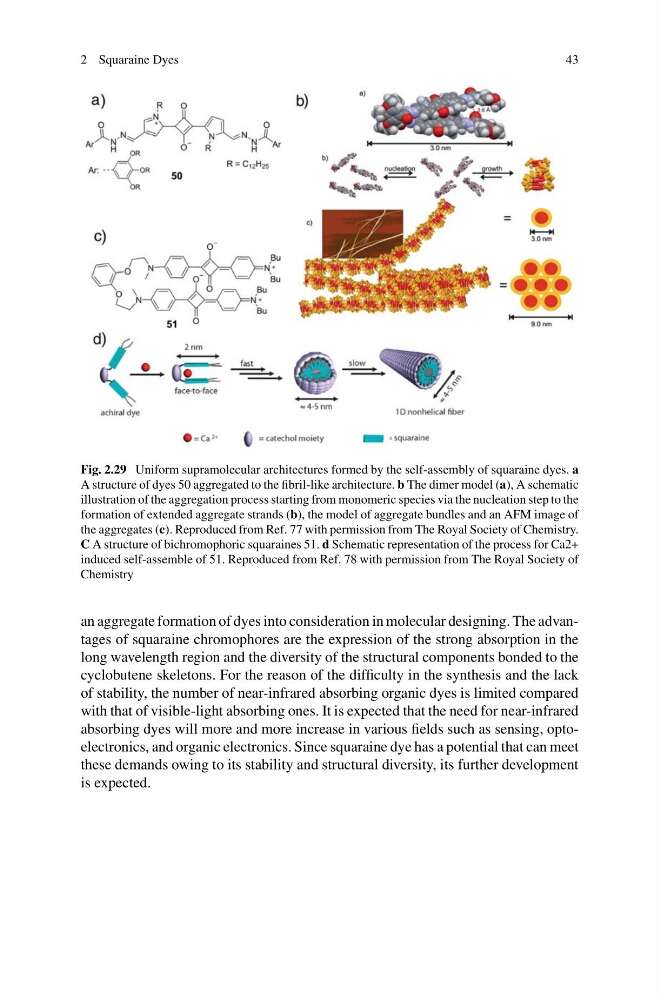
Fig. 2.29 Uniform supramolecular architectures formed by the self-assembly of squaraine dyes. a
A structure of dyes 50 aggregated to the fibril-like architecture. b The dimer model (a), A schematic
illustration of the aggregation process starting from monomeric species via the nucleation step to the
formation of extended aggregate strands (b), the model of aggregate bundles and an AFM image of
the aggregates (c). Reproduced from Ref. 77 with permission from The Royal Society of Chemistry.
C A structure of bichromophoric squaraines 51. d Schematic representation of the process for Ca2+
induced self-assemble of 51. Reproduced from Ref. 78 with permission from The Royal Society of
Chemistry
an aggregate formation of dyes into consideration in molecular designing. The advantages of squaraine chromophores are the expression of the strong absorption in the
long wavelength region and the diversity of the structural components bonded to the
cyclobutene skeletons. For the reason of the difficulty in the synthesis and the lack
of stability, the number of near-infrared absorbing organic dyes is limited compared
with that of visible-light absorbing ones. It is expected that the need for near-infrared
absorbing dyes will more and more increase in various fields such as sensing, optoelectronics, and organic electronics. Since squaraine dye has a potential that can meet
these demands owing to its stability and structural diversity, its further development
is expected.
43
Fig. 2.29 Uniform supramolecular architectures formed by the self-assembly of squaraine dyes. a
A structure of dyes 50 aggregated to the fibril-like architecture. b The dimer model (a), A schematic
illustration of the aggregation process starting from monomeric species via the nucleation step to the
formation of extended aggregate strands (b), the model of aggregate bundles and an AFM image of
the aggregates (c). Reproduced from Ref. 77 with permission from The Royal Society of Chemistry.
C A structure of bichromophoric squaraines 51. d Schematic representation of the process for Ca2+
induced self-assemble of 51. Reproduced from Ref. 78 with permission from The Royal Society of
Chemistry
an aggregate formation of dyes into consideration in molecular designing. The advantages of squaraine chromophores are the expression of the strong absorption in the
long wavelength region and the diversity of the structural components bonded to the
cyclobutene skeletons. For the reason of the difficulty in the synthesis and the lack
of stability, the number of near-infrared absorbing organic dyes is limited compared
with that of visible-light absorbing ones. It is expected that the need for near-infrared
absorbing dyes will more and more increase in various fields such as sensing, optoelectronics, and organic electronics. Since squaraine dye has a potential that can meet
these demands owing to its stability and structural diversity, its further development
is expected.