

478
Y. Ooyama
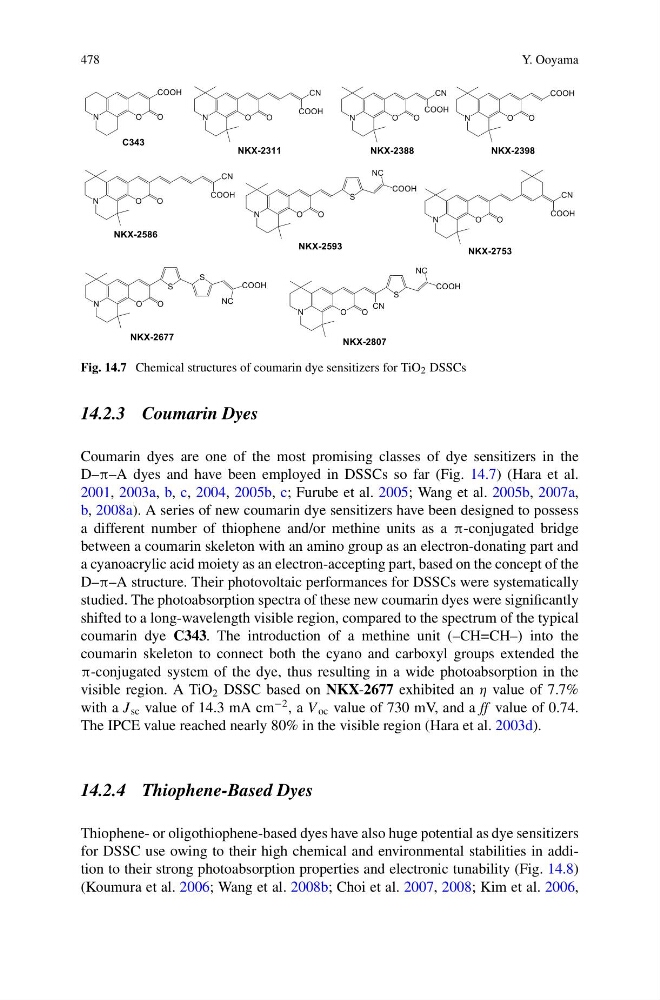
Fig. 14.7 Chemical structures of coumarin dye sensitizers for TiO 2 DSSCs
14.2.3 Coumarin Dyes
Coumarin dyes are one of the most promising classes of dye sensitizers in the
D–π–A dyes and have been employed in DSSCs so far (Fig. 14.7) (Hara et al.
2001, 2003a, b, c, 2004, 2005b, c; Furube et al. 2005; Wang et al. 2005b, 2007a,
b, 2008a). A series of new coumarin dye sensitizers have been designed to possess
a different number of thiophene and/or methine units as a π-conjugated bridge
between a coumarin skeleton with an amino group as an electron-donating part and
a cyanoacrylic acid moiety as an electron-accepting part, based on the concept of the
D–π–A structure. Their photovoltaic performances for DSSCs were systematically
studied. The photoabsorption spectra of these new coumarin dyes were significantly
shifted to a long-wavelength visible region, compared to the spectrum of the typical
coumarin dye C343. The introduction of a methine unit (–CH=CH–) into the
coumarin skeleton to connect both the cyano and carboxyl groups extended the
π-conjugated system of the dye, thus resulting in a wide photoabsorption in the
visible region. A TiO 2 DSSC based on NKX-2677 exhibited an η value of 7.7%
with a J sc value of 14.3 mA cm
−2 , a V oc value of 730 mV, and a ff value of 0.74.
The IPCE value reached nearly 80% in the visible region (Hara et al. 2003d).
14.2.4 Thiophene-Based Dyes
Thiophene- or oligothiophene-based dyes have also huge potential as dye sensitizers
for DSSC use owing to their high chemical and environmental stabilities in addition to their strong photoabsorption properties and electronic tunability (Fig. 14.8)
(Koumura et al. 2006; Wang et al. 2008b; Choi et al. 2007, 2008; Kim et al. 2006,
Y. Ooyama
Fig. 14.7 Chemical structures of coumarin dye sensitizers for TiO 2 DSSCs
14.2.3 Coumarin Dyes
Coumarin dyes are one of the most promising classes of dye sensitizers in the
D–π–A dyes and have been employed in DSSCs so far (Fig. 14.7) (Hara et al.
2001, 2003a, b, c, 2004, 2005b, c; Furube et al. 2005; Wang et al. 2005b, 2007a,
b, 2008a). A series of new coumarin dye sensitizers have been designed to possess
a different number of thiophene and/or methine units as a π-conjugated bridge
between a coumarin skeleton with an amino group as an electron-donating part and
a cyanoacrylic acid moiety as an electron-accepting part, based on the concept of the
D–π–A structure. Their photovoltaic performances for DSSCs were systematically
studied. The photoabsorption spectra of these new coumarin dyes were significantly
shifted to a long-wavelength visible region, compared to the spectrum of the typical
coumarin dye C343. The introduction of a methine unit (–CH=CH–) into the
coumarin skeleton to connect both the cyano and carboxyl groups extended the
π-conjugated system of the dye, thus resulting in a wide photoabsorption in the
visible region. A TiO 2 DSSC based on NKX-2677 exhibited an η value of 7.7%
with a J sc value of 14.3 mA cm
−2 , a V oc value of 730 mV, and a ff value of 0.74.
The IPCE value reached nearly 80% in the visible region (Hara et al. 2003d).
14.2.4 Thiophene-Based Dyes
Thiophene- or oligothiophene-based dyes have also huge potential as dye sensitizers
for DSSC use owing to their high chemical and environmental stabilities in addition to their strong photoabsorption properties and electronic tunability (Fig. 14.8)
(Koumura et al. 2006; Wang et al. 2008b; Choi et al. 2007, 2008; Kim et al. 2006,