

14 Photoenergy Conversion (Dye-Sensitized Solar Cells)
479
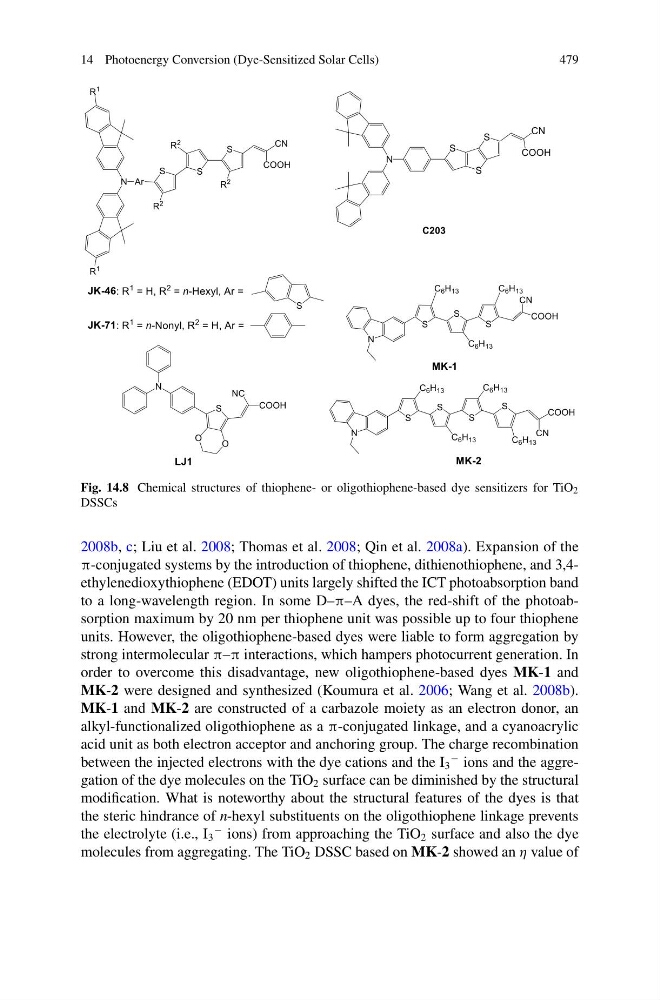
Fig. 14.8 Chemical structures of thiophene- or oligothiophene-based dye sensitizers for TiO 2
DSSCs
2008b, c; Liu et al. 2008; Thomas et al. 2008; Qin et al. 2008a). Expansion of the
π-conjugated systems by the introduction of thiophene, dithienothiophene, and 3,4ethylenedioxythiophene (EDOT) units largely shifted the ICT photoabsorption band
to a long-wavelength region. In some D–π–A dyes, the red-shift of the photoabsorption maximum by 20 nm per thiophene unit was possible up to four thiophene
units. However, the oligothiophene-based dyes were liable to form aggregation by
strong intermolecular π–π interactions, which hampers photocurrent generation. In
order to overcome this disadvantage, new oligothiophene-based dyes MK-1 and
MK-2 were designed and synthesized (Koumura et al. 2006; Wang et al. 2008b).
MK-1 and MK-2 are constructed of a carbazole moiety as an electron donor, an
alkyl-functionalized oligothiophene as a π-conjugated linkage, and a cyanoacrylic
acid unit as both electron acceptor and anchoring group. The charge recombination
between the injected electrons with the dye cations and the I 3
− ions and the aggregation of the dye molecules on the TiO 2 surface can be diminished by the structural
modification. What is noteworthy about the structural features of the dyes is that
the steric hindrance of n-hexyl substituents on the oligothiophene linkage prevents
the electrolyte (i.e., I 3
− ions) from approaching the TiO 2 surface and also the dye
molecules from aggregating. The TiO 2 DSSC based on MK-2 showed an η value of
479
Fig. 14.8 Chemical structures of thiophene- or oligothiophene-based dye sensitizers for TiO 2
DSSCs
2008b, c; Liu et al. 2008; Thomas et al. 2008; Qin et al. 2008a). Expansion of the
π-conjugated systems by the introduction of thiophene, dithienothiophene, and 3,4ethylenedioxythiophene (EDOT) units largely shifted the ICT photoabsorption band
to a long-wavelength region. In some D–π–A dyes, the red-shift of the photoabsorption maximum by 20 nm per thiophene unit was possible up to four thiophene
units. However, the oligothiophene-based dyes were liable to form aggregation by
strong intermolecular π–π interactions, which hampers photocurrent generation. In
order to overcome this disadvantage, new oligothiophene-based dyes MK-1 and
MK-2 were designed and synthesized (Koumura et al. 2006; Wang et al. 2008b).
MK-1 and MK-2 are constructed of a carbazole moiety as an electron donor, an
alkyl-functionalized oligothiophene as a π-conjugated linkage, and a cyanoacrylic
acid unit as both electron acceptor and anchoring group. The charge recombination
between the injected electrons with the dye cations and the I 3
− ions and the aggregation of the dye molecules on the TiO 2 surface can be diminished by the structural
modification. What is noteworthy about the structural features of the dyes is that
the steric hindrance of n-hexyl substituents on the oligothiophene linkage prevents
the electrolyte (i.e., I 3
− ions) from approaching the TiO 2 surface and also the dye
molecules from aggregating. The TiO 2 DSSC based on MK-2 showed an η value of