

14 Photoenergy Conversion (Dye-Sensitized Solar Cells)
477
14.2.2 Polyene Dyes
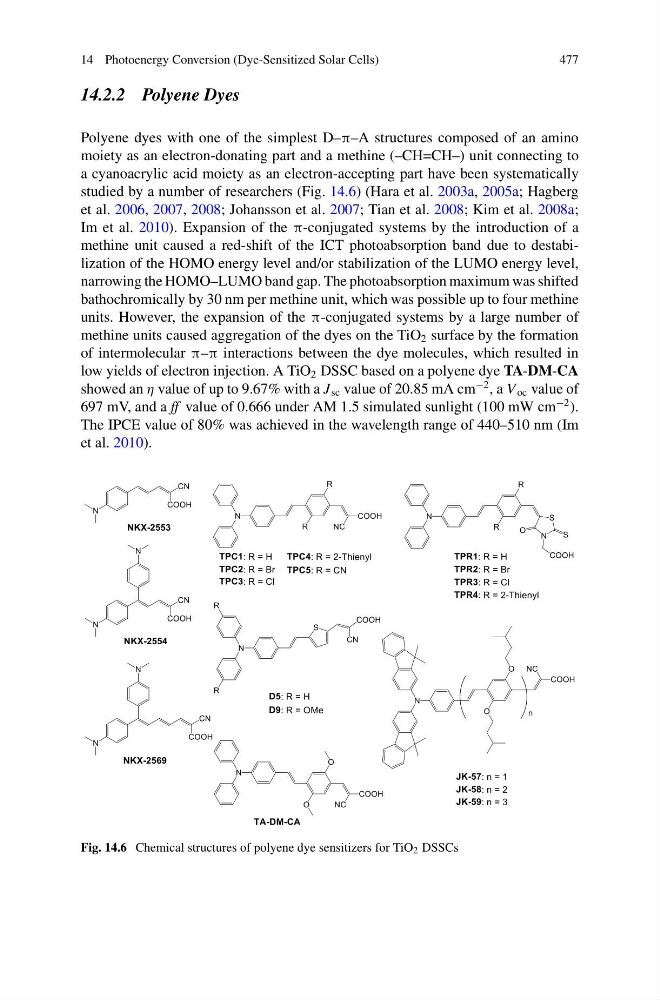
Polyene dyes with one of the simplest D–π–A structures composed of an amino
moiety as an electron-donating part and a methine (–CH=CH–) unit connecting to
a cyanoacrylic acid moiety as an electron-accepting part have been systematically
studied by a number of researchers (Fig. 14.6) (Hara et al. 2003a, 2005a; Hagberg
et al. 2006, 2007, 2008; Johansson et al. 2007; Tian et al. 2008; Kim et al. 2008a;
Im et al. 2010). Expansion of the π-conjugated systems by the introduction of a
methine unit caused a red-shift of the ICT photoabsorption band due to destabilization of the HOMO energy level and/or stabilization of the LUMO energy level,
narrowing the HOMO–LUMO band gap. The photoabsorption maximum was shifted
bathochromically by 30 nm per methine unit, which was possible up to four methine
units. However, the expansion of the π-conjugated systems by a large number of
methine units caused aggregation of the dyes on the TiO 2 surface by the formation
of intermolecular π–π interactions between the dye molecules, which resulted in
low yields of electron injection. A TiO 2 DSSC based on a polyene dye TA-DM-CA
showed an η value of up to 9.67% with a J sc value of 20.85 mA cm
−2 , a V oc value of
697 mV, and a ff value of 0.666 under AM 1.5 simulated sunlight (100 mW cm
−2 ).
The IPCE value of 80% was achieved in the wavelength range of 440–510 nm (Im
et al. 2010).
Fig. 14.6 Chemical structures of polyene dye sensitizers for TiO 2 DSSCs
477
14.2.2 Polyene Dyes
Polyene dyes with one of the simplest D–π–A structures composed of an amino
moiety as an electron-donating part and a methine (–CH=CH–) unit connecting to
a cyanoacrylic acid moiety as an electron-accepting part have been systematically
studied by a number of researchers (Fig. 14.6) (Hara et al. 2003a, 2005a; Hagberg
et al. 2006, 2007, 2008; Johansson et al. 2007; Tian et al. 2008; Kim et al. 2008a;
Im et al. 2010). Expansion of the π-conjugated systems by the introduction of a
methine unit caused a red-shift of the ICT photoabsorption band due to destabilization of the HOMO energy level and/or stabilization of the LUMO energy level,
narrowing the HOMO–LUMO band gap. The photoabsorption maximum was shifted
bathochromically by 30 nm per methine unit, which was possible up to four methine
units. However, the expansion of the π-conjugated systems by a large number of
methine units caused aggregation of the dyes on the TiO 2 surface by the formation
of intermolecular π–π interactions between the dye molecules, which resulted in
low yields of electron injection. A TiO 2 DSSC based on a polyene dye TA-DM-CA
showed an η value of up to 9.67% with a J sc value of 20.85 mA cm
−2 , a V oc value of
697 mV, and a ff value of 0.666 under AM 1.5 simulated sunlight (100 mW cm
−2 ).
The IPCE value of 80% was achieved in the wavelength range of 440–510 nm (Im
et al. 2010).
Fig. 14.6 Chemical structures of polyene dye sensitizers for TiO 2 DSSCs