

476
Y. Ooyama
14.2.1 Ruthenium(II) Polypyridyl Complex Dyes
Photovoltaic performances of DSSCs with ruthenium(II) polypyridyl complex dyes
have been investigated intensively since the first paper on high solar cell performances
of DSSCs based on a Ru complex dye was reported in 1991 (O’Regan and Grätzel
1991; Hagfeldt et al. 2010; Nazeeruddin et al. 1993, 1997, 1999, 2001, 2003; Pashaei
et al. 2016). In general, Ru complex dye photosensitizers are composed of a Ru(II)
ion and ancillary ligands with at least one anchoring group. The photoabsorption
properties of Ru complex dyes are closely associated with metal-to-ligand charge
transfer (MLCT) excitation, which causes efficient electron transfer to the CB of the
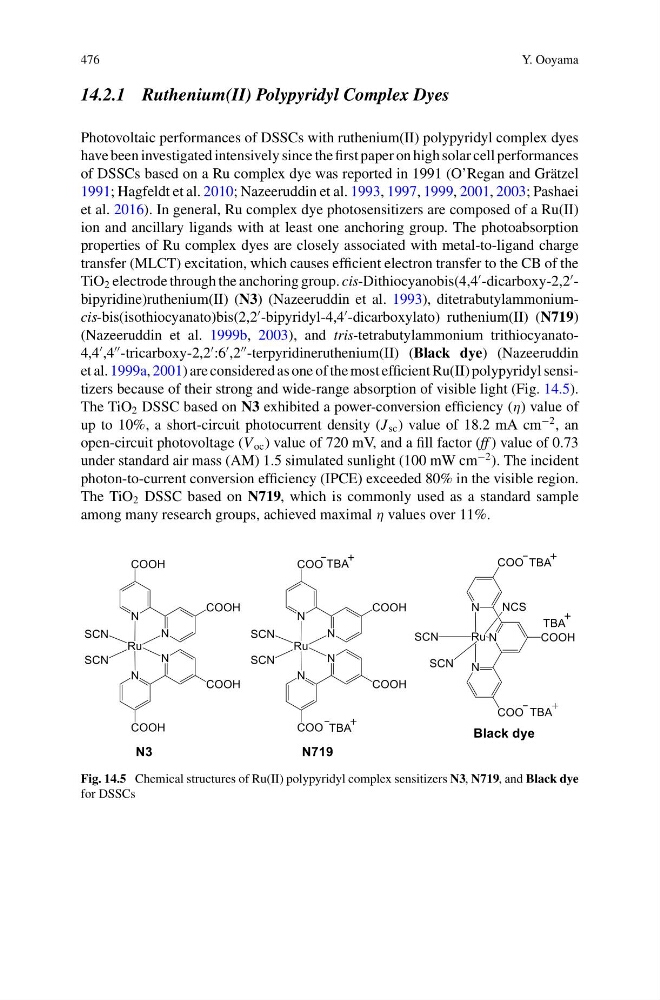
TiO 2 electrode through the anchoring group. cis-Dithiocyanobis(4,4
-dicarboxy-2,2
-
bipyridine)ruthenium(II) (N3) (Nazeeruddin et al. 1993), ditetrabutylammoniumcis-bis(isothiocyanato)bis(2,2
-bipyridyl-4,4
-dicarboxylato) ruthenium(II) (N719)
(Nazeeruddin et al. 1999b, 2003), and tris-tetrabutylammonium trithiocyanato4,4
,4
-tricarboxy-2,2
:6
,2
-terpyridineruthenium(II) (Black dye) (Nazeeruddin
et al. 1999a, 2001) are considered as one of the most efficient Ru(II) polypyridyl sensitizers because of their strong and wide-range absorption of visible light (Fig. 14.5).
The TiO 2 DSSC based on N3 exhibited a power-conversion efficiency (η) value of
up to 10%, a short-circuit photocurrent density (J sc ) value of 18.2 mA cm
−2 , an
open-circuit photovoltage (V oc ) value of 720 mV, and a fill factor (ff ) value of 0.73
under standard air mass (AM) 1.5 simulated sunlight (100 mW cm
−2 ). The incident
photon-to-current conversion efficiency (IPCE) exceeded 80% in the visible region.
The TiO 2 DSSC based on N719, which is commonly used as a standard sample
among many research groups, achieved maximal η values over 11%.
Fig. 14.5 Chemical structures of Ru(II) polypyridyl complex sensitizers N3, N719, and Black dye
for DSSCs
Y. Ooyama
14.2.1 Ruthenium(II) Polypyridyl Complex Dyes
Photovoltaic performances of DSSCs with ruthenium(II) polypyridyl complex dyes
have been investigated intensively since the first paper on high solar cell performances
of DSSCs based on a Ru complex dye was reported in 1991 (O’Regan and Grätzel
1991; Hagfeldt et al. 2010; Nazeeruddin et al. 1993, 1997, 1999, 2001, 2003; Pashaei
et al. 2016). In general, Ru complex dye photosensitizers are composed of a Ru(II)
ion and ancillary ligands with at least one anchoring group. The photoabsorption
properties of Ru complex dyes are closely associated with metal-to-ligand charge
transfer (MLCT) excitation, which causes efficient electron transfer to the CB of the
TiO 2 electrode through the anchoring group. cis-Dithiocyanobis(4,4
-dicarboxy-2,2
-
bipyridine)ruthenium(II) (N3) (Nazeeruddin et al. 1993), ditetrabutylammoniumcis-bis(isothiocyanato)bis(2,2
-bipyridyl-4,4
-dicarboxylato) ruthenium(II) (N719)
(Nazeeruddin et al. 1999b, 2003), and tris-tetrabutylammonium trithiocyanato4,4
,4
-tricarboxy-2,2
:6
,2
-terpyridineruthenium(II) (Black dye) (Nazeeruddin
et al. 1999a, 2001) are considered as one of the most efficient Ru(II) polypyridyl sensitizers because of their strong and wide-range absorption of visible light (Fig. 14.5).
The TiO 2 DSSC based on N3 exhibited a power-conversion efficiency (η) value of
up to 10%, a short-circuit photocurrent density (J sc ) value of 18.2 mA cm
−2 , an
open-circuit photovoltage (V oc ) value of 720 mV, and a fill factor (ff ) value of 0.73
under standard air mass (AM) 1.5 simulated sunlight (100 mW cm
−2 ). The incident
photon-to-current conversion efficiency (IPCE) exceeded 80% in the visible region.
The TiO 2 DSSC based on N719, which is commonly used as a standard sample
among many research groups, achieved maximal η values over 11%.
Fig. 14.5 Chemical structures of Ru(II) polypyridyl complex sensitizers N3, N719, and Black dye
for DSSCs