

14 Photoenergy Conversion (Dye-Sensitized Solar Cells)
475
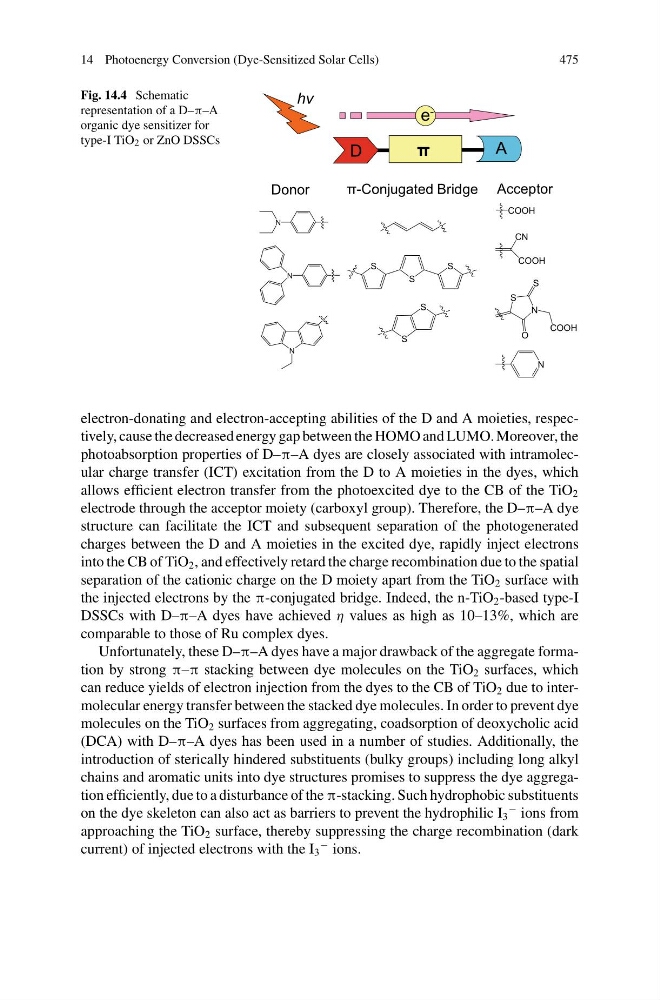
Fig. 14.4 Schematic
representation of a D–π–A
organic dye sensitizer for
type-I TiO 2 or ZnO DSSCs
CN
COOH
COOH
N
S
O
COOH
S
N
N
N
N
S
S
S
S
S
hv
e -
π-Conjugated Bridge
Donor
Acceptor
D
π
A
electron-donating and electron-accepting abilities of the D and A moieties, respectively, cause the decreased energy gap between the HOMO and LUMO. Moreover, the
photoabsorption properties of D–π–A dyes are closely associated with intramolecular charge transfer (ICT) excitation from the D to A moieties in the dyes, which
allows efficient electron transfer from the photoexcited dye to the CB of the TiO 2
electrode through the acceptor moiety (carboxyl group). Therefore, the D–π–A dye
structure can facilitate the ICT and subsequent separation of the photogenerated
charges between the D and A moieties in the excited dye, rapidly inject electrons
into the CB of TiO 2 , and effectively retard the charge recombination due to the spatial
separation of the cationic charge on the D moiety apart from the TiO 2 surface with
the injected electrons by the π-conjugated bridge. Indeed, the n-TiO 2 -based type-I
DSSCs with D–π–A dyes have achieved η values as high as 10–13%, which are
comparable to those of Ru complex dyes.
Unfortunately, these D–π–A dyes have a major drawback of the aggregate formation by strong π–π stacking between dye molecules on the TiO 2 surfaces, which
can reduce yields of electron injection from the dyes to the CB of TiO 2 due to intermolecular energy transfer between the stacked dye molecules. In order to prevent dye
molecules on the TiO 2 surfaces from aggregating, coadsorption of deoxycholic acid
(DCA) with D–π–A dyes has been used in a number of studies. Additionally, the
introduction of sterically hindered substituents (bulky groups) including long alkyl
chains and aromatic units into dye structures promises to suppress the dye aggregation efficiently, due to a disturbance of the π-stacking. Such hydrophobic substituents
on the dye skeleton can also act as barriers to prevent the hydrophilic I 3
− ions from
approaching the TiO 2 surface, thereby suppressing the charge recombination (dark
current) of injected electrons with the I 3
− ions.
475
Fig. 14.4 Schematic
representation of a D–π–A
organic dye sensitizer for
type-I TiO 2 or ZnO DSSCs
CN
COOH
COOH
N
S
O
COOH
S
N
N
N
N
S
S
S
S
S
hv
e -
π-Conjugated Bridge
Donor
Acceptor
D
π
A
electron-donating and electron-accepting abilities of the D and A moieties, respectively, cause the decreased energy gap between the HOMO and LUMO. Moreover, the
photoabsorption properties of D–π–A dyes are closely associated with intramolecular charge transfer (ICT) excitation from the D to A moieties in the dyes, which
allows efficient electron transfer from the photoexcited dye to the CB of the TiO 2
electrode through the acceptor moiety (carboxyl group). Therefore, the D–π–A dye
structure can facilitate the ICT and subsequent separation of the photogenerated
charges between the D and A moieties in the excited dye, rapidly inject electrons
into the CB of TiO 2 , and effectively retard the charge recombination due to the spatial
separation of the cationic charge on the D moiety apart from the TiO 2 surface with
the injected electrons by the π-conjugated bridge. Indeed, the n-TiO 2 -based type-I
DSSCs with D–π–A dyes have achieved η values as high as 10–13%, which are
comparable to those of Ru complex dyes.
Unfortunately, these D–π–A dyes have a major drawback of the aggregate formation by strong π–π stacking between dye molecules on the TiO 2 surfaces, which
can reduce yields of electron injection from the dyes to the CB of TiO 2 due to intermolecular energy transfer between the stacked dye molecules. In order to prevent dye
molecules on the TiO 2 surfaces from aggregating, coadsorption of deoxycholic acid
(DCA) with D–π–A dyes has been used in a number of studies. Additionally, the
introduction of sterically hindered substituents (bulky groups) including long alkyl
chains and aromatic units into dye structures promises to suppress the dye aggregation efficiently, due to a disturbance of the π-stacking. Such hydrophobic substituents
on the dye skeleton can also act as barriers to prevent the hydrophilic I 3
− ions from
approaching the TiO 2 surface, thereby suppressing the charge recombination (dark
current) of injected electrons with the I 3
− ions.