

474
Y. Ooyama
(a)
(b)
(c)
(d)
(e)
(f)
(g)
Ti
O
O
O
Ti
O
O
O
Ti
O
O
O
Ti
O
O
O
Ti
O
O
Ti
O
O
O
Ti
O
O
O
Ti
O
O
C
C
O
O
O
C
O
O
O
O
O
N
N
O
O
Ti
O
O
O
OH
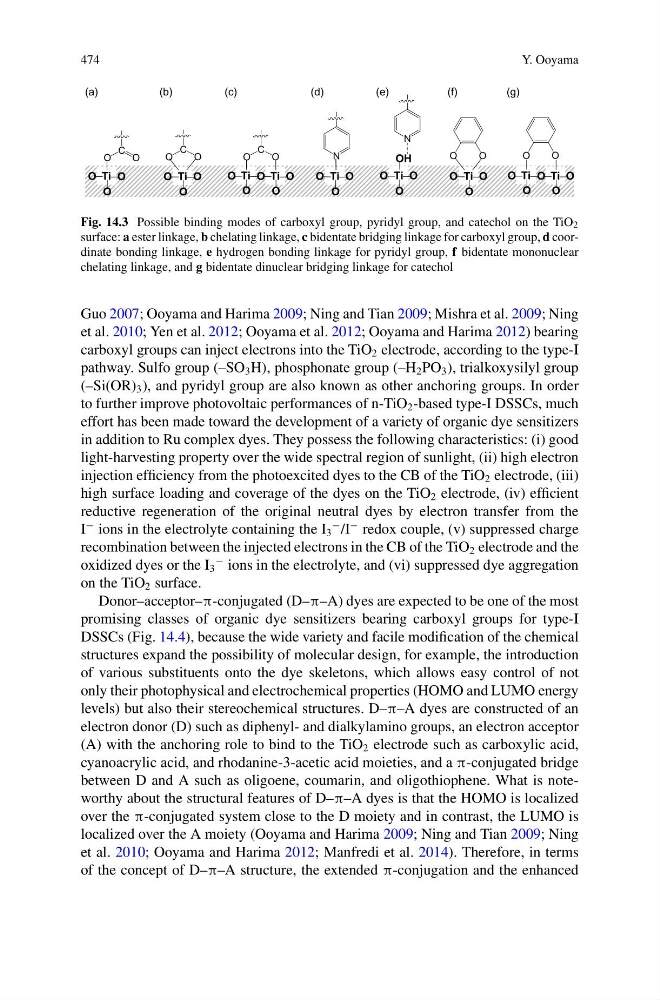
Fig. 14.3 Possible binding modes of carboxyl group, pyridyl group, and catechol on the TiO 2
surface: a ester linkage, b chelating linkage, c bidentate bridging linkage for carboxyl group, d coordinate bonding linkage, e hydrogen bonding linkage for pyridyl group, f bidentate mononuclear
chelating linkage, and g bidentate dinuclear bridging linkage for catechol
Guo 2007; Ooyama and Harima 2009; Ning and Tian 2009; Mishra et al. 2009; Ning
et al. 2010; Yen et al. 2012; Ooyama et al. 2012; Ooyama and Harima 2012) bearing
carboxyl groups can inject electrons into the TiO 2 electrode, according to the type-I
pathway. Sulfo group (–SO 3 H), phosphonate group (–H 2 PO 3 ), trialkoxysilyl group
(–Si(OR) 3 ), and pyridyl group are also known as other anchoring groups. In order
to further improve photovoltaic performances of n-TiO 2 -based type-I DSSCs, much
effort has been made toward the development of a variety of organic dye sensitizers
in addition to Ru complex dyes. They possess the following characteristics: (i) good
light-harvesting property over the wide spectral region of sunlight, (ii) high electron
injection efficiency from the photoexcited dyes to the CB of the TiO 2 electrode, (iii)
high surface loading and coverage of the dyes on the TiO 2 electrode, (iv) efficient
reductive regeneration of the original neutral dyes by electron transfer from the
I
− ions in the electrolyte containing the I 3
− /I
− redox couple, (v) suppressed charge
recombination between the injected electrons in the CB of the TiO 2 electrode and the
oxidized dyes or the I 3
− ions in the electrolyte, and (vi) suppressed dye aggregation
on the TiO 2 surface.
Donor–acceptor–π-conjugated (D–π–A) dyes are expected to be one of the most
promising classes of organic dye sensitizers bearing carboxyl groups for type-I
DSSCs (Fig. 14.4), because the wide variety and facile modification of the chemical
structures expand the possibility of molecular design, for example, the introduction
of various substituents onto the dye skeletons, which allows easy control of not
only their photophysical and electrochemical properties (HOMO and LUMO energy
levels) but also their stereochemical structures. D–π–A dyes are constructed of an
electron donor (D) such as diphenyl- and dialkylamino groups, an electron acceptor
(A) with the anchoring role to bind to the TiO 2 electrode such as carboxylic acid,
cyanoacrylic acid, and rhodanine-3-acetic acid moieties, and a π-conjugated bridge
between D and A such as oligoene, coumarin, and oligothiophene. What is noteworthy about the structural features of D–π–A dyes is that the HOMO is localized
over the π-conjugated system close to the D moiety and in contrast, the LUMO is
localized over the A moiety (Ooyama and Harima 2009; Ning and Tian 2009; Ning
et al. 2010; Ooyama and Harima 2012; Manfredi et al. 2014). Therefore, in terms
of the concept of D–π–A structure, the extended π-conjugation and the enhanced
Y. Ooyama
(a)
(b)
(c)
(d)
(e)
(f)
(g)
Ti
O
O
O
Ti
O
O
O
Ti
O
O
O
Ti
O
O
O
Ti
O
O
Ti
O
O
O
Ti
O
O
O
Ti
O
O
C
C
O
O
O
C
O
O
O
O
O
N
N
O
O
Ti
O
O
O
OH
Fig. 14.3 Possible binding modes of carboxyl group, pyridyl group, and catechol on the TiO 2
surface: a ester linkage, b chelating linkage, c bidentate bridging linkage for carboxyl group, d coordinate bonding linkage, e hydrogen bonding linkage for pyridyl group, f bidentate mononuclear
chelating linkage, and g bidentate dinuclear bridging linkage for catechol
Guo 2007; Ooyama and Harima 2009; Ning and Tian 2009; Mishra et al. 2009; Ning
et al. 2010; Yen et al. 2012; Ooyama et al. 2012; Ooyama and Harima 2012) bearing
carboxyl groups can inject electrons into the TiO 2 electrode, according to the type-I
pathway. Sulfo group (–SO 3 H), phosphonate group (–H 2 PO 3 ), trialkoxysilyl group
(–Si(OR) 3 ), and pyridyl group are also known as other anchoring groups. In order
to further improve photovoltaic performances of n-TiO 2 -based type-I DSSCs, much
effort has been made toward the development of a variety of organic dye sensitizers
in addition to Ru complex dyes. They possess the following characteristics: (i) good
light-harvesting property over the wide spectral region of sunlight, (ii) high electron
injection efficiency from the photoexcited dyes to the CB of the TiO 2 electrode, (iii)
high surface loading and coverage of the dyes on the TiO 2 electrode, (iv) efficient
reductive regeneration of the original neutral dyes by electron transfer from the
I
− ions in the electrolyte containing the I 3
− /I
− redox couple, (v) suppressed charge
recombination between the injected electrons in the CB of the TiO 2 electrode and the
oxidized dyes or the I 3
− ions in the electrolyte, and (vi) suppressed dye aggregation
on the TiO 2 surface.
Donor–acceptor–π-conjugated (D–π–A) dyes are expected to be one of the most
promising classes of organic dye sensitizers bearing carboxyl groups for type-I
DSSCs (Fig. 14.4), because the wide variety and facile modification of the chemical
structures expand the possibility of molecular design, for example, the introduction
of various substituents onto the dye skeletons, which allows easy control of not
only their photophysical and electrochemical properties (HOMO and LUMO energy
levels) but also their stereochemical structures. D–π–A dyes are constructed of an
electron donor (D) such as diphenyl- and dialkylamino groups, an electron acceptor
(A) with the anchoring role to bind to the TiO 2 electrode such as carboxylic acid,
cyanoacrylic acid, and rhodanine-3-acetic acid moieties, and a π-conjugated bridge
between D and A such as oligoene, coumarin, and oligothiophene. What is noteworthy about the structural features of D–π–A dyes is that the HOMO is localized
over the π-conjugated system close to the D moiety and in contrast, the LUMO is
localized over the A moiety (Ooyama and Harima 2009; Ning and Tian 2009; Ning
et al. 2010; Ooyama and Harima 2012; Manfredi et al. 2014). Therefore, in terms
of the concept of D–π–A structure, the extended π-conjugation and the enhanced