

13 Photodynamic Therapy
453
c
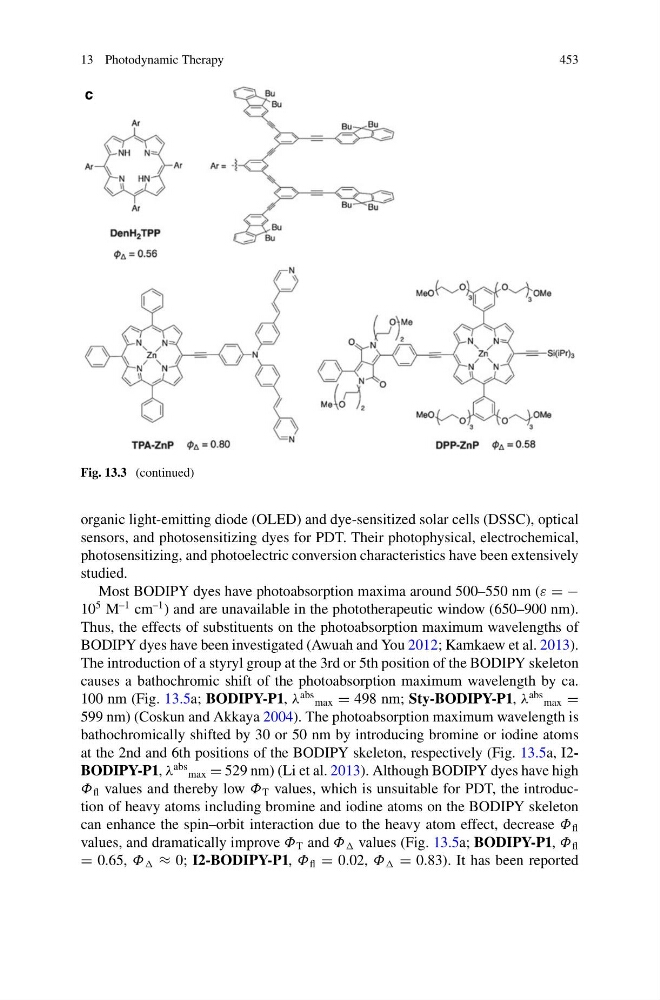
Fig. 13.3 (continued)
organic light-emitting diode (OLED) and dye-sensitized solar cells (DSSC), optical
sensors, and photosensitizing dyes for PDT. Their photophysical, electrochemical,
photosensitizing, and photoelectric conversion characteristics have been extensively
studied.
Most BODIPY dyes have photoabsorption maxima around 500–550 nm (ε = −
10
5 M
–1 cm
–1 ) and are unavailable in the phototherapeutic window (650–900 nm).
Thus, the effects of substituents on the photoabsorption maximum wavelengths of
BODIPY dyes have been investigated (Awuah and You 2012; Kamkaew et al. 2013).
The introduction of a styryl group at the 3rd or 5th position of the BODIPY skeleton
causes a bathochromic shift of the photoabsorption maximum wavelength by ca.
100 nm (Fig. 13.5a; BODIPY-P1, λ
abs
max = 498 nm; Sty-BODIPY-P1, λ
abs
max =
599 nm) (Coskun and Akkaya 2004). The photoabsorption maximum wavelength is
bathochromically shifted by 30 or 50 nm by introducing bromine or iodine atoms
at the 2nd and 6th positions of the BODIPY skeleton, respectively (Fig. 13.5a, I2BODIPY-P1, λ
abs
max = 529 nm) (Li et al. 2013). Although BODIPY dyes have high
Φ fl values and thereby low Φ T values, which is unsuitable for PDT, the introduction of heavy atoms including bromine and iodine atoms on the BODIPY skeleton
can enhance the spin–orbit interaction due to the heavy atom effect, decrease Φ fl
values, and dramatically improve Φ T and Φ values (Fig. 13.5a; BODIPY-P1, Φ fl
= 0.65, Φ ≈ 0; I2-BODIPY-P1, Φ fl = 0.02, Φ = 0.83). It has been reported
453
c
Fig. 13.3 (continued)
organic light-emitting diode (OLED) and dye-sensitized solar cells (DSSC), optical
sensors, and photosensitizing dyes for PDT. Their photophysical, electrochemical,
photosensitizing, and photoelectric conversion characteristics have been extensively
studied.
Most BODIPY dyes have photoabsorption maxima around 500–550 nm (ε = −
10
5 M
–1 cm
–1 ) and are unavailable in the phototherapeutic window (650–900 nm).
Thus, the effects of substituents on the photoabsorption maximum wavelengths of
BODIPY dyes have been investigated (Awuah and You 2012; Kamkaew et al. 2013).
The introduction of a styryl group at the 3rd or 5th position of the BODIPY skeleton
causes a bathochromic shift of the photoabsorption maximum wavelength by ca.
100 nm (Fig. 13.5a; BODIPY-P1, λ
abs
max = 498 nm; Sty-BODIPY-P1, λ
abs
max =
599 nm) (Coskun and Akkaya 2004). The photoabsorption maximum wavelength is
bathochromically shifted by 30 or 50 nm by introducing bromine or iodine atoms
at the 2nd and 6th positions of the BODIPY skeleton, respectively (Fig. 13.5a, I2BODIPY-P1, λ
abs
max = 529 nm) (Li et al. 2013). Although BODIPY dyes have high
Φ fl values and thereby low Φ T values, which is unsuitable for PDT, the introduction of heavy atoms including bromine and iodine atoms on the BODIPY skeleton
can enhance the spin–orbit interaction due to the heavy atom effect, decrease Φ fl
values, and dramatically improve Φ T and Φ values (Fig. 13.5a; BODIPY-P1, Φ fl
= 0.65, Φ ≈ 0; I2-BODIPY-P1, Φ fl = 0.02, Φ = 0.83). It has been reported