

454
K. Imato and Y. Ooyama
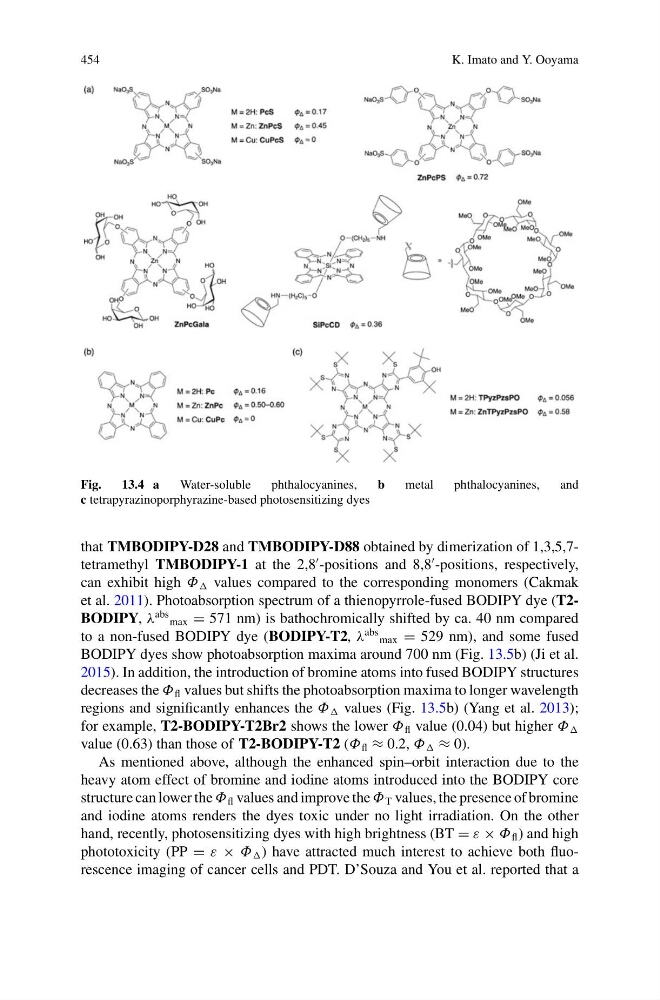
Fig.
13.4 a
Water-soluble
phthalocyanines,
b
metal
phthalocyanines,
and
c tetrapyrazinoporphyrazine-based photosensitizing dyes
that TMBODIPY-D28 and TMBODIPY-D88 obtained by dimerization of 1,3,5,7tetramethyl TMBODIPY-1 at the 2,8
-positions and 8,8
-positions, respectively,
can exhibit high Φ values compared to the corresponding monomers (Cakmak
et al. 2011). Photoabsorption spectrum of a thienopyrrole-fused BODIPY dye (T2BODIPY, λ
abs
max = 571 nm) is bathochromically shifted by ca. 40 nm compared
to a non-fused BODIPY dye (BODIPY-T2, λ
abs
max = 529 nm), and some fused
BODIPY dyes show photoabsorption maxima around 700 nm (Fig. 13.5b) (Ji et al.
2015). In addition, the introduction of bromine atoms into fused BODIPY structures
decreases the Φ fl values but shifts the photoabsorption maxima to longer wavelength
regions and significantly enhances the Φ values (Fig. 13.5b) (Yang et al. 2013);
for example, T2-BODIPY-T2Br2 shows the lower Φ fl value (0.04) but higher Φ
value (0.63) than those of T2-BODIPY-T2 (Φ fl ≈ 0.2, Φ ≈ 0).
As mentioned above, although the enhanced spin–orbit interaction due to the
heavy atom effect of bromine and iodine atoms introduced into the BODIPY core
structure can lower the Φ fl values and improve the Φ T values, the presence of bromine
and iodine atoms renders the dyes toxic under no light irradiation. On the other
hand, recently, photosensitizing dyes with high brightness (BT = ε × Φ fl ) and high
phototoxicity (PP = ε × Φ ) have attracted much interest to achieve both fluorescence imaging of cancer cells and PDT. D’Souza and You et al. reported that a
K. Imato and Y. Ooyama
Fig.
13.4 a
Water-soluble
phthalocyanines,
b
metal
phthalocyanines,
and
c tetrapyrazinoporphyrazine-based photosensitizing dyes
that TMBODIPY-D28 and TMBODIPY-D88 obtained by dimerization of 1,3,5,7tetramethyl TMBODIPY-1 at the 2,8
-positions and 8,8
-positions, respectively,
can exhibit high Φ values compared to the corresponding monomers (Cakmak
et al. 2011). Photoabsorption spectrum of a thienopyrrole-fused BODIPY dye (T2BODIPY, λ
abs
max = 571 nm) is bathochromically shifted by ca. 40 nm compared
to a non-fused BODIPY dye (BODIPY-T2, λ
abs
max = 529 nm), and some fused
BODIPY dyes show photoabsorption maxima around 700 nm (Fig. 13.5b) (Ji et al.
2015). In addition, the introduction of bromine atoms into fused BODIPY structures
decreases the Φ fl values but shifts the photoabsorption maxima to longer wavelength
regions and significantly enhances the Φ values (Fig. 13.5b) (Yang et al. 2013);
for example, T2-BODIPY-T2Br2 shows the lower Φ fl value (0.04) but higher Φ
value (0.63) than those of T2-BODIPY-T2 (Φ fl ≈ 0.2, Φ ≈ 0).
As mentioned above, although the enhanced spin–orbit interaction due to the
heavy atom effect of bromine and iodine atoms introduced into the BODIPY core
structure can lower the Φ fl values and improve the Φ T values, the presence of bromine
and iodine atoms renders the dyes toxic under no light irradiation. On the other
hand, recently, photosensitizing dyes with high brightness (BT = ε × Φ fl ) and high
phototoxicity (PP = ε × Φ ) have attracted much interest to achieve both fluorescence imaging of cancer cells and PDT. D’Souza and You et al. reported that a