

452
K. Imato and Y. Ooyama
b
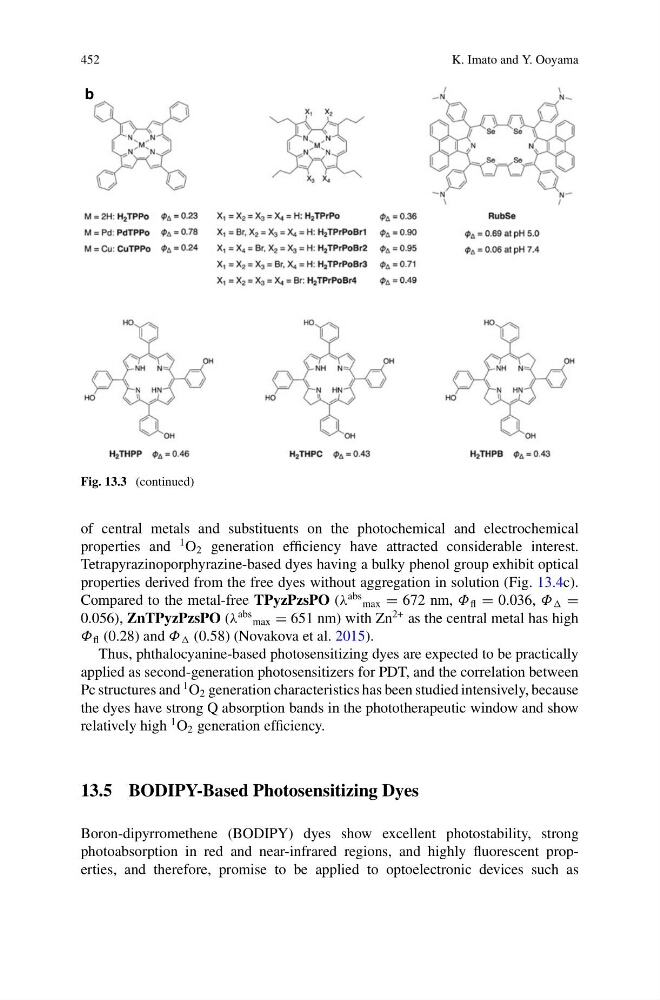
Fig. 13.3 (continued)
of central metals and substituents on the photochemical and electrochemical
properties and
1 O 2 generation efficiency have attracted considerable interest.
Tetrapyrazinoporphyrazine-based dyes having a bulky phenol group exhibit optical
properties derived from the free dyes without aggregation in solution (Fig. 13.4c).
Compared to the metal-free TPyzPzsPO (λ
abs
max = 672 nm, Φ fl = 0.036, Φ =
0.056), ZnTPyzPzsPO (λ
abs
max = 651 nm) with Zn
2+ as the central metal has high
Φ fl (0.28) and Φ (0.58) (Novakova et al. 2015).
Thus, phthalocyanine-based photosensitizing dyes are expected to be practically
applied as second-generation photosensitizers for PDT, and the correlation between
Pc structures and
1 O 2 generation characteristics has been studied intensively, because
the dyes have strong Q absorption bands in the phototherapeutic window and show
relatively high
1 O 2 generation efficiency.
13.5 BODIPY-Based Photosensitizing Dyes
Boron-dipyrromethene (BODIPY) dyes show excellent photostability, strong
photoabsorption in red and near-infrared regions, and highly fluorescent properties, and therefore, promise to be applied to optoelectronic devices such as
K. Imato and Y. Ooyama
b
Fig. 13.3 (continued)
of central metals and substituents on the photochemical and electrochemical
properties and
1 O 2 generation efficiency have attracted considerable interest.
Tetrapyrazinoporphyrazine-based dyes having a bulky phenol group exhibit optical
properties derived from the free dyes without aggregation in solution (Fig. 13.4c).
Compared to the metal-free TPyzPzsPO (λ
abs
max = 672 nm, Φ fl = 0.036, Φ =
0.056), ZnTPyzPzsPO (λ
abs
max = 651 nm) with Zn
2+ as the central metal has high
Φ fl (0.28) and Φ (0.58) (Novakova et al. 2015).
Thus, phthalocyanine-based photosensitizing dyes are expected to be practically
applied as second-generation photosensitizers for PDT, and the correlation between
Pc structures and
1 O 2 generation characteristics has been studied intensively, because
the dyes have strong Q absorption bands in the phototherapeutic window and show
relatively high
1 O 2 generation efficiency.
13.5 BODIPY-Based Photosensitizing Dyes
Boron-dipyrromethene (BODIPY) dyes show excellent photostability, strong
photoabsorption in red and near-infrared regions, and highly fluorescent properties, and therefore, promise to be applied to optoelectronic devices such as