

13 Photodynamic Therapy
451
substituents such as glucose, galactose, and cyclodextrin into the phthalocyanine
skeleton (Fig. 13.4a) (DeRosa and Crutchley 2002; Li et al. 2015; Mori et al. 2015;
Lau et al. 2011).
Similar to porphyrin-based photosensitizing dyes, phthalocyanine (Pc) dyes with
diamagnetic metal ions such as Zn
2+ and Al
3+ as the central metal exhibit high
Φ values, whereas those with paramagnetic metal ions including Co
2+ and Cu
2+
show significantly low Φ values, compared to the metal-free Pc (Fig. 13.4a,b)
(DeRosa and Crutchley 2002). This is due to the long-lived triplet states of Pcbased photosensitizing dyes with a diamagnetic metal (τ T = 10
2
μs). ZnPc having
Zn
2+ as the central metal has a Φ value of ca. 0.5–0.6 and is used as a standard
photosensitizing dye for Pc dyes.
Tetrapyrazinoporphyrazine-based dyes are aza analogues of Pc and have both
fluorescence and
1 O 2 generation characteristics. Therefore, recently, the effects
a
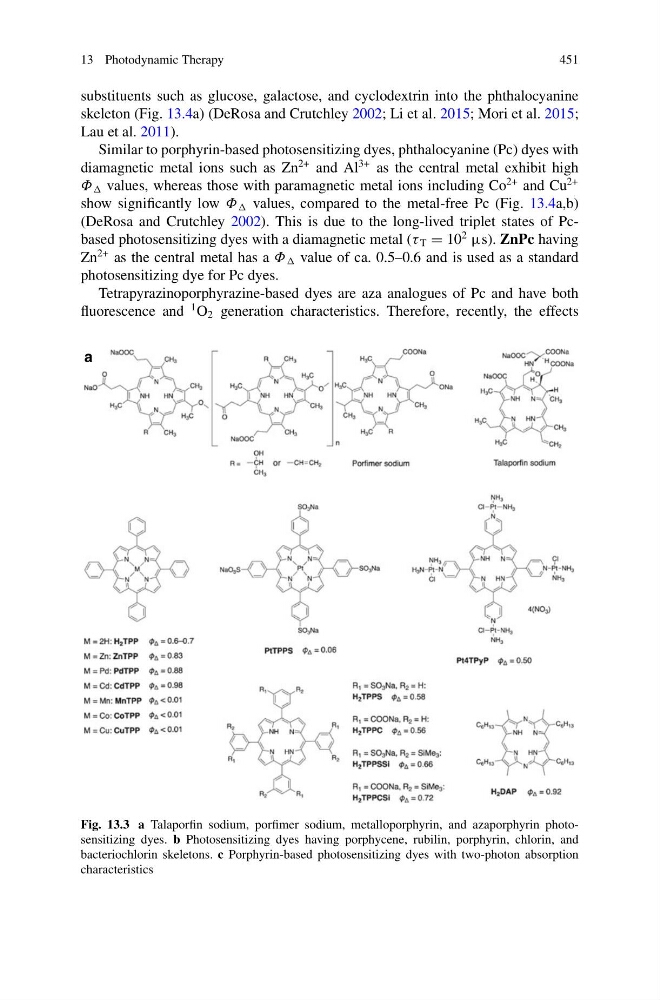
Fig. 13.3 a Talaporfin sodium, porfimer sodium, metalloporphyrin, and azaporphyrin photosensitizing dyes. b Photosensitizing dyes having porphycene, rubilin, porphyrin, chlorin, and
bacteriochlorin skeletons. c Porphyrin-based photosensitizing dyes with two-photon absorption
characteristics
451
substituents such as glucose, galactose, and cyclodextrin into the phthalocyanine
skeleton (Fig. 13.4a) (DeRosa and Crutchley 2002; Li et al. 2015; Mori et al. 2015;
Lau et al. 2011).
Similar to porphyrin-based photosensitizing dyes, phthalocyanine (Pc) dyes with
diamagnetic metal ions such as Zn
2+ and Al
3+ as the central metal exhibit high
Φ values, whereas those with paramagnetic metal ions including Co
2+ and Cu
2+
show significantly low Φ values, compared to the metal-free Pc (Fig. 13.4a,b)
(DeRosa and Crutchley 2002). This is due to the long-lived triplet states of Pcbased photosensitizing dyes with a diamagnetic metal (τ T = 10
2
μs). ZnPc having
Zn
2+ as the central metal has a Φ value of ca. 0.5–0.6 and is used as a standard
photosensitizing dye for Pc dyes.
Tetrapyrazinoporphyrazine-based dyes are aza analogues of Pc and have both
fluorescence and
1 O 2 generation characteristics. Therefore, recently, the effects
a
Fig. 13.3 a Talaporfin sodium, porfimer sodium, metalloporphyrin, and azaporphyrin photosensitizing dyes. b Photosensitizing dyes having porphycene, rubilin, porphyrin, chlorin, and
bacteriochlorin skeletons. c Porphyrin-based photosensitizing dyes with two-photon absorption
characteristics