

12 White-Light Emissive Materials Based on Supramolecular …
437
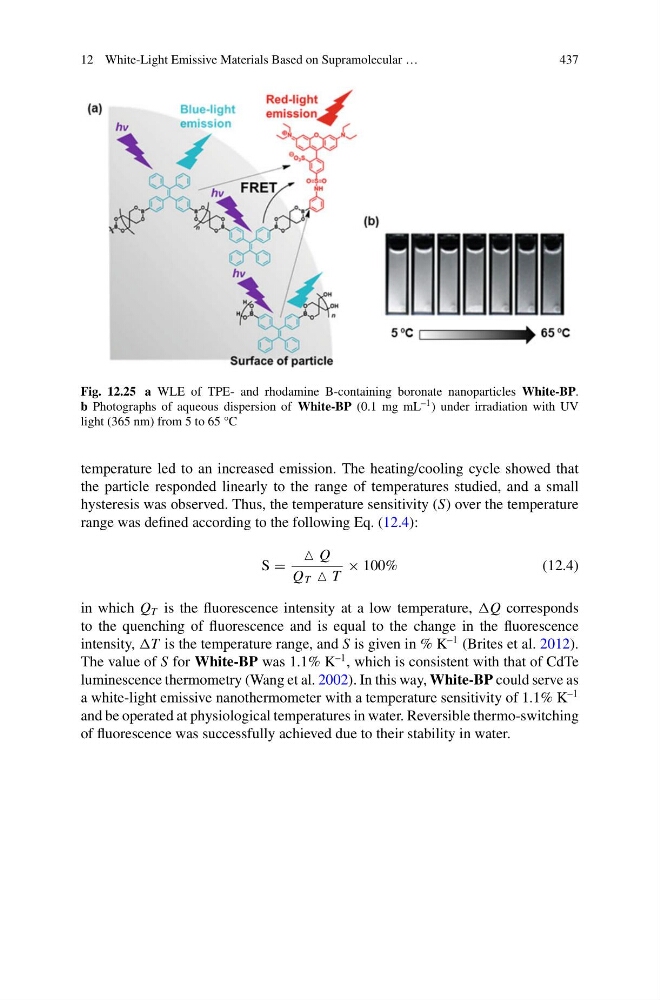
Fig. 12.25 a WLE of TPE- and rhodamine B-containing boronate nanoparticles White-BP.
b Photographs of aqueous dispersion of White-BP (0.1 mg mL –1 ) under irradiation with UV
light (365 nm) from 5 to 65 °C
temperature led to an increased emission. The heating/cooling cycle showed that
the particle responded linearly to the range of temperatures studied, and a small
hysteresis was observed. Thus, the temperature sensitivity (S) over the temperature
range was defined according to the following Eq. (12.4):
S =
Q
Q T T
× 100%
(12.4)
in which Q T is the fluorescence intensity at a low temperature, Q corresponds
to the quenching of fluorescence and is equal to the change in the fluorescence
intensity, T is the temperature range, and S is given in % K
–1 (Brites et al. 2012).
The value of S for White-BP was 1.1% K
–1 , which is consistent with that of CdTe
luminescence thermometry (Wang et al. 2002). In this way, White-BP could serve as
a white-light emissive nanothermometer with a temperature sensitivity of 1.1% K
–1
and be operated at physiological temperatures in water. Reversible thermo-switching
of fluorescence was successfully achieved due to their stability in water.
437
Fig. 12.25 a WLE of TPE- and rhodamine B-containing boronate nanoparticles White-BP.
b Photographs of aqueous dispersion of White-BP (0.1 mg mL –1 ) under irradiation with UV
light (365 nm) from 5 to 65 °C
temperature led to an increased emission. The heating/cooling cycle showed that
the particle responded linearly to the range of temperatures studied, and a small
hysteresis was observed. Thus, the temperature sensitivity (S) over the temperature
range was defined according to the following Eq. (12.4):
S =
Q
Q T T
× 100%
(12.4)
in which Q T is the fluorescence intensity at a low temperature, Q corresponds
to the quenching of fluorescence and is equal to the change in the fluorescence
intensity, T is the temperature range, and S is given in % K
–1 (Brites et al. 2012).
The value of S for White-BP was 1.1% K
–1 , which is consistent with that of CdTe
luminescence thermometry (Wang et al. 2002). In this way, White-BP could serve as
a white-light emissive nanothermometer with a temperature sensitivity of 1.1% K
–1
and be operated at physiological temperatures in water. Reversible thermo-switching
of fluorescence was successfully achieved due to their stability in water.