

436
Y. Kubo
their recyclability as chemosensors was demonstrated by using ethylenediaminetetraacetic acid (EDTA). Taken together, a WLE chemosensor workable in water was
proposed by the surface modification of boronate microparticles.
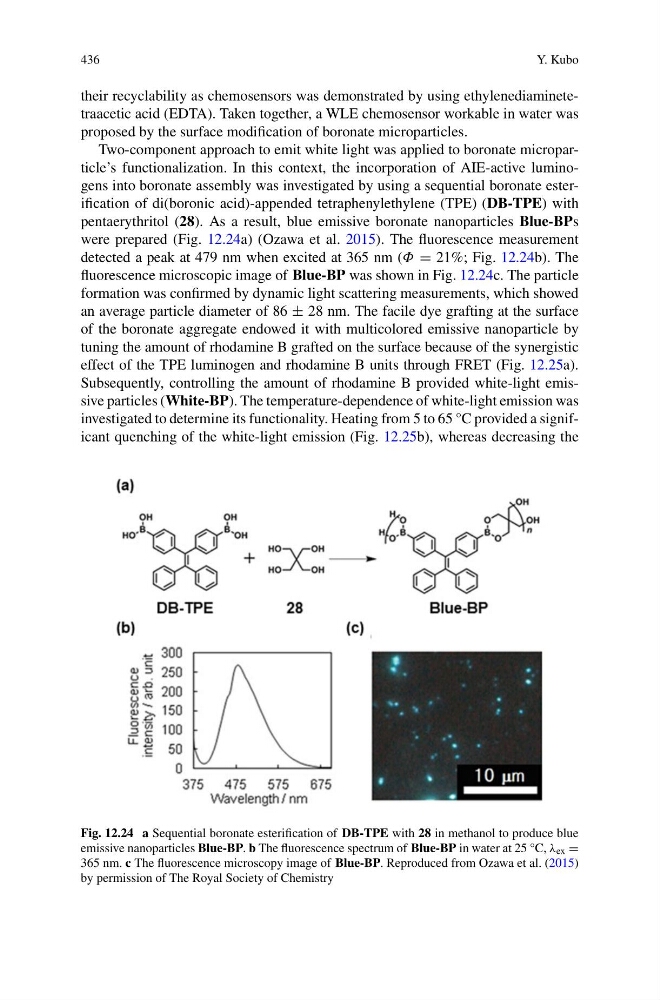
Two-component approach to emit white light was applied to boronate microparticle’s functionalization. In this context, the incorporation of AIE-active luminogens into boronate assembly was investigated by using a sequential boronate esterification of di(boronic acid)-appended tetraphenylethylene (TPE) (DB-TPE) with
pentaerythritol (28). As a result, blue emissive boronate nanoparticles Blue-BPs
were prepared (Fig. 12.24a) (Ozawa et al. 2015). The fluorescence measurement
detected a peak at 479 nm when excited at 365 nm (Φ = 21%; Fig. 12.24b). The
fluorescence microscopic image of Blue-BP was shown in Fig. 12.24c. The particle
formation was confirmed by dynamic light scattering measurements, which showed
an average particle diameter of 86 ± 28 nm. The facile dye grafting at the surface
of the boronate aggregate endowed it with multicolored emissive nanoparticle by
tuning the amount of rhodamine B grafted on the surface because of the synergistic
effect of the TPE luminogen and rhodamine B units through FRET (Fig. 12.25a).
Subsequently, controlling the amount of rhodamine B provided white-light emissive particles (White-BP). The temperature-dependence of white-light emission was
investigated to determine its functionality. Heating from 5 to 65 °C provided a significant quenching of the white-light emission (Fig. 12.25b), whereas decreasing the
Fig. 12.24 a Sequential boronate esterification of DB-TPE with 28 in methanol to produce blue
emissive nanoparticles Blue-BP. b The fluorescence spectrum of Blue-BP in water at 25 °C, λ ex =
365 nm. c The fluorescence microscopy image of Blue-BP. Reproduced from Ozawa et al. (2015)
by permission of The Royal Society of Chemistry
Y. Kubo
their recyclability as chemosensors was demonstrated by using ethylenediaminetetraacetic acid (EDTA). Taken together, a WLE chemosensor workable in water was
proposed by the surface modification of boronate microparticles.
Two-component approach to emit white light was applied to boronate microparticle’s functionalization. In this context, the incorporation of AIE-active luminogens into boronate assembly was investigated by using a sequential boronate esterification of di(boronic acid)-appended tetraphenylethylene (TPE) (DB-TPE) with
pentaerythritol (28). As a result, blue emissive boronate nanoparticles Blue-BPs
were prepared (Fig. 12.24a) (Ozawa et al. 2015). The fluorescence measurement
detected a peak at 479 nm when excited at 365 nm (Φ = 21%; Fig. 12.24b). The
fluorescence microscopic image of Blue-BP was shown in Fig. 12.24c. The particle
formation was confirmed by dynamic light scattering measurements, which showed
an average particle diameter of 86 ± 28 nm. The facile dye grafting at the surface
of the boronate aggregate endowed it with multicolored emissive nanoparticle by
tuning the amount of rhodamine B grafted on the surface because of the synergistic
effect of the TPE luminogen and rhodamine B units through FRET (Fig. 12.25a).
Subsequently, controlling the amount of rhodamine B provided white-light emissive particles (White-BP). The temperature-dependence of white-light emission was
investigated to determine its functionality. Heating from 5 to 65 °C provided a significant quenching of the white-light emission (Fig. 12.25b), whereas decreasing the
Fig. 12.24 a Sequential boronate esterification of DB-TPE with 28 in methanol to produce blue
emissive nanoparticles Blue-BP. b The fluorescence spectrum of Blue-BP in water at 25 °C, λ ex =
365 nm. c The fluorescence microscopy image of Blue-BP. Reproduced from Ozawa et al. (2015)
by permission of The Royal Society of Chemistry