

12 White-Light Emissive Materials Based on Supramolecular …
435
signals (δ = 121.5–129.5 ppm) assignable to the aromatic C–H carbons of the pyrenyl
moiety. Surface analysis was also conducted by using a Langmuir-type adsorption
isotherm to provide an estimated theoretical maximum value of 45% for the fraction of surface coverage by boronate pyrene molecules (Fig. 12.22b). To fabricate
nanoparticles with WLE, dansyl-appended boronic acid (26) and a rhodamine B
derivative (27) was grafted on the surface in a similar manner. The resultant particles
were emitted at 515 nm (Φ = 0.52) and 600 nm (Φ = 0.34) in the 4-(2-hydroxyethyl)1-piperazineethanesulfonic acid (HEPES) buffer (pH 7.0), respectively. According
to CIE coordinates in the chromaticity diagram, color tuning of the particles was
achieved by adjusting the relative concentrations of the blue-, green-, and redemissive dihydroxylboryl dyes to produce the desired Sens-BP microparticles with
white-light emissive properties (Fig. 12.22c) (Nishiyabu et al. 2013).
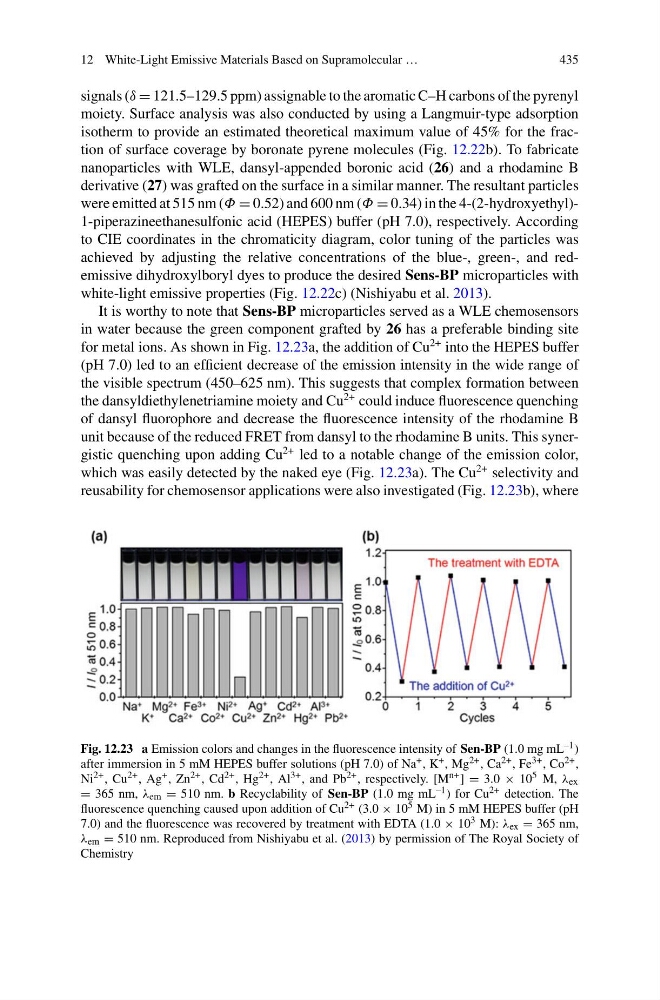
It is worthy to note that Sens-BP microparticles served as a WLE chemosensors
in water because the green component grafted by 26 has a preferable binding site
for metal ions. As shown in Fig. 12.23a, the addition of Cu
2+ into the HEPES buffer
(pH 7.0) led to an efficient decrease of the emission intensity in the wide range of
the visible spectrum (450–625 nm). This suggests that complex formation between
the dansyldiethylenetriamine moiety and Cu
2+ could induce fluorescence quenching
of dansyl fluorophore and decrease the fluorescence intensity of the rhodamine B
unit because of the reduced FRET from dansyl to the rhodamine B units. This synergistic quenching upon adding Cu
2+ led to a notable change of the emission color,
which was easily detected by the naked eye (Fig. 12.23a). The Cu
2+ selectivity and
reusability for chemosensor applications were also investigated (Fig. 12.23b), where
Fig. 12.23 a Emission colors and changes in the fluorescence intensity of Sen-BP (1.0 mg mL –1 )
after immersion in 5 mM HEPES buffer solutions (pH 7.0) of Na + , K + , Mg 2+ , Ca 2+ , Fe 3+ , Co 2+ ,
Ni 2+ , Cu 2+ , Ag + , Zn 2+ , Cd 2+ , Hg 2+ , Al 3+ , and Pb 2+ , respectively. [M n+ ] = 3.0 × 10 5 M, λ ex
= 365 nm, λ em = 510 nm. b Recyclability of Sen-BP (1.0 mg mL –1 ) for Cu 2+ detection. The
fluorescence quenching caused upon addition of Cu 2+ (3.0 × 10 5 M) in 5 mM HEPES buffer (pH
7.0) and the fluorescence was recovered by treatment with EDTA (1.0 × 10 3 M): λ ex = 365 nm,
λ em = 510 nm. Reproduced from Nishiyabu et al. (2013) by permission of The Royal Society of
Chemistry
435
signals (δ = 121.5–129.5 ppm) assignable to the aromatic C–H carbons of the pyrenyl
moiety. Surface analysis was also conducted by using a Langmuir-type adsorption
isotherm to provide an estimated theoretical maximum value of 45% for the fraction of surface coverage by boronate pyrene molecules (Fig. 12.22b). To fabricate
nanoparticles with WLE, dansyl-appended boronic acid (26) and a rhodamine B
derivative (27) was grafted on the surface in a similar manner. The resultant particles
were emitted at 515 nm (Φ = 0.52) and 600 nm (Φ = 0.34) in the 4-(2-hydroxyethyl)1-piperazineethanesulfonic acid (HEPES) buffer (pH 7.0), respectively. According
to CIE coordinates in the chromaticity diagram, color tuning of the particles was
achieved by adjusting the relative concentrations of the blue-, green-, and redemissive dihydroxylboryl dyes to produce the desired Sens-BP microparticles with
white-light emissive properties (Fig. 12.22c) (Nishiyabu et al. 2013).
It is worthy to note that Sens-BP microparticles served as a WLE chemosensors
in water because the green component grafted by 26 has a preferable binding site
for metal ions. As shown in Fig. 12.23a, the addition of Cu
2+ into the HEPES buffer
(pH 7.0) led to an efficient decrease of the emission intensity in the wide range of
the visible spectrum (450–625 nm). This suggests that complex formation between
the dansyldiethylenetriamine moiety and Cu
2+ could induce fluorescence quenching
of dansyl fluorophore and decrease the fluorescence intensity of the rhodamine B
unit because of the reduced FRET from dansyl to the rhodamine B units. This synergistic quenching upon adding Cu
2+ led to a notable change of the emission color,
which was easily detected by the naked eye (Fig. 12.23a). The Cu
2+ selectivity and
reusability for chemosensor applications were also investigated (Fig. 12.23b), where
Fig. 12.23 a Emission colors and changes in the fluorescence intensity of Sen-BP (1.0 mg mL –1 )
after immersion in 5 mM HEPES buffer solutions (pH 7.0) of Na + , K + , Mg 2+ , Ca 2+ , Fe 3+ , Co 2+ ,
Ni 2+ , Cu 2+ , Ag + , Zn 2+ , Cd 2+ , Hg 2+ , Al 3+ , and Pb 2+ , respectively. [M n+ ] = 3.0 × 10 5 M, λ ex
= 365 nm, λ em = 510 nm. b Recyclability of Sen-BP (1.0 mg mL –1 ) for Cu 2+ detection. The
fluorescence quenching caused upon addition of Cu 2+ (3.0 × 10 5 M) in 5 mM HEPES buffer (pH
7.0) and the fluorescence was recovered by treatment with EDTA (1.0 × 10 3 M): λ ex = 365 nm,
λ em = 510 nm. Reproduced from Nishiyabu et al. (2013) by permission of The Royal Society of
Chemistry