

434
Y. Kubo
an averaged diameter of 2.3 ± 0.3 μm (Matsushima et al. 2012). BPs can be
dispersed in aqueous media as microparticles, and they have a negative value for
the zeta potential (ξ) at the surface of BP. This suggests that terminal hydroxyl
groups of the component polymers would be present at the microscopic periphery of
the microparticles (Vijayakumar et al. 2011), and that surface functionalization by
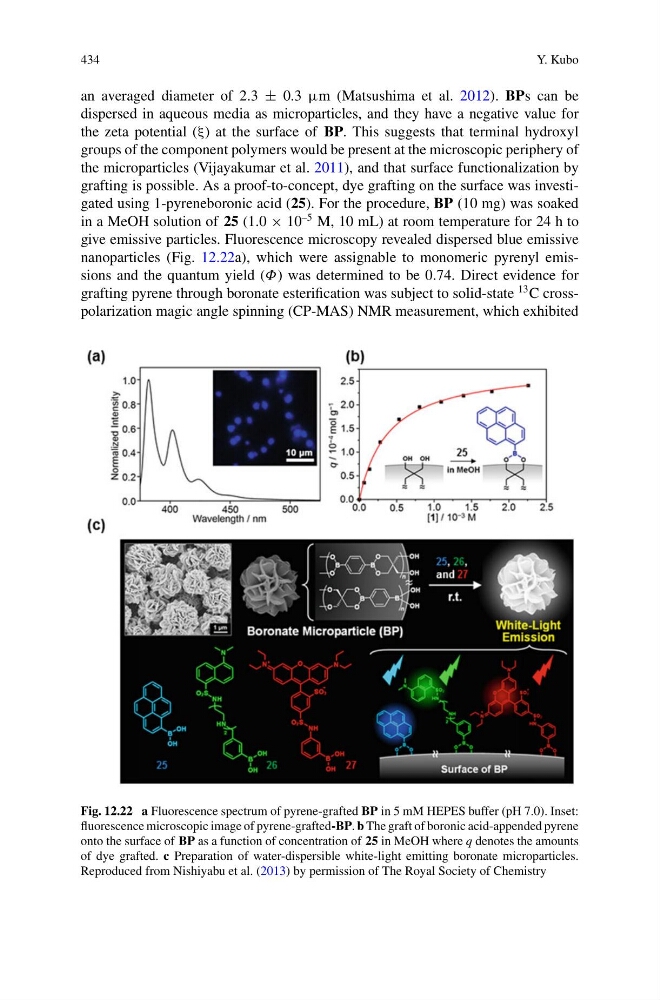
grafting is possible. As a proof-to-concept, dye grafting on the surface was investigated using 1-pyreneboronic acid (25). For the procedure, BP (10 mg) was soaked
in a MeOH solution of 25 (1.0 × 10
–5 M, 10 mL) at room temperature for 24 h to
give emissive particles. Fluorescence microscopy revealed dispersed blue emissive
nanoparticles (Fig. 12.22a), which were assignable to monomeric pyrenyl emissions and the quantum yield (Φ) was determined to be 0.74. Direct evidence for
grafting pyrene through boronate esterification was subject to solid-state
13 C crosspolarization magic angle spinning (CP-MAS) NMR measurement, which exhibited
Fig. 12.22 a Fluorescence spectrum of pyrene-grafted BP in 5 mM HEPES buffer (pH 7.0). Inset:
fluorescence microscopic image of pyrene-grafted-BP. b The graft of boronic acid-appended pyrene
onto the surface of BP as a function of concentration of 25 in MeOH where q denotes the amounts
of dye grafted. c Preparation of water-dispersible white-light emitting boronate microparticles.
Reproduced from Nishiyabu et al. (2013) by permission of The Royal Society of Chemistry
Y. Kubo
an averaged diameter of 2.3 ± 0.3 μm (Matsushima et al. 2012). BPs can be
dispersed in aqueous media as microparticles, and they have a negative value for
the zeta potential (ξ) at the surface of BP. This suggests that terminal hydroxyl
groups of the component polymers would be present at the microscopic periphery of
the microparticles (Vijayakumar et al. 2011), and that surface functionalization by
grafting is possible. As a proof-to-concept, dye grafting on the surface was investigated using 1-pyreneboronic acid (25). For the procedure, BP (10 mg) was soaked
in a MeOH solution of 25 (1.0 × 10
–5 M, 10 mL) at room temperature for 24 h to
give emissive particles. Fluorescence microscopy revealed dispersed blue emissive
nanoparticles (Fig. 12.22a), which were assignable to monomeric pyrenyl emissions and the quantum yield (Φ) was determined to be 0.74. Direct evidence for
grafting pyrene through boronate esterification was subject to solid-state
13 C crosspolarization magic angle spinning (CP-MAS) NMR measurement, which exhibited
Fig. 12.22 a Fluorescence spectrum of pyrene-grafted BP in 5 mM HEPES buffer (pH 7.0). Inset:
fluorescence microscopic image of pyrene-grafted-BP. b The graft of boronic acid-appended pyrene
onto the surface of BP as a function of concentration of 25 in MeOH where q denotes the amounts
of dye grafted. c Preparation of water-dispersible white-light emitting boronate microparticles.
Reproduced from Nishiyabu et al. (2013) by permission of The Royal Society of Chemistry