

12 White-Light Emissive Materials Based on Supramolecular …
433
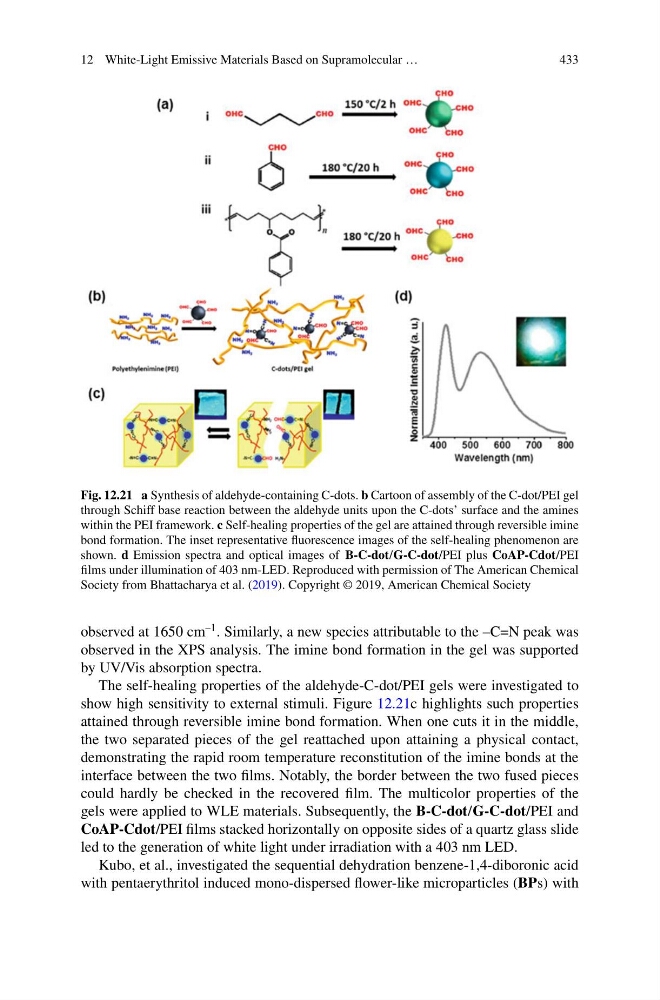
Fig. 12.21 a Synthesis of aldehyde-containing C-dots. b Cartoon of assembly of the C-dot/PEI gel
through Schiff base reaction between the aldehyde units upon the C-dots’ surface and the amines
within the PEI framework. c Self-healing properties of the gel are attained through reversible imine
bond formation. The inset representative fluorescence images of the self-healing phenomenon are
shown. d Emission spectra and optical images of B-C-dot/G-C-dot/PEI plus CoAP-Cdot/PEI
films under illumination of 403 nm-LED. Reproduced with permission of The American Chemical
Society from Bhattacharya et al. (2019). Copyright © 2019, American Chemical Society
observed at 1650 cm
–1 . Similarly, a new species attributable to the –C=N peak was
observed in the XPS analysis. The imine bond formation in the gel was supported
by UV/Vis absorption spectra.
The self-healing properties of the aldehyde-C-dot/PEI gels were investigated to
show high sensitivity to external stimuli. Figure 12.21c highlights such properties
attained through reversible imine bond formation. When one cuts it in the middle,
the two separated pieces of the gel reattached upon attaining a physical contact,
demonstrating the rapid room temperature reconstitution of the imine bonds at the
interface between the two films. Notably, the border between the two fused pieces
could hardly be checked in the recovered film. The multicolor properties of the
gels were applied to WLE materials. Subsequently, the B-C-dot/G-C-dot/PEI and
CoAP-Cdot/PEI films stacked horizontally on opposite sides of a quartz glass slide
led to the generation of white light under irradiation with a 403 nm LED.
Kubo, et al., investigated the sequential dehydration benzene-1,4-diboronic acid
with pentaerythritol induced mono-dispersed flower-like microparticles (BPs) with
433
Fig. 12.21 a Synthesis of aldehyde-containing C-dots. b Cartoon of assembly of the C-dot/PEI gel
through Schiff base reaction between the aldehyde units upon the C-dots’ surface and the amines
within the PEI framework. c Self-healing properties of the gel are attained through reversible imine
bond formation. The inset representative fluorescence images of the self-healing phenomenon are
shown. d Emission spectra and optical images of B-C-dot/G-C-dot/PEI plus CoAP-Cdot/PEI
films under illumination of 403 nm-LED. Reproduced with permission of The American Chemical
Society from Bhattacharya et al. (2019). Copyright © 2019, American Chemical Society
observed at 1650 cm
–1 . Similarly, a new species attributable to the –C=N peak was
observed in the XPS analysis. The imine bond formation in the gel was supported
by UV/Vis absorption spectra.
The self-healing properties of the aldehyde-C-dot/PEI gels were investigated to
show high sensitivity to external stimuli. Figure 12.21c highlights such properties
attained through reversible imine bond formation. When one cuts it in the middle,
the two separated pieces of the gel reattached upon attaining a physical contact,
demonstrating the rapid room temperature reconstitution of the imine bonds at the
interface between the two films. Notably, the border between the two fused pieces
could hardly be checked in the recovered film. The multicolor properties of the
gels were applied to WLE materials. Subsequently, the B-C-dot/G-C-dot/PEI and
CoAP-Cdot/PEI films stacked horizontally on opposite sides of a quartz glass slide
led to the generation of white light under irradiation with a 403 nm LED.
Kubo, et al., investigated the sequential dehydration benzene-1,4-diboronic acid
with pentaerythritol induced mono-dispersed flower-like microparticles (BPs) with