

430
Y. Kubo
dynamic quenching also took place due to the energy transfer at the excited state. On
the other hand, the fluorescence quenching of R with RhB showed a straight line of
the Stern-Volmer plot of I 0 /I versus [RhB]. Taking into account the lifetime of the R
+ RhB mixture decreasing from 5.05 ns of pure R to 3.81 ns indicating the dymaic
quenching and suggesting the excited state energy transfer from R to RhB. However,
no energy transfer from Q to RhB occurred in the solution state. Alternatively, the
closer proximity between the donor (Q) and acceptor (RhB) in the gel state enabled
it to cause an appreciable energy transfer between them. WLE gel was obtained by
varying the RhB and R concentration in the 1:1 MQ gel, which had a molar ratio
of M:Q:R:RhB = 100:100:0.5:0.02 on excitation at 360 nm (Fig. 12.18b). The CIE
coordinates of 0.31 and 0.36, the values being very close to those of white light.
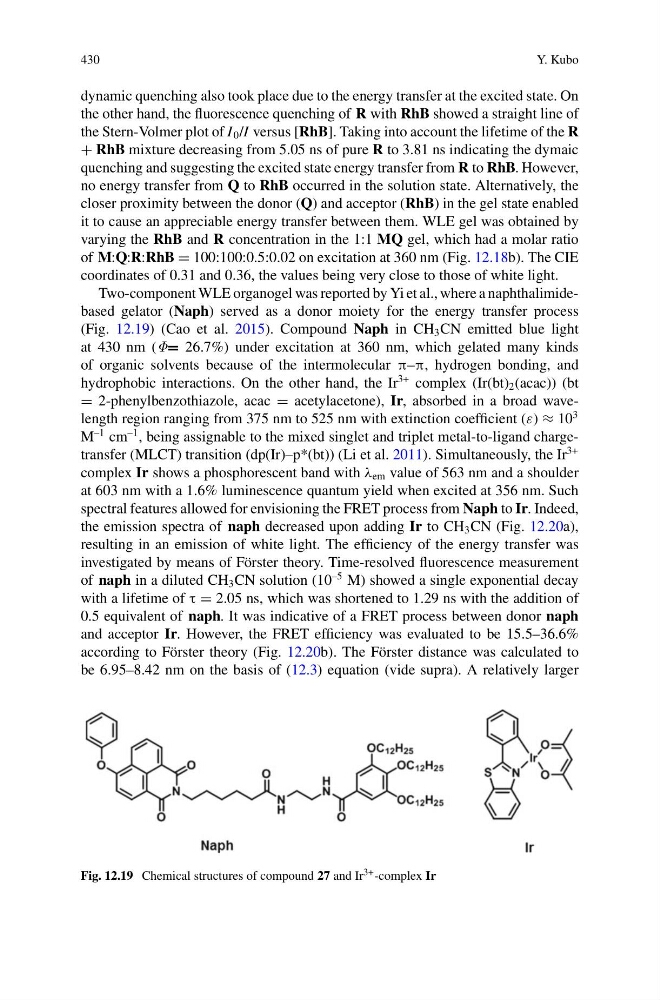
Two-component WLE organogel was reported by Yi et al., where a naphthalimidebased gelator (Naph) served as a donor moiety for the energy transfer process
(Fig. 12.19) (Cao et al. 2015). Compound Naph in CH 3 CN emitted blue light
at 430 nm (F= 26.7%) under excitation at 360 nm, which gelated many kinds
of organic solvents because of the intermolecular π–π, hydrogen bonding, and
hydrophobic interactions. On the other hand, the Ir
3+ complex (Ir(bt) 2 (acac)) (bt
= 2-phenylbenzothiazole, acac = acetylacetone), Ir, absorbed in a broad wavelength region ranging from 375 nm to 525 nm with extinction coefficient (ε) ≈ 10
3
M
–1 cm
–1 , being assignable to the mixed singlet and triplet metal-to-ligand chargetransfer (MLCT) transition (dp(Ir)–p*(bt)) (Li et al. 2011). Simultaneously, the Ir
3+
complex Ir shows a phosphorescent band with λ em value of 563 nm and a shoulder
at 603 nm with a 1.6% luminescence quantum yield when excited at 356 nm. Such
spectral features allowed for envisioning the FRET process from Naph to Ir. Indeed,
the emission spectra of naph decreased upon adding Ir to CH 3 CN (Fig. 12.20a),
resulting in an emission of white light. The efficiency of the energy transfer was
investigated by means of Förster theory. Time-resolved fluorescence measurement
of naph in a diluted CH 3 CN solution (10
–5 M) showed a single exponential decay
with a lifetime of τ = 2.05 ns, which was shortened to 1.29 ns with the addition of
0.5 equivalent of naph. It was indicative of a FRET process between donor naph
and acceptor Ir. However, the FRET efficiency was evaluated to be 15.5–36.6%
according to Förster theory (Fig. 12.20b). The Förster distance was calculated to
be 6.95–8.42 nm on the basis of (12.3) equation (vide supra). A relatively larger
Fig. 12.19 Chemical structures of compound 27 and Ir 3+ -complex Ir
Y. Kubo
dynamic quenching also took place due to the energy transfer at the excited state. On
the other hand, the fluorescence quenching of R with RhB showed a straight line of
the Stern-Volmer plot of I 0 /I versus [RhB]. Taking into account the lifetime of the R
+ RhB mixture decreasing from 5.05 ns of pure R to 3.81 ns indicating the dymaic
quenching and suggesting the excited state energy transfer from R to RhB. However,
no energy transfer from Q to RhB occurred in the solution state. Alternatively, the
closer proximity between the donor (Q) and acceptor (RhB) in the gel state enabled
it to cause an appreciable energy transfer between them. WLE gel was obtained by
varying the RhB and R concentration in the 1:1 MQ gel, which had a molar ratio
of M:Q:R:RhB = 100:100:0.5:0.02 on excitation at 360 nm (Fig. 12.18b). The CIE
coordinates of 0.31 and 0.36, the values being very close to those of white light.
Two-component WLE organogel was reported by Yi et al., where a naphthalimidebased gelator (Naph) served as a donor moiety for the energy transfer process
(Fig. 12.19) (Cao et al. 2015). Compound Naph in CH 3 CN emitted blue light
at 430 nm (F= 26.7%) under excitation at 360 nm, which gelated many kinds
of organic solvents because of the intermolecular π–π, hydrogen bonding, and
hydrophobic interactions. On the other hand, the Ir
3+ complex (Ir(bt) 2 (acac)) (bt
= 2-phenylbenzothiazole, acac = acetylacetone), Ir, absorbed in a broad wavelength region ranging from 375 nm to 525 nm with extinction coefficient (ε) ≈ 10
3
M
–1 cm
–1 , being assignable to the mixed singlet and triplet metal-to-ligand chargetransfer (MLCT) transition (dp(Ir)–p*(bt)) (Li et al. 2011). Simultaneously, the Ir
3+
complex Ir shows a phosphorescent band with λ em value of 563 nm and a shoulder
at 603 nm with a 1.6% luminescence quantum yield when excited at 356 nm. Such
spectral features allowed for envisioning the FRET process from Naph to Ir. Indeed,
the emission spectra of naph decreased upon adding Ir to CH 3 CN (Fig. 12.20a),
resulting in an emission of white light. The efficiency of the energy transfer was
investigated by means of Förster theory. Time-resolved fluorescence measurement
of naph in a diluted CH 3 CN solution (10
–5 M) showed a single exponential decay
with a lifetime of τ = 2.05 ns, which was shortened to 1.29 ns with the addition of
0.5 equivalent of naph. It was indicative of a FRET process between donor naph
and acceptor Ir. However, the FRET efficiency was evaluated to be 15.5–36.6%
according to Förster theory (Fig. 12.20b). The Förster distance was calculated to
be 6.95–8.42 nm on the basis of (12.3) equation (vide supra). A relatively larger
Fig. 12.19 Chemical structures of compound 27 and Ir 3+ -complex Ir