

12 White-Light Emissive Materials Based on Supramolecular …
429
to acceptor plays a significant role for light harvesting to emit white light, gel as a platform is so available that it provides a molecular organization that could help efficient
FRET process (Praveen et al. 2014). As a typical example, a co-assembled hydrogel of
melamine was developed, where 6,7-dimethoxy-2,4[1H,3H]-quinazolinedione (Q),
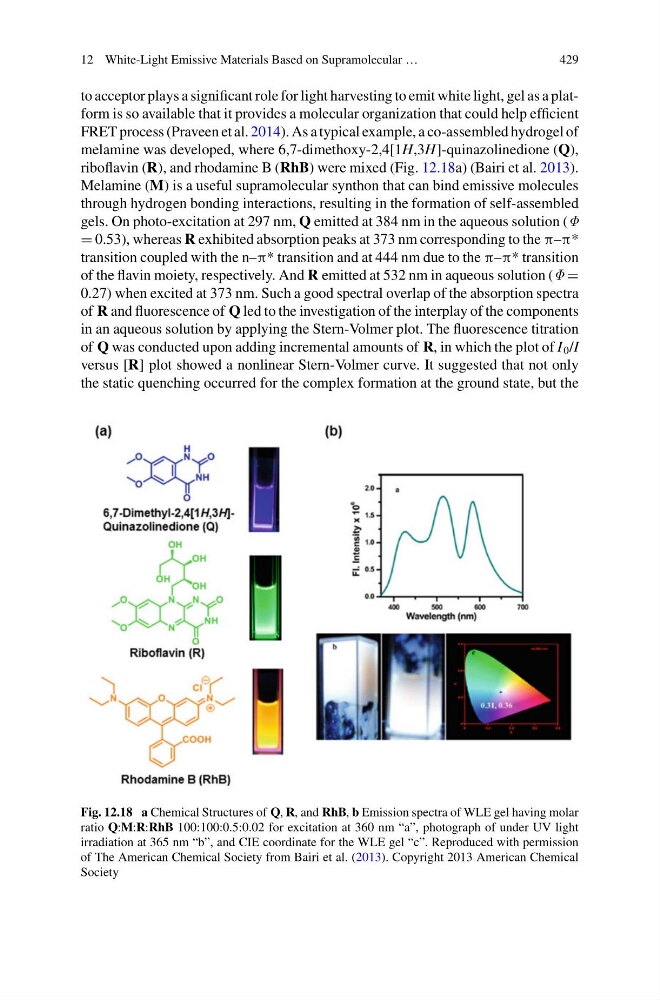
riboflavin (R), and rhodamine B (RhB) were mixed (Fig. 12.18a) (Bairi et al. 2013).
Melamine (M) is a useful supramolecular synthon that can bind emissive molecules
through hydrogen bonding interactions, resulting in the formation of self-assembled
gels. On photo-excitation at 297 nm, Q emitted at 384 nm in the aqueous solution (F
= 0.53), whereas R exhibited absorption peaks at 373 nm corresponding to the π–π*
transition coupled with the n–π* transition and at 444 nm due to the π–π* transition
of the flavin moiety, respectively. And R emitted at 532 nm in aqueous solution (F =
0.27) when excited at 373 nm. Such a good spectral overlap of the absorption spectra
of R and fluorescence of Q led to the investigation of the interplay of the components
in an aqueous solution by applying the Stern-Volmer plot. The fluorescence titration
of Q was conducted upon adding incremental amounts of R, in which the plot of I 0 /I
versus [R] plot showed a nonlinear Stern-Volmer curve. It suggested that not only
the static quenching occurred for the complex formation at the ground state, but the
Fig. 12.18 a Chemical Structures of Q, R, and RhB, b Emission spectra of WLE gel having molar
ratio Q:M:R:RhB 100:100:0.5:0.02 for excitation at 360 nm “a”, photograph of under UV light
irradiation at 365 nm “b”, and CIE coordinate for the WLE gel “c”. Reproduced with permission
of The American Chemical Society from Bairi et al. (2013). Copyright 2013 American Chemical
Society
429
to acceptor plays a significant role for light harvesting to emit white light, gel as a platform is so available that it provides a molecular organization that could help efficient
FRET process (Praveen et al. 2014). As a typical example, a co-assembled hydrogel of
melamine was developed, where 6,7-dimethoxy-2,4[1H,3H]-quinazolinedione (Q),
riboflavin (R), and rhodamine B (RhB) were mixed (Fig. 12.18a) (Bairi et al. 2013).
Melamine (M) is a useful supramolecular synthon that can bind emissive molecules
through hydrogen bonding interactions, resulting in the formation of self-assembled
gels. On photo-excitation at 297 nm, Q emitted at 384 nm in the aqueous solution (F
= 0.53), whereas R exhibited absorption peaks at 373 nm corresponding to the π–π*
transition coupled with the n–π* transition and at 444 nm due to the π–π* transition
of the flavin moiety, respectively. And R emitted at 532 nm in aqueous solution (F =
0.27) when excited at 373 nm. Such a good spectral overlap of the absorption spectra
of R and fluorescence of Q led to the investigation of the interplay of the components
in an aqueous solution by applying the Stern-Volmer plot. The fluorescence titration
of Q was conducted upon adding incremental amounts of R, in which the plot of I 0 /I
versus [R] plot showed a nonlinear Stern-Volmer curve. It suggested that not only
the static quenching occurred for the complex formation at the ground state, but the
Fig. 12.18 a Chemical Structures of Q, R, and RhB, b Emission spectra of WLE gel having molar
ratio Q:M:R:RhB 100:100:0.5:0.02 for excitation at 360 nm “a”, photograph of under UV light
irradiation at 365 nm “b”, and CIE coordinate for the WLE gel “c”. Reproduced with permission
of The American Chemical Society from Bairi et al. (2013). Copyright 2013 American Chemical
Society