

428
Y. Kubo
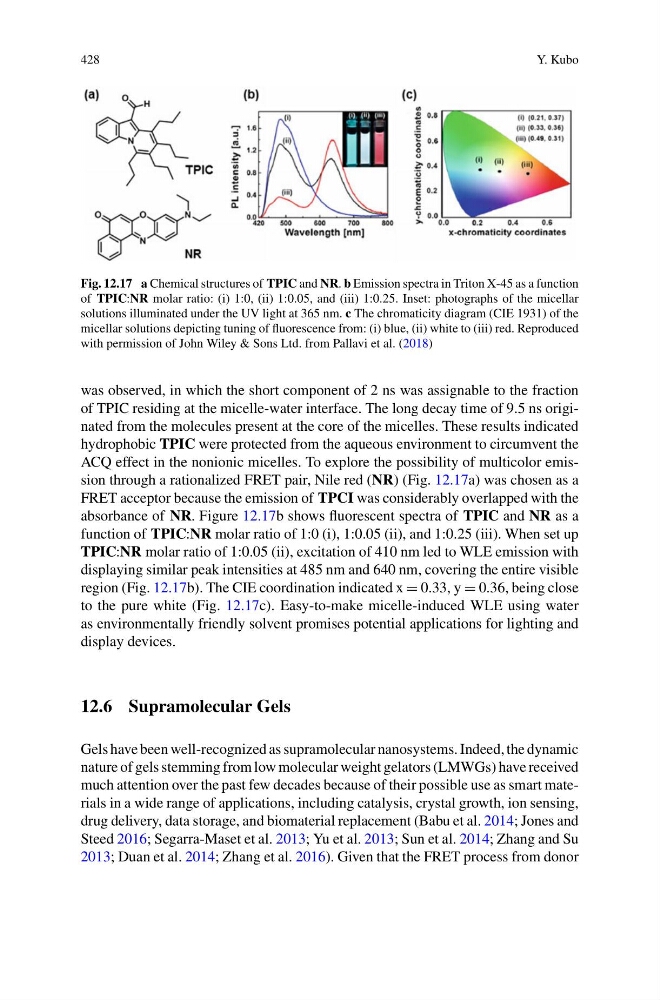
Fig. 12.17 a Chemical structures of TPIC and NR. b Emission spectra in Triton X-45 as a function
of TPIC:NR molar ratio: (i) 1:0, (ii) 1:0.05, and (iii) 1:0.25. Inset: photographs of the micellar
solutions illuminated under the UV light at 365 nm. c The chromaticity diagram (CIE 1931) of the
micellar solutions depicting tuning of fluorescence from: (i) blue, (ii) white to (iii) red. Reproduced
with permission of John Wiley & Sons Ltd. from Pallavi et al. (2018)
was observed, in which the short component of 2 ns was assignable to the fraction
of TPIC residing at the micelle-water interface. The long decay time of 9.5 ns originated from the molecules present at the core of the micelles. These results indicated
hydrophobic TPIC were protected from the aqueous environment to circumvent the
ACQ effect in the nonionic micelles. To explore the possibility of multicolor emission through a rationalized FRET pair, Nile red (NR) (Fig. 12.17a) was chosen as a
FRET acceptor because the emission of TPCI was considerably overlapped with the
absorbance of NR. Figure 12.17b shows fluorescent spectra of TPIC and NR as a
function of TPIC:NR molar ratio of 1:0 (i), 1:0.05 (ii), and 1:0.25 (iii). When set up
TPIC:NR molar ratio of 1:0.05 (ii), excitation of 410 nm led to WLE emission with
displaying similar peak intensities at 485 nm and 640 nm, covering the entire visible
region (Fig. 12.17b). The CIE coordination indicated x = 0.33, y = 0.36, being close
to the pure white (Fig. 12.17c). Easy-to-make micelle-induced WLE using water
as environmentally friendly solvent promises potential applications for lighting and
display devices.
12.6 Supramolecular Gels
Gels have been well-recognized as supramolecular nanosystems. Indeed, the dynamic
nature of gels stemming from low molecular weight gelators (LMWGs) have received
much attention over the past few decades because of their possible use as smart materials in a wide range of applications, including catalysis, crystal growth, ion sensing,
drug delivery, data storage, and biomaterial replacement (Babu et al. 2014; Jones and
Steed 2016; Segarra-Maset et al. 2013; Yu et al. 2013; Sun et al. 2014; Zhang and Su
2013; Duan et al. 2014; Zhang et al. 2016). Given that the FRET process from donor
Y. Kubo
Fig. 12.17 a Chemical structures of TPIC and NR. b Emission spectra in Triton X-45 as a function
of TPIC:NR molar ratio: (i) 1:0, (ii) 1:0.05, and (iii) 1:0.25. Inset: photographs of the micellar
solutions illuminated under the UV light at 365 nm. c The chromaticity diagram (CIE 1931) of the
micellar solutions depicting tuning of fluorescence from: (i) blue, (ii) white to (iii) red. Reproduced
with permission of John Wiley & Sons Ltd. from Pallavi et al. (2018)
was observed, in which the short component of 2 ns was assignable to the fraction
of TPIC residing at the micelle-water interface. The long decay time of 9.5 ns originated from the molecules present at the core of the micelles. These results indicated
hydrophobic TPIC were protected from the aqueous environment to circumvent the
ACQ effect in the nonionic micelles. To explore the possibility of multicolor emission through a rationalized FRET pair, Nile red (NR) (Fig. 12.17a) was chosen as a
FRET acceptor because the emission of TPCI was considerably overlapped with the
absorbance of NR. Figure 12.17b shows fluorescent spectra of TPIC and NR as a
function of TPIC:NR molar ratio of 1:0 (i), 1:0.05 (ii), and 1:0.25 (iii). When set up
TPIC:NR molar ratio of 1:0.05 (ii), excitation of 410 nm led to WLE emission with
displaying similar peak intensities at 485 nm and 640 nm, covering the entire visible
region (Fig. 12.17b). The CIE coordination indicated x = 0.33, y = 0.36, being close
to the pure white (Fig. 12.17c). Easy-to-make micelle-induced WLE using water
as environmentally friendly solvent promises potential applications for lighting and
display devices.
12.6 Supramolecular Gels
Gels have been well-recognized as supramolecular nanosystems. Indeed, the dynamic
nature of gels stemming from low molecular weight gelators (LMWGs) have received
much attention over the past few decades because of their possible use as smart materials in a wide range of applications, including catalysis, crystal growth, ion sensing,
drug delivery, data storage, and biomaterial replacement (Babu et al. 2014; Jones and
Steed 2016; Segarra-Maset et al. 2013; Yu et al. 2013; Sun et al. 2014; Zhang and Su
2013; Duan et al. 2014; Zhang et al. 2016). Given that the FRET process from donor