

12 White-Light Emissive Materials Based on Supramolecular …
427
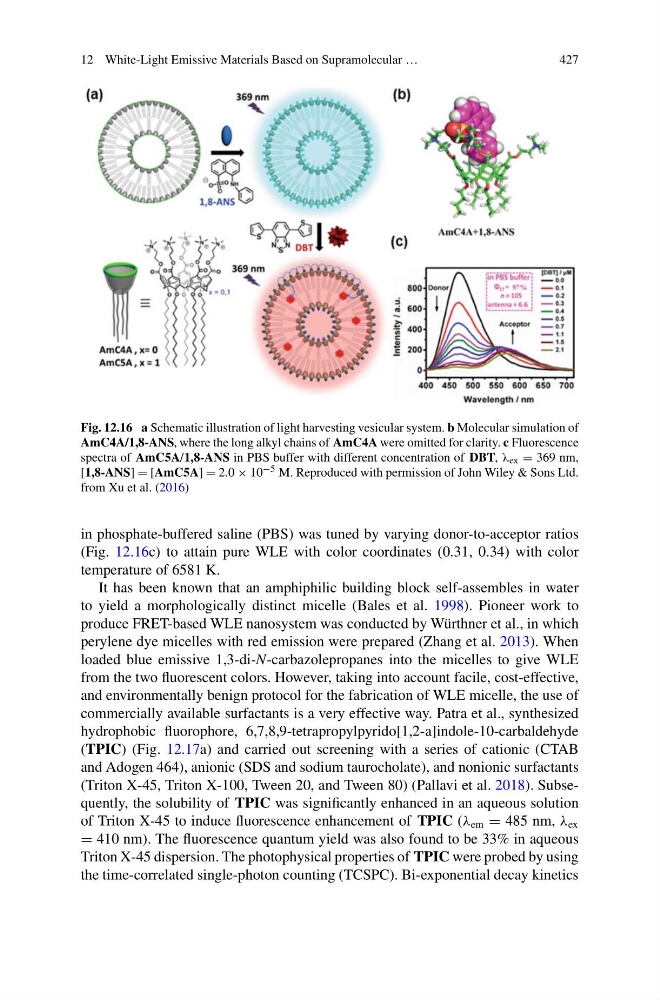
Fig. 12.16 a Schematic illustration of light harvesting vesicular system. b Molecular simulation of
AmC4A/1,8-ANS, where the long alkyl chains of AmC4A were omitted for clarity. c Fluorescence
spectra of AmC5A/1,8-ANS in PBS buffer with different concentration of DBT, λ ex = 369 nm,
[1,8-ANS] = [AmC5A] = 2.0 × 10 −5 M. Reproduced with permission of John Wiley & Sons Ltd.
from Xu et al. (2016)
in phosphate-buffered saline (PBS) was tuned by varying donor-to-acceptor ratios
(Fig. 12.16c) to attain pure WLE with color coordinates (0.31, 0.34) with color
temperature of 6581 K.
It has been known that an amphiphilic building block self-assembles in water
to yield a morphologically distinct micelle (Bales et al. 1998). Pioneer work to
produce FRET-based WLE nanosystem was conducted by Würthner et al., in which
perylene dye micelles with red emission were prepared (Zhang et al. 2013). When
loaded blue emissive 1,3-di-N-carbazolepropanes into the micelles to give WLE
from the two fluorescent colors. However, taking into account facile, cost-effective,
and environmentally benign protocol for the fabrication of WLE micelle, the use of
commercially available surfactants is a very effective way. Patra et al., synthesized
hydrophobic fluorophore, 6,7,8,9-tetrapropylpyrido[1,2-a]indole-10-carbaldehyde
(TPIC) (Fig. 12.17a) and carried out screening with a series of cationic (CTAB
and Adogen 464), anionic (SDS and sodium taurocholate), and nonionic surfactants
(Triton X-45, Triton X-100, Tween 20, and Tween 80) (Pallavi et al. 2018). Subsequently, the solubility of TPIC was significantly enhanced in an aqueous solution
of Triton X-45 to induce fluorescence enhancement of TPIC (λ em = 485 nm, λ ex
= 410 nm). The fluorescence quantum yield was also found to be 33% in aqueous
Triton X-45 dispersion. The photophysical properties of TPIC were probed by using
the time-correlated single-photon counting (TCSPC). Bi-exponential decay kinetics
427
Fig. 12.16 a Schematic illustration of light harvesting vesicular system. b Molecular simulation of
AmC4A/1,8-ANS, where the long alkyl chains of AmC4A were omitted for clarity. c Fluorescence
spectra of AmC5A/1,8-ANS in PBS buffer with different concentration of DBT, λ ex = 369 nm,
[1,8-ANS] = [AmC5A] = 2.0 × 10 −5 M. Reproduced with permission of John Wiley & Sons Ltd.
from Xu et al. (2016)
in phosphate-buffered saline (PBS) was tuned by varying donor-to-acceptor ratios
(Fig. 12.16c) to attain pure WLE with color coordinates (0.31, 0.34) with color
temperature of 6581 K.
It has been known that an amphiphilic building block self-assembles in water
to yield a morphologically distinct micelle (Bales et al. 1998). Pioneer work to
produce FRET-based WLE nanosystem was conducted by Würthner et al., in which
perylene dye micelles with red emission were prepared (Zhang et al. 2013). When
loaded blue emissive 1,3-di-N-carbazolepropanes into the micelles to give WLE
from the two fluorescent colors. However, taking into account facile, cost-effective,
and environmentally benign protocol for the fabrication of WLE micelle, the use of
commercially available surfactants is a very effective way. Patra et al., synthesized
hydrophobic fluorophore, 6,7,8,9-tetrapropylpyrido[1,2-a]indole-10-carbaldehyde
(TPIC) (Fig. 12.17a) and carried out screening with a series of cationic (CTAB
and Adogen 464), anionic (SDS and sodium taurocholate), and nonionic surfactants
(Triton X-45, Triton X-100, Tween 20, and Tween 80) (Pallavi et al. 2018). Subsequently, the solubility of TPIC was significantly enhanced in an aqueous solution
of Triton X-45 to induce fluorescence enhancement of TPIC (λ em = 485 nm, λ ex
= 410 nm). The fluorescence quantum yield was also found to be 33% in aqueous
Triton X-45 dispersion. The photophysical properties of TPIC were probed by using
the time-correlated single-photon counting (TCSPC). Bi-exponential decay kinetics