

426
Y. Kubo
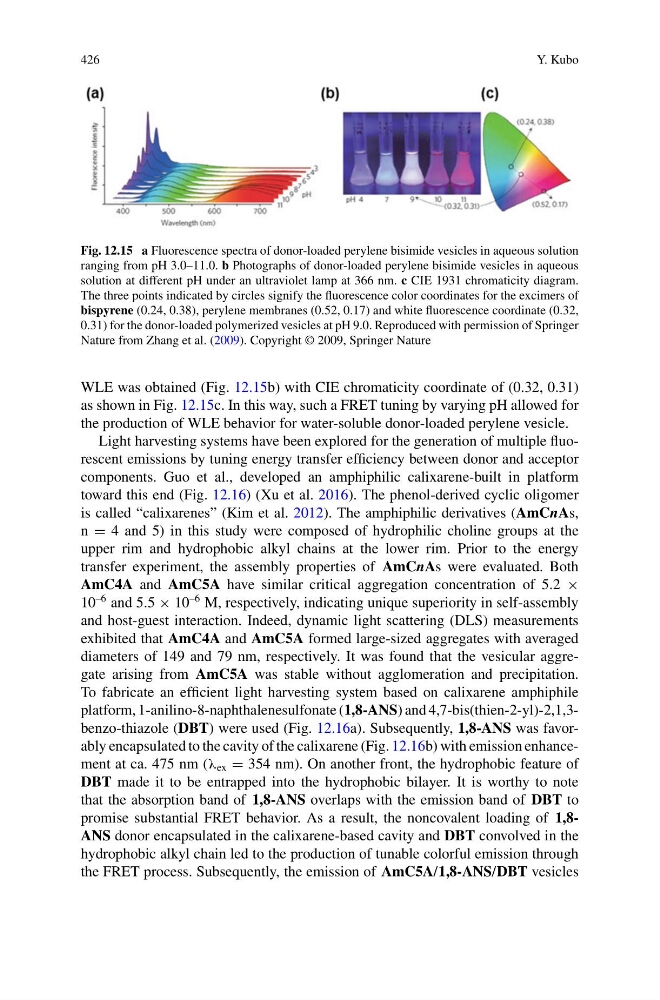
Fig. 12.15 a Fluorescence spectra of donor-loaded perylene bisimide vesicles in aqueous solution
ranging from pH 3.0–11.0. b Photographs of donor-loaded perylene bisimide vesicles in aqueous
solution at different pH under an ultraviolet lamp at 366 nm. c CIE 1931 chromaticity diagram.
The three points indicated by circles signify the fluorescence color coordinates for the excimers of
bispyrene (0.24, 0.38), perylene membranes (0.52, 0.17) and white fluorescence coordinate (0.32,
0.31) for the donor-loaded polymerized vesicles at pH 9.0. Reproduced with permission of Springer
Nature from Zhang et al. (2009). Copyright © 2009, Springer Nature
WLE was obtained (Fig. 12.15b) with CIE chromaticity coordinate of (0.32, 0.31)
as shown in Fig. 12.15c. In this way, such a FRET tuning by varying pH allowed for
the production of WLE behavior for water-soluble donor-loaded perylene vesicle.
Light harvesting systems have been explored for the generation of multiple fluorescent emissions by tuning energy transfer efficiency between donor and acceptor
components. Guo et al., developed an amphiphilic calixarene-built in platform
toward this end (Fig. 12.16) (Xu et al. 2016). The phenol-derived cyclic oligomer
is called “calixarenes” (Kim et al. 2012). The amphiphilic derivatives (AmCnAs,
n = 4 and 5) in this study were composed of hydrophilic choline groups at the
upper rim and hydrophobic alkyl chains at the lower rim. Prior to the energy
transfer experiment, the assembly properties of AmCnAs were evaluated. Both
AmC4A and AmC5A have similar critical aggregation concentration of 5.2 ×
10
–6 and 5.5 × 10
–6 M, respectively, indicating unique superiority in self-assembly
and host-guest interaction. Indeed, dynamic light scattering (DLS) measurements
exhibited that AmC4A and AmC5A formed large-sized aggregates with averaged
diameters of 149 and 79 nm, respectively. It was found that the vesicular aggregate arising from AmC5A was stable without agglomeration and precipitation.
To fabricate an efficient light harvesting system based on calixarene amphiphile
platform, 1-anilino-8-naphthalenesulfonate (1,8-ANS) and 4,7-bis(thien-2-yl)-2,1,3benzo-thiazole (DBT) were used (Fig. 12.16a). Subsequently, 1,8-ANS was favorably encapsulated to the cavity of the calixarene (Fig. 12.16b) with emission enhancement at ca. 475 nm (λ ex = 354 nm). On another front, the hydrophobic feature of
DBT made it to be entrapped into the hydrophobic bilayer. It is worthy to note
that the absorption band of 1,8-ANS overlaps with the emission band of DBT to
promise substantial FRET behavior. As a result, the noncovalent loading of 1,8ANS donor encapsulated in the calixarene-based cavity and DBT convolved in the
hydrophobic alkyl chain led to the production of tunable colorful emission through
the FRET process. Subsequently, the emission of AmC5A/1,8-ANS/DBT vesicles
Y. Kubo
Fig. 12.15 a Fluorescence spectra of donor-loaded perylene bisimide vesicles in aqueous solution
ranging from pH 3.0–11.0. b Photographs of donor-loaded perylene bisimide vesicles in aqueous
solution at different pH under an ultraviolet lamp at 366 nm. c CIE 1931 chromaticity diagram.
The three points indicated by circles signify the fluorescence color coordinates for the excimers of
bispyrene (0.24, 0.38), perylene membranes (0.52, 0.17) and white fluorescence coordinate (0.32,
0.31) for the donor-loaded polymerized vesicles at pH 9.0. Reproduced with permission of Springer
Nature from Zhang et al. (2009). Copyright © 2009, Springer Nature
WLE was obtained (Fig. 12.15b) with CIE chromaticity coordinate of (0.32, 0.31)
as shown in Fig. 12.15c. In this way, such a FRET tuning by varying pH allowed for
the production of WLE behavior for water-soluble donor-loaded perylene vesicle.
Light harvesting systems have been explored for the generation of multiple fluorescent emissions by tuning energy transfer efficiency between donor and acceptor
components. Guo et al., developed an amphiphilic calixarene-built in platform
toward this end (Fig. 12.16) (Xu et al. 2016). The phenol-derived cyclic oligomer
is called “calixarenes” (Kim et al. 2012). The amphiphilic derivatives (AmCnAs,
n = 4 and 5) in this study were composed of hydrophilic choline groups at the
upper rim and hydrophobic alkyl chains at the lower rim. Prior to the energy
transfer experiment, the assembly properties of AmCnAs were evaluated. Both
AmC4A and AmC5A have similar critical aggregation concentration of 5.2 ×
10
–6 and 5.5 × 10
–6 M, respectively, indicating unique superiority in self-assembly
and host-guest interaction. Indeed, dynamic light scattering (DLS) measurements
exhibited that AmC4A and AmC5A formed large-sized aggregates with averaged
diameters of 149 and 79 nm, respectively. It was found that the vesicular aggregate arising from AmC5A was stable without agglomeration and precipitation.
To fabricate an efficient light harvesting system based on calixarene amphiphile
platform, 1-anilino-8-naphthalenesulfonate (1,8-ANS) and 4,7-bis(thien-2-yl)-2,1,3benzo-thiazole (DBT) were used (Fig. 12.16a). Subsequently, 1,8-ANS was favorably encapsulated to the cavity of the calixarene (Fig. 12.16b) with emission enhancement at ca. 475 nm (λ ex = 354 nm). On another front, the hydrophobic feature of
DBT made it to be entrapped into the hydrophobic bilayer. It is worthy to note
that the absorption band of 1,8-ANS overlaps with the emission band of DBT to
promise substantial FRET behavior. As a result, the noncovalent loading of 1,8ANS donor encapsulated in the calixarene-based cavity and DBT convolved in the
hydrophobic alkyl chain led to the production of tunable colorful emission through
the FRET process. Subsequently, the emission of AmC5A/1,8-ANS/DBT vesicles